The quickest way to slash onboarding time for new agency clients is to shift from manual tracking to a stateful, data-driven Quick Start process. By replacing static email checklists with automated milestone tracking and guided product tours, your team can instantly identify exactly when a client is blocked or simply overwhelmed by platform friction.
We know the feeling. The ink is barely dry on the contract, but the next three weeks become a black hole of email threads, missing admin permissions, and repeated setup steps. It is the "Messy Middle" where initial project excitement dies, replaced by administrative friction that leaves everyone frustrated before the first post even goes live.
In this audit, we will break down your agency’s onboarding against the most common setup bottlenecks. You will walk away with a clear diagnostic framework to identify where your launch momentum dies and how to pivot to a state-aware setup that makes the client’s success inevitable. The hidden cost of traditional onboarding is "setup friction debt." Every manual instruction you email increases the risk of client abandonment and sets a low-velocity precedent for the entire project.
What the best tools need to handle

Velocity in onboarding is entirely dependent on your team's visibility into the client’s setup state. If you cannot see exactly where they are blocked, you are just guessing.
The best tools do not just host documentation. They act as a persistent, data-backed bridge between the client and your agency. Instead of waiting for a client to reply to an email, your platform should validate if a milestone is complete.
| Feature | Manual Onboarding (Spreadsheets) | Data-Driven Quick Start (Mydrop) |
|---|---|---|
| Visibility | Lagging, relies on client updates | Real-time, platform-synced |
| Guidance | Static PDF, generic guides | Contextual, interactive tours |
| Bottlenecks | Invisible until project stalls | Proactively flagged |
| Setup Pace | Depends on email response speed | Driven by platform milestones |
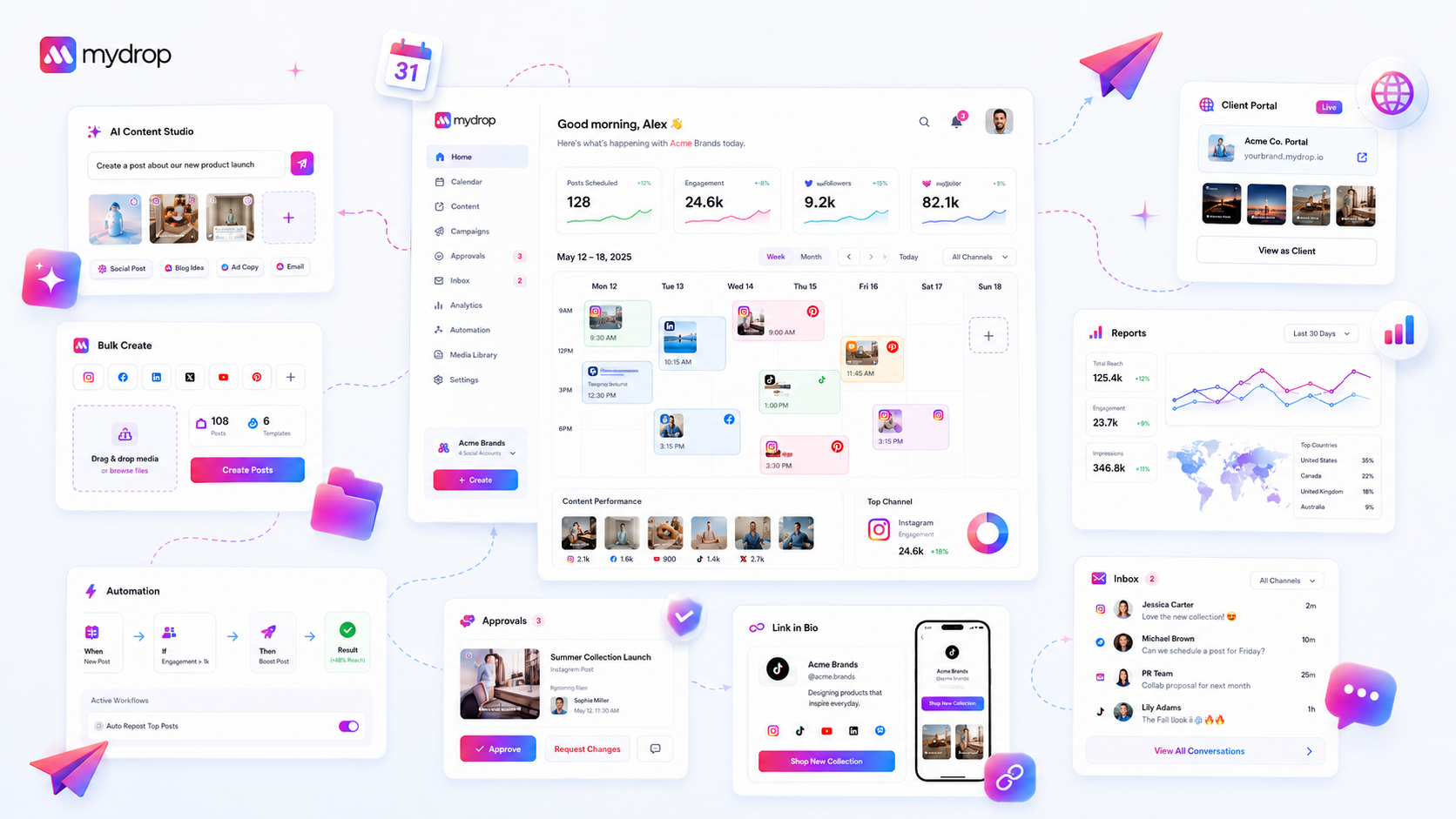
For example, at Mydrop, we track setup progress using live product data, like connected profiles or created brands, to trigger guided steps. When a client lands on the Home dashboard, they see exactly which setup milestone they need to hit next, rather than wondering what the agency wants them to do.
Common mistake: Relying on manual status trackers that are disconnected from the platform data. If the tracker says "Complete" but the profile is not connected in the tool, the tracker is lying to you.
If your current workflow requires you to chase down whether a client has finished profile connections or uploaded media, you have already lost velocity. Your tool needs to do that chasing for you, using guided setup and interactive checklists that actually track progress against real, working state.
Where basic tools start to break

We have all been there. You start with a nice, clean spreadsheet to track client onboarding. By week three, it is a crime scene. Rows are marked as complete by the client but still locked on your side. Emails are lost in transit. The spreadsheet, once a source of truth, becomes a liability that hides exactly where the momentum died.
The real issue is that static tools like spreadsheets and email lack state awareness. They cannot "see" the client's actual progress in your platform. When you rely on these tools, you are forced to play the role of a manual detective, chasing status updates instead of driving outcomes.
Here is an audit to help you score your current setup process.
| Metric | Score (1-5) | Warning Sign |
|---|---|---|
| Visibility | 1 (Blind) to 5 (Real-time) | If you need a manual update to know status, score 1. |
| Guidance | 1 (PDF Manuals) to 5 (In-app Tours) | If you rely on external docs, score 1. |
| Automation | 1 (Manual) to 5 (Data-driven) | If you manually track milestones, score 1. |
| Total Score | Sum of 3 Metrics | Thresholds: < 8 (High Risk), 8-12 (Manual/Slow), > 12 (Modern) |
If your team is scoring under 8, your onboarding is not just slow; it is fragile. Every time you ask a client, "Did you connect the Instagram profile yet?", you are introducing friction. The goal is to move from asking to knowing.
The buying criteria that matter
When you are managing dozens of brands, you cannot afford manual hand-holding. If your onboarding tool does not actively help the client move, it is just adding to your coordination debt. You need a platform that understands what the client has done and what they need to do next.
At Mydrop, we see that the most successful launches rely on built-in, data-driven guardrails rather than static checklists. When looking for a tool, prioritize these three criteria:
- State-Aware Onboarding: The platform must know the difference between a client who is blocked and a client who is just busy. It should use live product data-like connected profiles or created brands-to show the relevant, next-best action. If a user has already connected their profiles, they should not see the "connect profile" step in their Quick Start checklist.
- In-App Guidance over External Docs: Move away from PDF manuals. Look for platforms that use guided product tours or interactive prompts that trigger exactly when the user reaches a specific milestone. If the tool offers "show me" actions that walk the user through a workflow within the interface, you have found a winner.
- Automated Progress Validation: Stop checking spreadsheets. The system should automatically infer progress. Whether it is uploaded media, active automations, or the first AI-generated post, the platform should validate these milestones as they happen, not when a human manually marks a box.
The most dangerous assumption in agency work is believing the client knows the platform as well as you do. They do not.
Operator rule: If your onboarding requires a 20-page document to explain, the bottleneck is not the client's capability. The bottleneck is the platform's inability to guide them.
Ultimately, your goal is to make the client's success inevitable by removing the guesswork. When the platform itself handles the "how-to," your team can spend its time on strategy, not on administrative chasing.
How Mydrop supports this workflow
The quickest way to fix onboarding is to stop treating it as a communication task and start treating it as a data-synchronization problem. At Mydrop, we built the Quick Start panel to do exactly that. Instead of guessing if your client has finished connecting their profiles or setting up their brand assets, the panel pulls that info directly from the platform’s live state.
When a client opens their dashboard, they don’t just get a wall of text. They get a progress checklist that validates milestones in real-time. If they haven’t connected their Facebook page, the system knows. If they haven’t uploaded their brand colors, the system knows. You can finally stop sending the "hey, checking in on your progress" emails because the dashboard acts as the persistent, objective source of truth for both sides.
We also replaced static, 4-page PDF manuals with guided product tours. If a user stalls at a complex profile-connection step, they can click a "Show Me" button to launch an interactive, step-by-step walkthrough. This turns a high-friction administrative blocker into a self-service win.
By utilizing onboarding overlays triggered by the workspace data, the team ensures that the right guide appears exactly when the user needs it. It creates a "fail-fast" loop where the platform catches the confusion before the user has time to send an email to support. This is the difference between a high-friction, "manual-everything" setup and a high-velocity, state-aware launch.
A simple shortlist checklist
To audit your current agency onboarding process, use this velocity scorecard. If you cannot answer "yes" for every item, you likely have hidden coordination debt slowing down your launch velocity.
Onboarding Velocity Audit Scorecard
| Milestone | Diagnostic Question | Red Flag (High Friction) | Green Light (High Velocity) |
|---|---|---|---|
| 1. Visibility | Can you see the setup progress? | Manual check-ins via email/Slack. | Live dashboard showing % complete. |
| 2. Friction | How do clients get support? | Sending PDF guides or long emails. | In-app guided tours or "Show Me" links. |
| 3. Validation | How is completion verified? | User says "I'm done" via message. | Platform data confirms API/data state. |
| 4. Autonomy | Can the client unblock themselves? | Waiting for your team to "approve" setup. | Guided workflows drive them to completion. |
| 5. Context | Where does the "How-to" live? | External docs or shared drive links. | Contextual overlays inside the app. |
Decision check: If your onboarding relies on a manual status update from the client, you are not managing onboarding; you are managing a guessing game. Automate the validation, not the reminders.
Conclusion
Most teams do not have a content problem; they have a decision and setup bottleneck. If you are spending your first three weeks with a new client chasing down admin permissions or explaining how to set up their brand assets, you are losing momentum that you can never recover.
The goal for every high-performing agency is to reach "first-post readiness" within 48 hours of the contract being signed. To get there, you must move away from static checklists and toward a system that tracks state in real-time.
When you shift to an automated, milestone-driven setup, you stop being the "IT help desk" for your clients and start being the strategic partner they hired. Your team can spend their time on campaign strategy rather than administration, and your clients feel the professional difference of a seamless, high-velocity onboarding experience. Your next client launch is the perfect time to start.