The best social media onboarding tools for agencies are those that treat onboarding as a state-aware workflow-automatically detecting progress through live data like connected profiles, brand groups, and first-scheduled posts, rather than relying on static, manual checklists that team members often ignore.
We get it. You have just landed a new account, and that "activation high" is immediately crushed by the reality of manual setup: chasing passwords, setting up brand assets, and training a new hire. It is messy, it is unbillable, and it is the single biggest hidden drain on your agency margins.
The real cost lives in the entropy gap-that period of three days between account access and the first live post where brand voice, credentials, and team communication get lost in the shuffle. If your current tool relies on you to manually update a project management board to know if an account is "ready," it is not an onboarding tool; it is just another piece of administrative work. You need visibility that equals velocity.
What the best tools need to handle

When you are managing dozens of brand profiles across multiple markets, "onboarding" is not a one-time setup event. It is a recurring operational challenge. The best platforms act as a conduit for continuity, ensuring that a junior social media manager or a new team member can move from "no access" to "strategy execution" without stalling out on the basics.
To scale, you need to transition your focus from administrative onboarding (did they sign the contract?) to functional onboarding (are they ready to publish?). This requires an onboarding surface that understands your workspace state in real time.
Operator rule: If your onboarding layer does not trigger based on live product data-like whether a user has actually created a brand asset or connected their first OAuth profile-it is just a glorified PDF help file.
Here is how to evaluate the readiness of your team and accounts using an Activation Scorecard.
The Activation Scorecard: Manual vs. State-Aware
| Capability | Manual/Siloed Setup | State-Aware Activation |
|---|---|---|
| Status Tracking | Spreadsheet or Slack ping | In-app, real-time milestone bar |
| Guidance | Static PDF/Wiki guide | Interactive tours & context-aware prompts |
| Account Readiness | Guessed by project lead | Validated by live workspace data |
| New Hire Ramp-up | Weeks of shadowing | Days through "Show Me" workflow overlays |
| Risk Detection | Discovered at review time | Flagged via automated setup checklists |
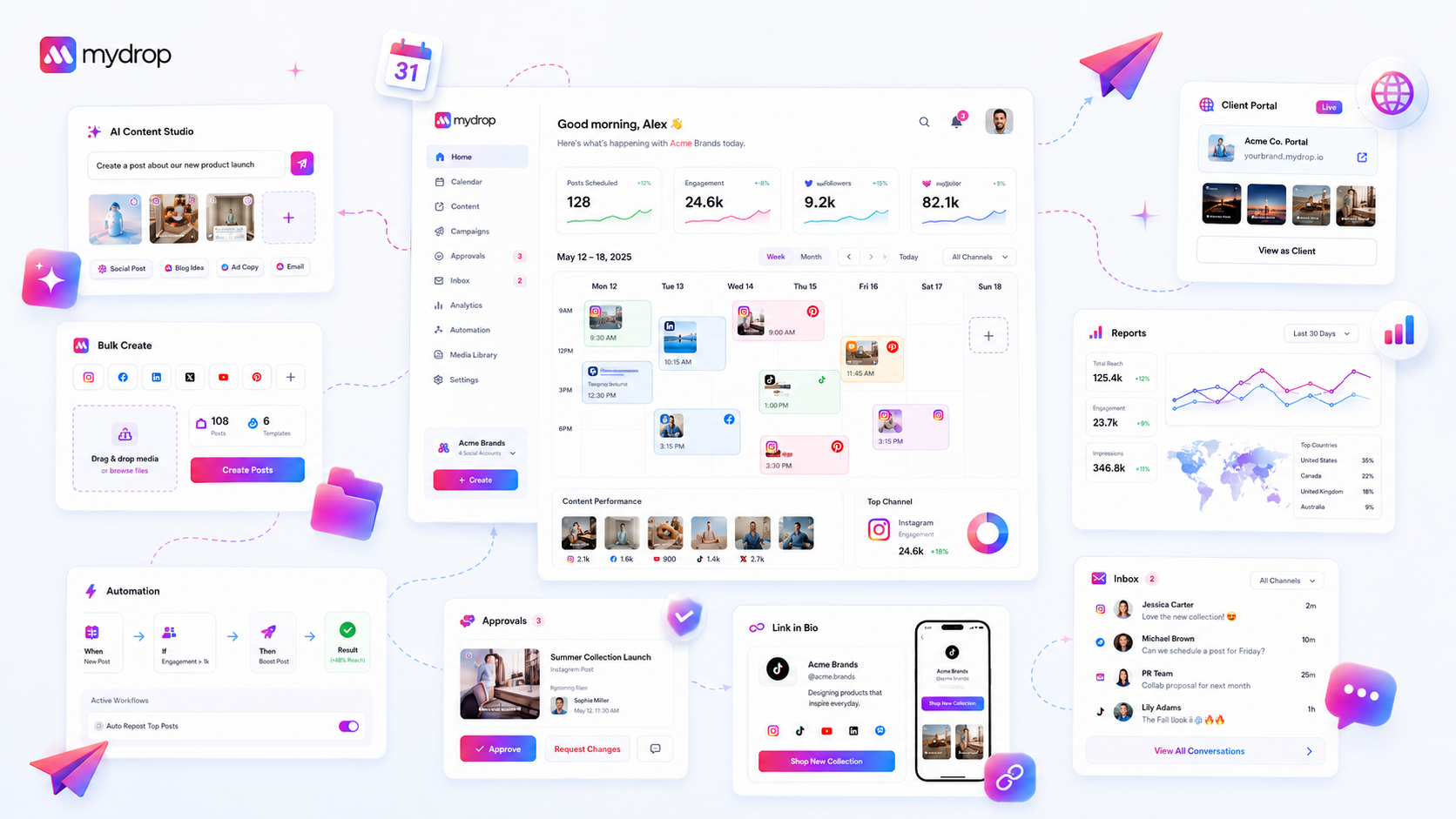
Most teams do not actually have a training problem. They have a context bottleneck. When a team member gets stuck on a brand asset upload or a profile connection, a generic onboarding article is useless. They need the tool to identify exactly where they stopped and offer an in-place nudge to get them moving again. This is where Mydrop changes the dynamic. Instead of dumping new users into an empty, intimidating dashboard, it uses a Quick Start checklist that validates setup milestones directly from the database-meaning the tool knows exactly which step the user missed before the team lead even realizes there is a delay.
Where basic tools start to break

Basic tools fall apart the moment your agency scales beyond a single brand manager and one or two active channels. You know the pattern: you purchase a seat on a generic scheduling platform, add the new hire, and send over a 20-page "onboarding PDF" that is already six months out of date.
The tool treats the new user as an empty vessel. It does not know the difference between a Junior Social Media Manager and an Executive Stakeholder. It assumes every user needs the same generic tour, even if the user has already spent three hours inside the app. This is the entropy gap. While the tool waits for a manual "Done" checkbox, your team is lost in email threads trying to figure out which brand assets are approved for current campaigns.
When the tool lacks state awareness, it cannot detect when a workflow is actually stuck. It sees a user who hasn't finished the guide and assumes they are lazy, rather than realizing they are stuck because they lack the necessary admin permissions for a specific profile. You end up with a dashboard that tells you "Setup Complete" while your team is still manually copying and pasting creative assets into a Google Drive folder at 8 p.m.
The buying criteria that matter
Stop evaluating onboarding tools by how pretty their UI tours are. Start evaluating them by how they consume your actual workspace data to verify activation. A tool that doesn't "know" your current setup state is just another administrative burden.
Use this scorecard to identify whether a platform is actually helping you scale, or just adding to the noise.
| Capability | Static Tool (The Trap) | State-Aware Tool (The Goal) |
|---|---|---|
| Verification | Relies on manual "Done" clicks. | Validates setup via live data (API/DB status). |
| Guidance | Generic, static help articles. | Contextual overlays based on missing assets. |
| History | Empty dashboard on first login. | Pre-populated with recent relevant workspace data. |
| Progress | Vague "Setup %" progress bar. | Checklists keyed to actual milestones. |
The 5-Point Activation Checklist
To achieve real velocity, your tool must be able to verify these five data points autonomously:
- Profile Connection: Are credentials actively authenticated via OAuth?
- Brand Assets: Are brand logos and primary color groups defined in the library?
- Active Automation: Are there active rules for post-triggering or approvals?
- Content Baseline: Has the team created at least one post that isn't a canned suggestion?
- Intelligence Check: Have team members actually tried AI post generation?
If a tool cannot detect these milestones, it cannot offer the next logical step. At Mydrop, we designed our onboarding around this exact state-aware logic. Instead of forcing you through a rigid tour you cannot skip, the app checks your workspace status. If you have already connected your profiles but haven't touched the media library, the interface stops nagging you about profile setup and highlights the library workflow instead.
Decision check: If your onboarding tool requires a manual status report from your team to know they are ready to work, you do not have an activation workflow. You have a reporting bottleneck.
The best onboarding doesn't teach users about the software; it guides them through the work they are already trying to do.
How Mydrop supports this workflow
At Mydrop, we built our onboarding surface specifically to stop the "information scramble" that kills agency velocity. We realized that if an account manager has to toggle between a shared spreadsheet and a platform interface to see what is missing, they have already lost momentum.
Instead of generic help articles, our workspace uses state-aware overlays. When a new hire logs into a workspace, the app scans the actual data: Are the social profiles linked? Is there a brand group defined? Has the team actually tried an AI post generation? If the answer is no, the UI surfaces contextual guidance exactly where it matters. You do not need to hunt for documentation because the product knows exactly what milestone is missing from the Quick Start checklist.
This is the shift from "How do I do this?" to "Oh, I see I am missing my media assets." By anchoring guidance in real-time workspace data, we help managers move from account setup to live strategy without the three-day "entropy gap" that plagues most agencies.
A simple shortlist checklist
If you are auditing your current onboarding stack this week, use this scorecard to see if you are actually scaling or just adding more administrative work to your team's plate.
| Feature | Low-Velocity Tool (Manual) | High-Velocity Tool (State-Aware) |
|---|---|---|
| Status Tracking | Static checklist / Spreadsheet | Live data integration (API-driven) |
| Guided Tours | Generic PDFs / Video links | Contextual UI overlays (In-app) |
| New Hire Ramp | Manual walkthroughs | Auto-surfaced "First Post" prompts |
| Account Health | Guesswork / Email check-ins | Real-time "Ready to Post" metrics |
Workflow check: If your onboarding tool requires a team member to manually mark a task as "done" inside a tracking spreadsheet, it is not an onboarding tool. It is just another source of coordination debt.
Conclusion
The goal of agency onboarding is not to finish a checklist. It is to reach the first successful, compliant, and strategic post as fast as possible. When you strip away the administrative friction of chasing passwords and manually setting up assets, you stop measuring "how long it takes to train" and start measuring "how fast we can deliver value to the client."
Most agencies do not have a resource problem. They have a coordination bottleneck. By choosing a platform that treats onboarding as a dynamic, data-driven workflow rather than a static administrative hurdle, you reclaim the hours your team currently spends on setup chaos. That is time you can finally put back into the strategy and creative work that actually wins and keeps accounts.