
The best social media OAuth software for agencies is one that enables client-led authorization, completely removing your team from the credential-handling loop. If you are still chasing passwords or manually logging into client accounts, you are essentially functioning as a high-stakes storage locker for liabilities that should never be on your server.
We get it. The "password dance" is a standard part of agency life, but that doesn't make it any less of a security nightmare. When you ask a client to share a password-or worse, a set of MFA codes-you are introducing a manual point of failure that breaks the moment a password changes or a token expires. You need a system that treats social connections as client-owned assets, not agency-managed burdens.
What the best tools need to handle

The shift from agency-controlled to client-controlled connections isn't just about security; it is about operational sanity. You are looking for a platform that treats OAuth as a self-service portal feature, not an administrative task.
Here is how a high-maturity connection flow should actually look:
- Zero-Credential Handover: The software should never prompt a client for a raw password. It must redirect the client to the native platform (e.g., LinkedIn or Instagram), handle the authentication locally, and pass a secure token back to your portal.
- Intelligent Account Discovery: When a client authorizes access, the tool must be smart enough to handle "multi-page" scenarios. If they link a personal Facebook account that manages 50 business pages, the software must offer a
pending profile connectionstep where the client selects exactly which assets they want to sync. - Lifecycle Awareness: Tokens die. It is an unavoidable reality of the platform APIs. The best tools don't just break silently on a weekend; they trigger automated, white-labeled expiry notifications to the client, guiding them through a simple "re-authorize" button in your portal.
Operator rule: If your tool requires you to perform the OAuth flow on behalf of the client, you have already failed the zero-credential test. The connection must originate from the client's local session within your portal.
The Credential-Handling Audit
| Workflow Mode | Security Risk | Manual Overhead | Client Trust |
|---|---|---|---|
| Manual Password Collection | Maximum (Full Liability) | High (Chasing/Updating) | Low (Friction) |
| Agency-Led Proxy Login | High (Policy Breach) | Moderate (Maintenance) | Medium |
| Client-Led Portal OAuth | Minimal (Token Isolated) | Zero (Self-Service) | High (Professional) |
Most agencies think they have a "process" problem, but they really have a coordination debt. If your team spends even two hours a week manually syncing accounts or chasing expired tokens, you are burning billable time on infrastructure instead of strategy.
A solid portal-based flow allows the client to see exactly what they are connecting. At Mydrop, we see that when clients can preview their own pages and confirm their own scopes, they feel significantly more in control. It removes the mystery of what you are actually doing with their account. The goal is to move from being a password middleman to a strategic partner, and you simply cannot do that if your operational foundation relies on a spreadsheet of sticky notes.
Where basic tools start to break

The real headache begins when a tool treats your enterprise needs like a simple consumer app. Most basic social media tools are built on a "one-to-one" mental model. They expect a single user to log in and authorize their personal account. But you aren't managing personal accounts; you are managing hundreds of business assets across multiple markets.
When the tool lacks a robust pending profile connection flow, you get stuck in the "Multi-Page Nightmare." A client tries to connect their Facebook account, but the OAuth screen returns a list of 50 pages they have admin rights to. A basic tool might force them to authorize everything, cluttering your dashboard with irrelevant noise, or worse, it might fail to import any of them because the API handshake wasn't designed for bulk selection.
We have seen too many teams waste entire afternoons manually troubleshooting tokens because their platform couldn't handle the selection phase gracefully.
The "Service vs. Social" Trap
Another common failure point is the "Service Connection" masquerade. Some platforms conflate social publishing profiles with service connections like Google Drive or Canva. If your tool doesn't explicitly distinguish between these in the UI, you end up with a messy, unverified list of connections that aren't actually ready to publish content.
Common mistake: Treating a connection to a client's Google Calendar as a publishable social profile. This creates "ghost" profiles in your portal that confuse the team and clutter your analytics dashboard.
The buying criteria that matter
When you are evaluating software for your agency portal, you need more than a slick UI. You need a rigorous standard for how the tool handles the entire token lifecycle. If you are still relying on a "copy-paste-password" workflow, your team is holding the bag for every security risk that follows.
Use this scorecard to evaluate your next potential provider.
The Enterprise OAuth Scorecard
| Capability | High Risk (Manual/Basic) | Enterprise Ready (Mydrop/Best-in-class) |
|---|---|---|
| Credential Handling | Requires password sharing or manual entry. | Client-led OAuth. Agency never sees credentials. |
| Multi-Page Sync | Fails or imports everything by default. | Offers pending profile review before creation. |
| Token Health | Silent failure until a post breaks. | Proactive alerts on expiry or scope drift. |
| Onboarding UX | Heavy documentation/email back-and-forth. | Self-serve portal flow for clients. |
| Relationship | Account-level only. | Brand-portal grouped access. |
The Non-Negotiable Checklist
Before you commit to a platform, run a quick test on these three functional requirements:
- Can the client initiate the connection themselves? The flow must originate inside the client-facing portal, not the agency backend.
- Does the provider include a "Pending" staging state? You must have a screen to review and confirm which accounts are being imported before they are activated in your publishing calendar or analytics dashboard.
- Is there a clear path for token renewal? When a token expires-and it will-does the platform send a white-labeled notification to the client with a secure, one-click link to re-authorize?
The goal is to move from being a password middleman to a strategic partner. If a tool requires you to chase down clients for login credentials, it is just adding to your coordination debt. Choose software that empowers your clients to handle their own connections securely, while you stay focused on the strategy that drives their growth.
How Mydrop supports this workflow
At Mydrop, we built our profile connection logic around a simple realization: the agency should never see the client's social media password. It is a security liability that creates more friction than it solves. When a client needs to connect a brand profile, they shouldn't be emailing you a password or joining a Zoom call to type it in while you watch.
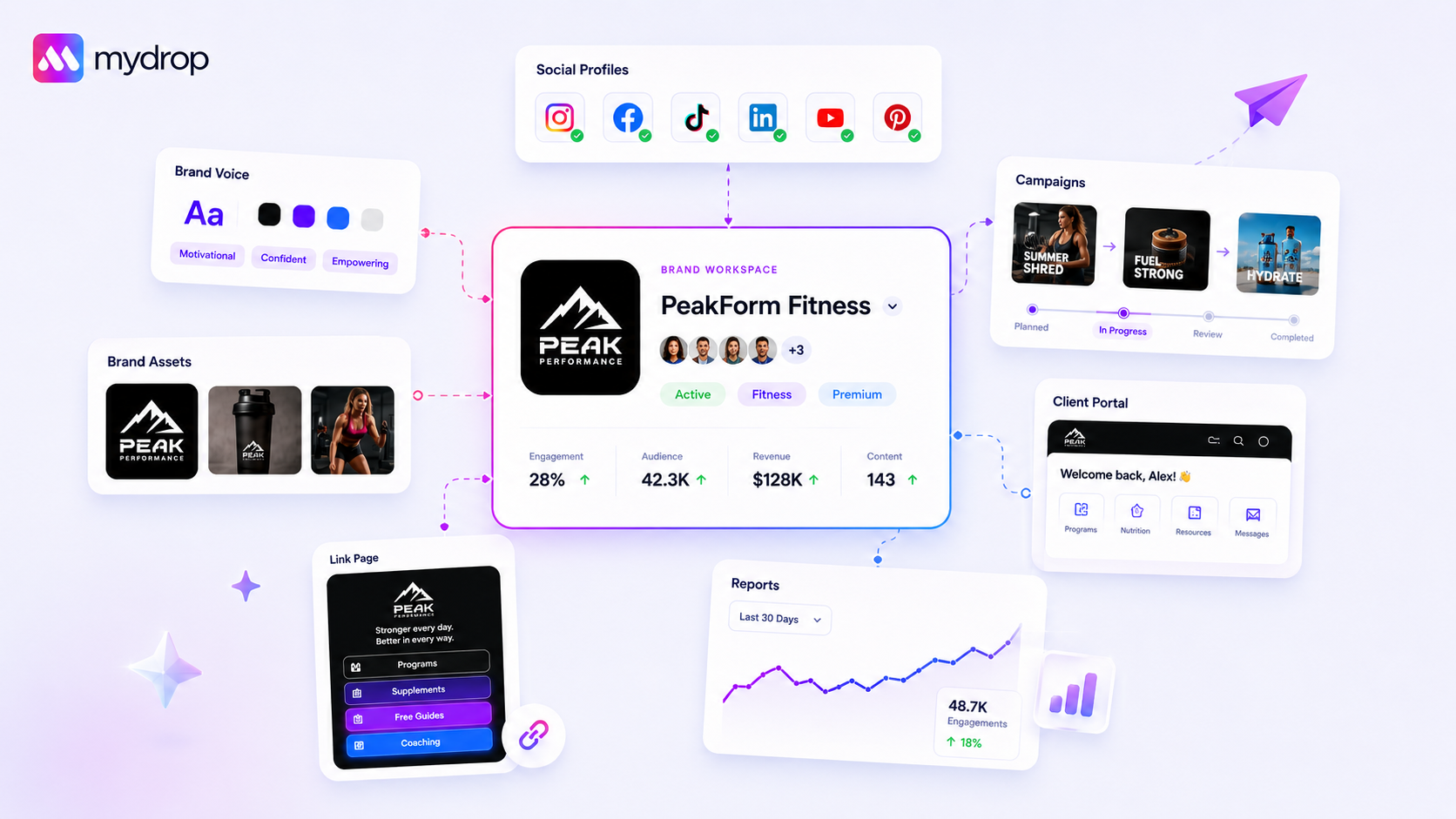
Instead, Mydrop enables a public brand portal flow. You send your client a link, they land on a clean, white-labeled page, and they initiate the OAuth connection themselves directly with the platform-Facebook, LinkedIn, TikTok, or whoever it is. Because our system handles the code_verifier and the token exchange in the background, the client only sees the standard "Grant Access" screen from the provider.
Once they authorize, our pending profile connection system kicks in. This is where most tools fail: they just dump every single page that user has access to into your account. We don't. We present the client with a clear list of discovered profiles so they can confirm exactly which ones should be imported. This prevents that messy scenario where you accidentally import a client's personal Instagram account along with their business page.
It keeps the token owner propagation clean and ensures that the agency gets exactly what it needs, and nothing more.
A simple shortlist checklist
Before you commit to a platform, run this list against your current or prospective tool. If you have to check "No" for more than one, you are likely buying yourself a future headache.
| Requirement | Why it matters |
|---|---|
| Zero-Password UI | Does the flow rely on official provider OAuth exclusively? If the tool asks for a password, stop. |
| Multi-Profile Filtering | When a client logs in, can they selectively import specific pages, or does the tool auto-import everything? |
| White-Labeled Portal | Can the client authorize accounts from a branded portal, or do they have to join your main dashboard? |
| Automated Expiry Alerts | Does the system proactively notify you before the token dies, or do you only find out when the post fails? |
| Service vs. Profile Split | Does the tool distinguish between actual publishable profiles and "service" connections like Google Photos or Drive? |
Conclusion
The "password dance" is a relic of the early days of social media management. It is exhausting for your team, risky for your clients, and frankly, a bottleneck to your agency’s growth. If you are serious about scale, you have to move past manual credential handling.
The goal isn't just to make the connection process easier; it is to make it invisible. When the platform handles the handshake, the security liability shifts back to the provider where it belongs, and your team gets back the hours previously wasted on credential support.
Most agencies don't have a connection problem. They have a coordination debt problem. Fix the connection flow first, and the rest of your publishing pipeline will finally have the room it needs to breathe.