
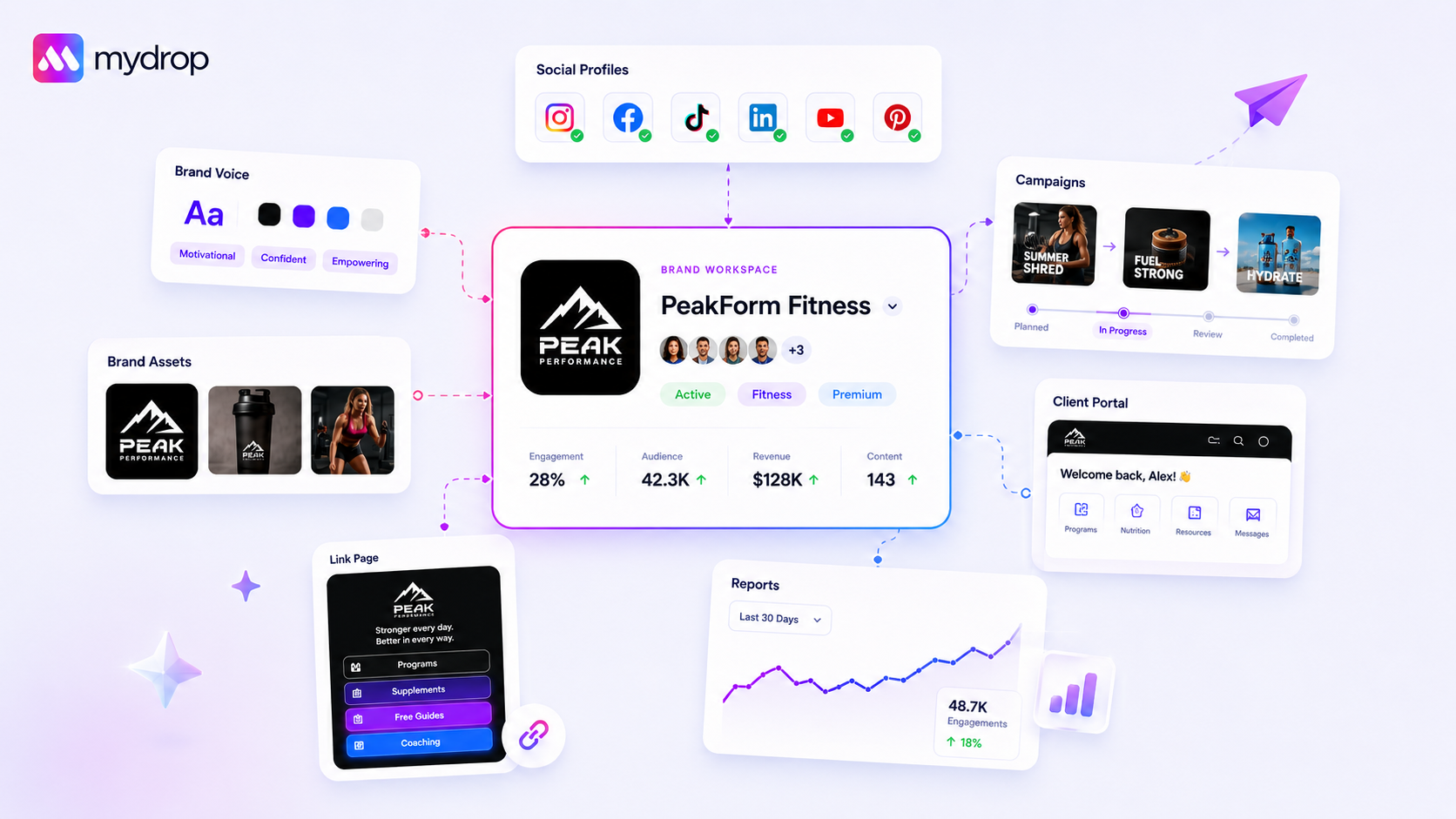
Agencies managing hundreds of client profiles should look for tools that offer portal-based, multi-account OAuth confirmation. This approach eliminates the risky password-sharing culture and prevents full app access for clients, replacing it with scoped, granular authorization that keeps agency and client credentials strictly separate.
We know the drill. You are onboarding a new client, and the process is a chaotic mess of DMs, shared password spreadsheets, and frantic emails. You are trying to move fast, but you are also holding your breath, hoping a junior staffer does not accidentally trigger a geo-lock security alert that freezes a client’s account for 48 hours. The fear that one security oversight could compromise a client’s entire brand presence is a weight you should not have to carry.
This guide provides a clear decision matrix for evaluating social media connection tools, helping you identify whether your current workflow is a security liability or a scalable, professional asset. The hidden cost of convenience is that many tools ask for full login credentials because it is easier for the developer, but it creates a massive, unnecessary vulnerability for your agency and your clients.
What the best tools need to handle

The most secure agency-level connection tool is not just about connecting profiles; it is about removing the agency from the security loop entirely through delegated, password-less OAuth workflows.
When evaluating your options, you need to look past simple connectivity and check for these operational safeguards. Basic tools might get the job done today, but they break down when you hit scale.
| Feature | The "Basic Tool" Approach | The Enterprise-Ready Standard |
|---|---|---|
| Credential Handling | Stores client passwords or tokens in a shared, high-risk bucket. | Zero-password policy: Agency never sees or touches client credentials. |
| Onboarding Path | Emailing "can you send me your login" spreadsheets. | Branded, secure portal where clients authorize their own profiles. |
| Scope Management | Requests "all access" scopes to prevent future errors. | Requests granular, task-specific scopes (e.g., publish-only). |
| Account Discovery | Manual entry of every channel ID and handle. | Multi-account OAuth confirmation for bulk discovery. |
| Token Refresh | Requires manual client re-login after every expiry. | Automated health monitoring with secure, proactive prompts. |
Operator rule: If a tool asks your client to email a password or paste a two-factor code into a Slack message, stop the implementation immediately. That is not a workflow; it is a security debt accruing interest.
The goal is to shift from "account access" to "service connection." A true enterprise tool treats connection as a two-step process:
- The client authorizes their own account via a secure portal, where they control the specific, scoped permissions.
- The agency receives only the technical handshake required to publish, never the keys to the kingdom.
This protects your agency’s reputation, keeps you compliant, and ensures that you can onboard a brand in minutes rather than days. When your team stops chasing passwords, they can focus on the actual strategy that your clients are paying for.
Where basic tools start to break

Here is the awkward truth: most "standard" social management tools were built for solo creators, not the tangled reality of an agency. When you try to force an enterprise workflow into a tool designed for one influencer, the seams rip open immediately. The biggest failure point is the All-or-Nothing Login.
Many tools demand a full set of credentials because that is the easiest path for their developers. They ask for the password to the client's Facebook Business Manager, which is essentially asking for the keys to the entire house just to hang a painting in the hallway.
When you hold those keys, you inherit a massive liability. If a junior staffer logs in from a suspicious network and triggers a geo-lock, or if a client changes their password and your system starts throwing constant error pings, you are suddenly spending your afternoon on a tech-support call rather than strategy. This isn't just an inconvenience; it is coordination debt that drains your team's energy every single day.
The buying criteria that matter
To stop the cycle of credential-chasing, you need to evaluate tools based on how they hand off control. Use this scorecard to audit your current stack against a professional-grade standard.
The 5-Point Agency Security Scorecard
| Criteria | The "Old Way" (Liability) | The Professional Standard |
|---|---|---|
| Credential Handover | Client shares password via email/spreadsheet | Zero-password access via delegated OAuth |
| Scope of Access | Full app access / Admin-level rights | Granular, scoped permissions |
| Account Onboarding | Agency manually enters logins | Client-authorized portal connection |
| Conflict Resolution | Single-account blocking fails everything | Multi-account confirmation via staging |
| Token Health | Hidden until someone complains | Proactive monitoring & expiration alerts |
Decision check: If your onboarding process involves a document that requires "Password" as a field, your agency is carrying risk that you are not being paid to manage.
Why this rubric matters for your team:
- Granular Authorization: The best tools don't just "connect a profile." They use the platform's native API to request only the specific permissions needed-like publishing to a page-without gaining the ability to delete the account or touch the client's private settings.
- The "Staging" Step: When you connect a brand, the tool should show you exactly what it found before you commit. You need a pending connection workflow that allows you to select only the relevant channels, ensuring you don't accidentally import a client's personal Instagram into a professional dashboard.
- Decoupled Permissions: You want a portal where clients can authenticate their own accounts. This keeps their login screen in their own browser, protected by their existing MFA, while your tool simply receives a secure, temporary token. You never see, store, or touch the password.
Most teams do not have a tool problem; they have a governance bottleneck. Every minute your team spends troubleshooting a broken token or managing a password spreadsheet is a minute lost on actual creative work. A tool that offloads that security burden back to the client isn't just a utility-it is a competitive advantage that lets you scale your client roster without increasing your security risk.
How Mydrop supports this workflow
At Mydrop, we built our profile connection flow specifically to stop the "spreadsheet as a crime scene" problem. We treat social connections as a delegated service, not an administrative chore.
When you need to onboard a new client, you don't ask for a password. You send a link to our Brand Portal. Your client logs into their native social account directly via the provider's own consent screen. Mydrop never sees or touches their password. Once they authorize the scopes, our system stores a secure token.
If they connect a Facebook page that is linked to three different Instagram business accounts, you aren't left guessing what was actually imported. You get a clean Pending Profile Connection view. You can see every asset returned by the OAuth flow and confirm exactly which ones should be active in your dashboard before any sync kicks off.
This is the point where most tools fail-they just dump everything into your workspace and hope for the best. We force the review. This prevents "connection clutter" and ensures your analytics dashboard isn't flooded with inactive or irrelevant accounts. By the time you hit "Confirm," you have a locked-in, secure connection that stays healthy because it was established correctly from day one.
A simple shortlist checklist
If you are evaluating tools this quarter, stop asking about "feature lists" and start auditing the handshake. Use this checklist to see if a candidate tool is built for an agency or just a hobbyist.
| Feature requirement | Why it is a dealbreaker |
|---|---|
| Password-less Portal | If you still touch a password, you own the liability when it leaks. |
| Multi-account Preview | Without this, you will spend hours cleaning up "accidental imports." |
| Granular OAuth Scopes | Ensure the tool only requests what it needs to post and pull data. |
| Token Health Dashboard | You need to know which tokens are expiring before the API cuts you off. |
| Bulk Re-auth Flow | When a token dies, can you send one link to refresh the whole brand? |
Workflow check: If a tool requires you to be an Admin on the client's Facebook Business Manager just to get a post live, you have already lost the security battle. Look for tools that let the Client be the Admin and the Tool be the Guest.
Conclusion
The difference between a frantic team and a high-velocity agency isn't better software for making content; it is better software for securing the pipes that deliver it.
Most teams do not have a content production problem. They have a coordination debt problem. Every time you chase a password, manually refresh a broken token, or explain to a client why their account was geo-locked because a junior staffer logged in from a different continent, you are paying interest on that debt.
Stop treating social connections as a one-time setup task. Treat them as a living infrastructure. By moving your agency to a password-less, portal-based OAuth workflow, you turn a security liability into a professional service offering. You give your clients peace of mind that their brand credentials are never leaving their sight, and you give your team the gift of never having to ask for a login ever again.
The best tools aren't the ones with the most buttons. They are the ones that quietly handle the security handshake so you can focus on the work that actually earns your retainer.