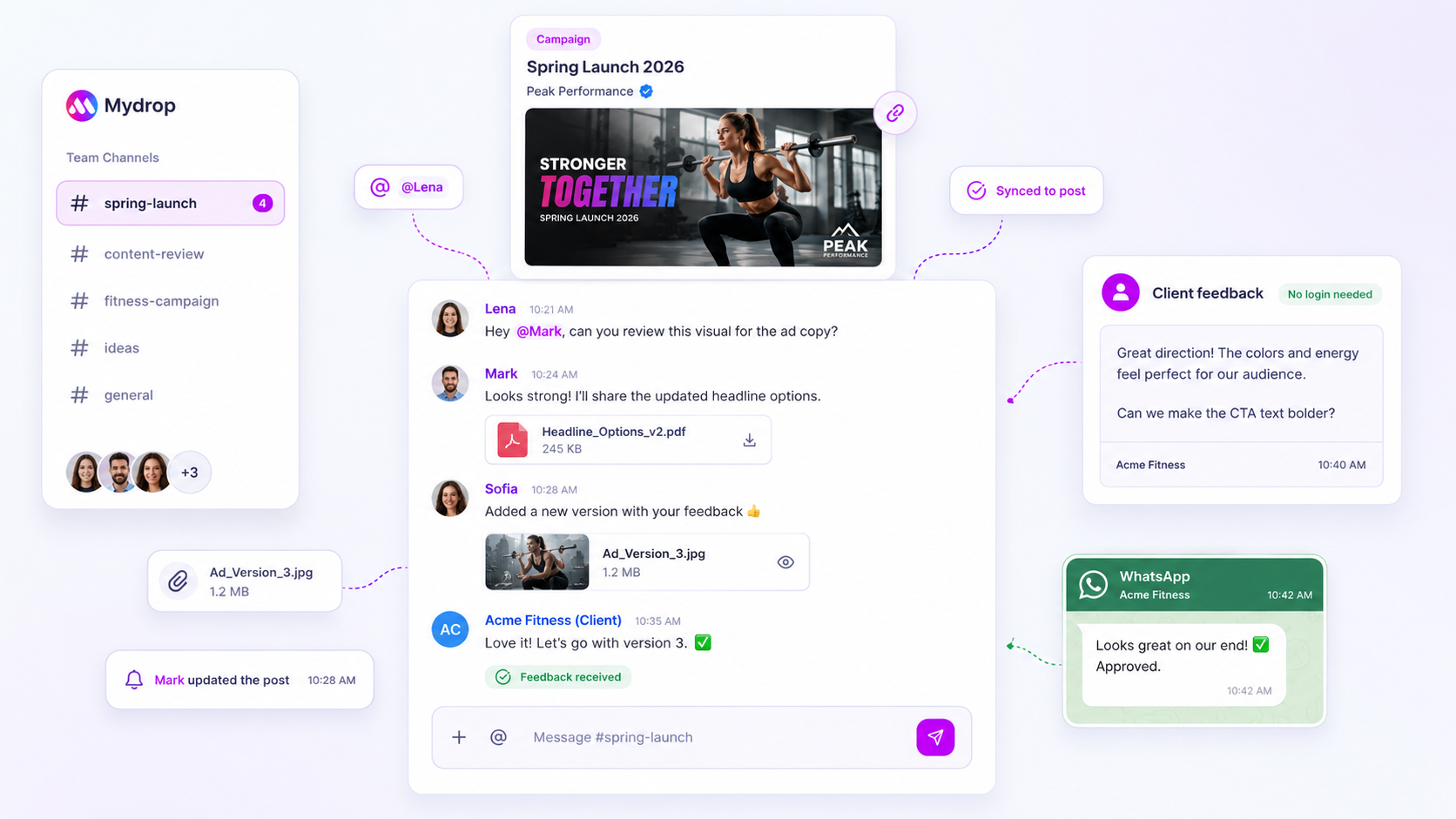
The most effective way to fix your creative feedback handoff isn't adding another notification-heavy tool to your stack; it is anchoring creative direction exactly where your work lives. When feedback is scattered across Slack channels, email threads, and DM chains, you are not just losing time, you are accumulating coordination debt. The real fix is shifting from transient, chat-based communication to persistent, workspace-integrated notes that live alongside your content calendar.
We get it. You are three Slack channels deep trying to find that one specific tweak a stakeholder mentioned on a creative mockup, only to realize it was actually buried in an email thread from Tuesday. It is exhausting, it kills your creative momentum, and it makes you feel like you are fighting just to get the information you need to do your job. No one should be chasing down feedback at 6 p.m. on a deadline.
What the best tools need to handle

Creative feedback is not just a communication issue; it is an infrastructure problem. If you have to leave your planning interface to find the notes about a post, you have already lost time. The best tools for enterprise teams solve this by ensuring that context follows the work, rather than forcing you to hunt for it.
When evaluating collaboration tools, you need to look for features that provide visibility, persistence, and low-friction capture. If a note is hard to find, it will not be used. If it is not tied to the actual project, it will not be trusted.
Here is a simple rubric to audit your current feedback flow:
| Requirement | The "Scavenger Hunt" Approach | The "Integrated" Flow |
|---|---|---|
| Persistence | Lost in chat history | Always accessible |
| Context | Detached from the post | Anchored to the calendar |
| Capture | Requires context switching | Instant, in-workflow |
| Accountability | Vague, "who said what?" | Clear metadata and timestamps |
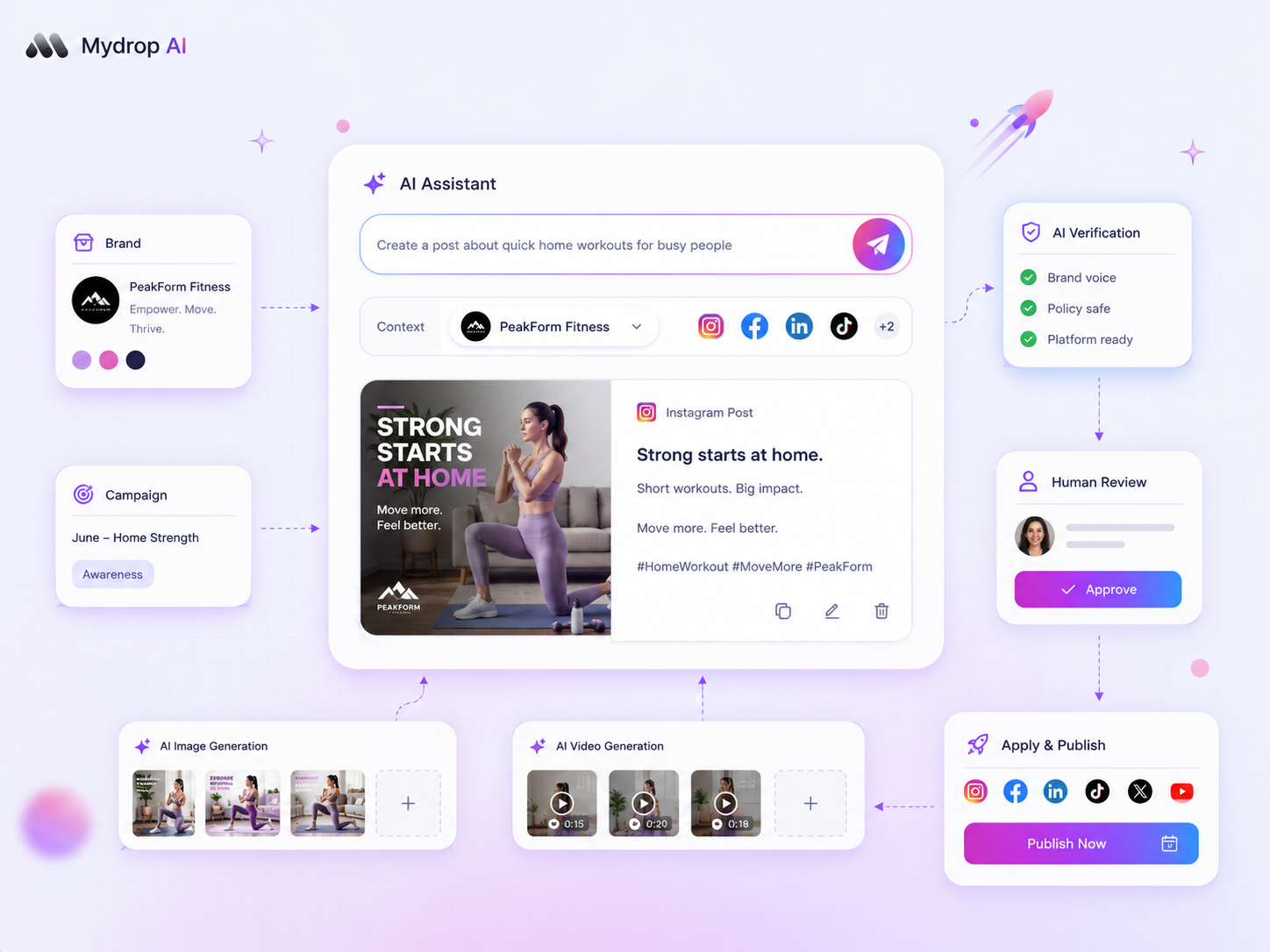
At Mydrop, we see teams managing hundreds of brand profiles who struggle simply because their feedback is not visible when and where they need it. This is why we built our Notes feature to be lightweight and accessible directly within the Calendar and Home dashboard. You should not have to open a secondary app or search through Slack archives just to confirm a design change.
When you have a way to capture quick ideas and feedback without creating a full post, you reduce the friction of the entire creative process. A simple note, surfaced exactly when you are looking at your scheduled calendar, transforms a chaotic feedback loop into a structured, visible record. The goal is to make the right information the easiest information to find.
Where basic tools start to break
Here is the awkward truth about your current tech stack: the more powerful your messaging apps become, the more damage they do to your creative process. When feedback lives in a fast-moving Slack channel or an ever-growing email chain, it stops being information and starts being noise.
We have seen this across hundreds of brands. You have a brilliant designer creating a mockup. A stakeholder drops a "quick thought" in Slack at 4:30 PM on a Thursday. By Monday morning, that message is buried under 400 other notifications, the designer has forgotten to apply the change, and the team is scrambling to fix a live post. The tool didn't fail; your coordination strategy did.
Basic messaging tools are built for ephemeral communication, not persistent record-keeping. They lack the gravity to hold context. When you rely on them for creative direction, you end up with "contextual drift"-where the intent of the request becomes disconnected from the actual asset. You aren't just losing time searching; you are losing the why behind your creative decisions.
The buying criteria that matter
Stop looking for tools that promise more features. Start looking for tools that promise more coherence. When auditing your workflow, use this scorecard to separate platforms that genuinely reduce coordination debt from ones that just add more tabs to your browser.
Creative Feedback Buying Scorecard
| Criterion | What to look for | Why it matters |
|---|---|---|
| Anchoring | Can you attach feedback directly to the asset or calendar slot? | Prevents context-switching and "search fatigue." |
| Persistence | Does the note live on even after the task is finished? | Provides a historical record for future revision cycles. |
| Visibility | Is the note visible to everyone involved without an extra click? | Eliminates the "did anyone see that?" communication gap. |
| Low-Friction Capture | Can a stakeholder leave a note without starting a new thread? | Encourages timely input instead of "save it for the meeting." |
Operator rule: If your feedback loop requires a separate app, a search bar, or a copy-paste action to get context back into your planning view, it is a leaky bucket.
Your goal is to move from a notification-based workflow-where you wait to be pinged-to a context-based workflow, where the information meets you where you work. When we look at how Mydrop handles this, we don't treat notes as a separate chat feature. Instead, we treat them as lightweight, workspace-integrated layers that live directly on your Calendar and Home dashboard.
It sounds simple, but this is the part people underestimate. By surfacing these notes in the same space where you schedule and publish, you turn what used to be a frantic scavenger hunt into a structured, visible feedback loop. You stop asking "Where is that change?" and start asking "What is the next creative move?"
How Mydrop supports this workflow
At Mydrop, we have seen how teams managing hundreds of brand profiles lose hours simply tracking down the latest version of a plan. The problem is almost never the lack of information; it is the absence of visibility for that information when it actually matters. Mydrop Notes solves this by anchoring creative direction right in your Calendar or on your Home dashboard.
Instead of hunting through Slack history, the feedback is surfaced where you actually do the planning. If a stakeholder requests a change to a video asset, you capture that in a note pinned directly to the post card in your calendar. When the creative lead or designer opens their workflow, the required changes are right there, attached to the work. It is persistent, it is visible, and it does not require a separate app to find. It is about keeping the context close to the work, rather than forcing the work to adapt to the notification stream of a chat app.
This approach transforms your workspace from a static list of posts into a living record of creative intent. We have found that when teams move from scattered chat messages to integrated notes, the back and forth that usually defines the revision cycle shrinks significantly. You stop spending time playing detective to find out why a design was changed, and you start spending that time actually shipping content.
A simple shortlist checklist
Before you commit to a new collaboration tool, or before you decide to reorganize your current team workflow, run your setup through this operational check. If your tool cannot handle these three simple requirements, it is probably adding to your coordination debt rather than solving it.
The Creative Collaboration Scorecard
| Requirement | Why it matters | Decision Rule |
|---|---|---|
| Workflow Anchoring | Feedback must live on the asset, not in a separate feed. | If you have to switch tabs to find the feedback, the tool fails. |
| Persistence | Creative direction needs to survive the campaign duration. | If the information disappears after 48 hours or is buried in chat, the tool fails. |
| Visible Context | Stakeholders must see the notes without extra clicks. | If a teammate cannot see the notes on their home view, the tool fails. |
Operating checklist for this week:
- Identify your most common bottleneck. Is it the intake of creative requests or the final approval stage?
- Audit your current feedback location. For the next three projects, record where the primary creative feedback originated. Was it Slack, email, or somewhere else?
- Consolidate to a workspace note. For your next campaign, force all feedback into a single, shared workspace note that is visible to everyone involved in the approval loop.
- Review the revision cycle time. Compare the time it took to resolve this feedback against your baseline.
Conclusion
Most teams do not have a content problem. They have a decision bottleneck. When you rely on transient chat to manage permanent creative direction, you are essentially building your strategy on top of a pile of unindexed, temporary files. It creates an environment where people are constantly working from the wrong context, leading to missed deadlines and frustrated stakeholders.
The best tools are the ones that disappear into the background. They do not demand your attention with another notification badge, and they do not ask you to leave the screen where you are doing your actual work. They simply hold the context and make it available the moment you need it. If you can stop the scavenger hunt for feedback and start anchoring your creative direction exactly where your calendar lives, you will instantly reclaim hours of focus every single week. You do not need more channels; you just need a better place to record your decisions.