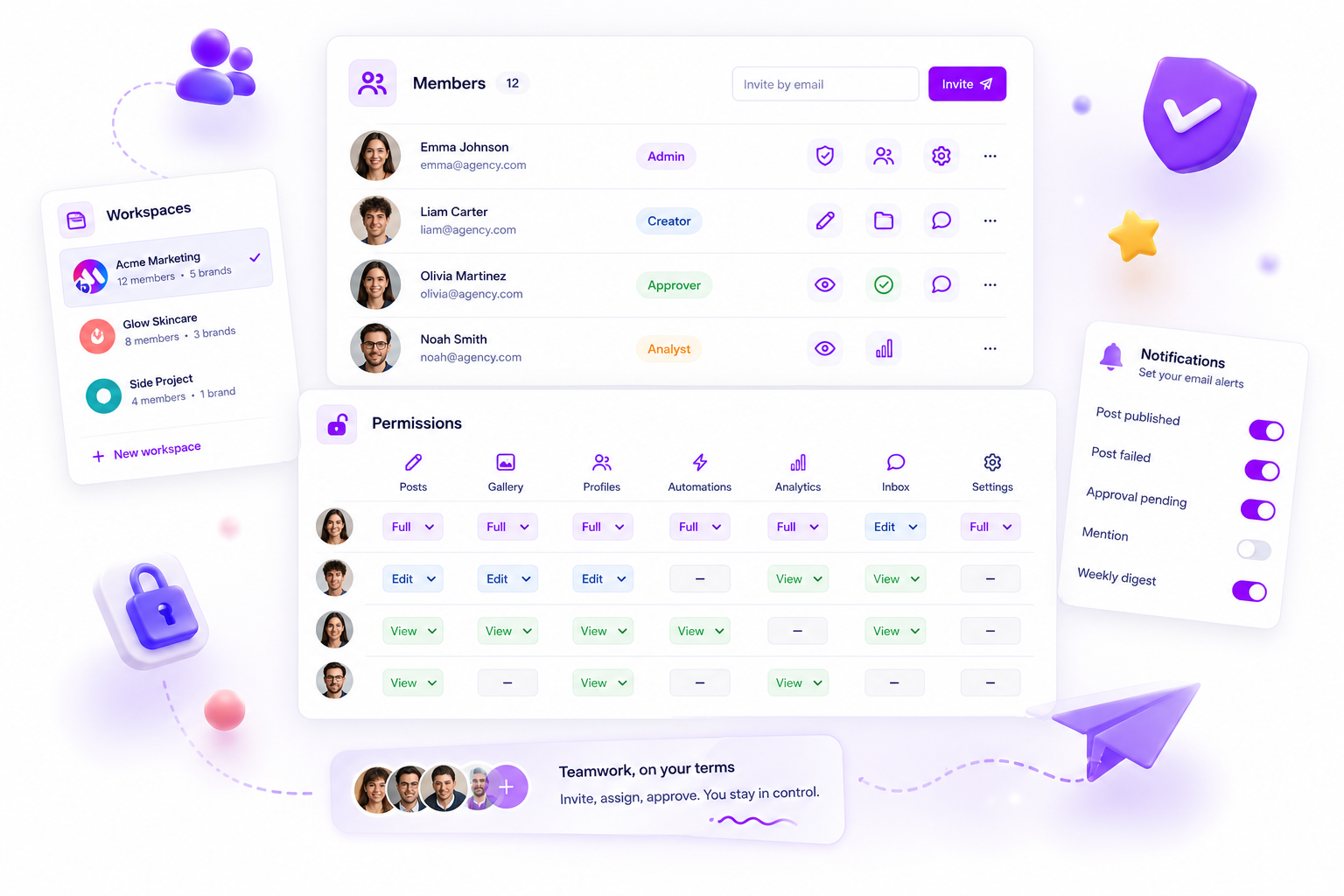
Most teams treat AI as a way to generate more content, but that just creates more noise for your approvers. The real win isn't faster writing; it's faster verifying. You need a tool that doesn't just draft posts but actually checks them against your brand rules, platform constraints, and campaign goals before a human even sees them. If your approval process still involves endless back-and-forth emails, you are fighting a coordination war, not a content one. Shift-left verification turns your AI into an automated gatekeeper, catching compliance and voice issues at the draft stage, so your final review is just a formality, not a total rewrite.
We get it. You are stuck in that endless loop of "looks good, but..." feedback from stakeholders. Your creative process feels less like strategy and more like a high-stakes game of revision tennis. The messy middle of approvals is where great content goes to die, and frankly, no one enjoys chasing signatures at 6 p.m. on a Friday.
What the best tools need to handle

The biggest mistake agencies make is treating AI as a "magic writer" that sits outside the operational flow. If the tool doesn't understand your account, it is just generating expensive drafts that your team has to fix anyway. To actually reduce revision cycles, an AI assistant needs to be more than a chatbot; it needs to be an integrated workspace copilot.
Here is the reality of agency workflows: You are juggling dozens of brands, hundreds of profiles, and a rotating cast of stakeholders. If your tool cannot see your existing brand assets or past performance, the AI will inevitably miss the mark. You need a platform that treats your brand library, previous successful posts, and even your current campaign plans as live context for every draft.
At Mydrop, we realized that an AI assistant is only as good as the context it can access. When you ask for a post, it should already know your brand voice guidelines, your active campaign constraints, and which images are approved for use. If it does not, you are not saving time; you are just creating more work.
Operator rule: If your AI tool cannot tell you why a draft might fail compliance before you submit it, you are not using an approval tool; you are using a liability generator.
To evaluate whether a tool can actually support your team, use this scorecard to rate your current process.
| Evaluation Metric | Why it Matters | Goal for Agencies |
|---|---|---|
| Brand Context Awareness | Prevents off-voice drafts. | AI pulls from your library automatically. |
| Platform Constraints | Stops format-related rejections. | Real-time character/aspect ratio checks. |
| Structured Artifacts | Allows for machine-readable review. | Drafts are data objects, not just text. |
| Upstream Verification | Eliminates late-stage churn. | Automated policy/compliance check at draft. |
When you move from manual "submit-and-pray" workflows to this verified-draft model, you are not just saving time. You are changing the fundamental nature of your team's feedback loop. Instead of fixing typos, tone, or compliance issues during the final approval stage, your reviewers spend their time evaluating the strategy, not the mechanics.
Where basic tools start to break

Most teams rely on generic AI tools that operate in a vacuum. You ask for a post, you get a caption, and then you spend the next hour fixing it to match your brand voice, formatting requirements, and platform-specific constraints. This is the "blind paste" problem: the AI creates content that ignores your existing account history, media limitations, and the specific tone your stakeholders expect.
In our experience, teams managing hundreds of brand profiles across multiple markets quickly learn that this is not a scaling strategy. It is just a faster way to create junk that eventually gets rejected. When your AI assistant cannot see your workspace, it creates content that feels off-brand. When it cannot check platform-specific character limits or media aspect ratios, your team is stuck playing "manual quality control" just to make the draft fit.
This is where most workflows stall. You have a draft, but you still have to verify it against your own internal rules. The legal team or the brand lead still has to look at every single post because the tool provided no assurance that it was compliant. The hidden cost here is not just the time spent on edits; it is the creative fatigue your team feels when they realize the AI they were told would "save time" actually just created more administrative work.
Common mistake: Treating AI-generated text as a finished product rather than a draft that needs to be verified against your brand’s operating context before it ever touches your review process.
The buying criteria that matter
If you are evaluating software to manage this, stop looking for "AI content generation" and start looking for "AI-driven verification." You need a tool that treats a social post as a structured, reviewable object, not just a string of text in a chat window.
When your team is under pressure to publish more, the only way to avoid chaos is to embed verification upstream. This is what we call "Shift-Left Verification." If you can automate the technical and brand-alignment checks at the creation stage, you stop the revision cycles before they start.
Here is how to assess the "leakiness" of your current approval process.
Approval Friction Scorecard
Use this checklist to rate how easily your team manages content before it reaches formal review.
| Evaluation Area | Low Friction (Goal) | High Friction (Danger) |
|---|---|---|
| Brand Context | AI suggests content grounded in brand history. | AI suggests generic content that needs heavy editing. |
| Technical Limits | AI checks platform constraints (limits/format) automatically. | Manual checks needed for every post draft. |
| Review Workflow | Verification steps included before submission. | All verification happens during final approval. |
| Output Type | Structured artifacts ready for review. | Raw chat responses that require copy-pasting. |
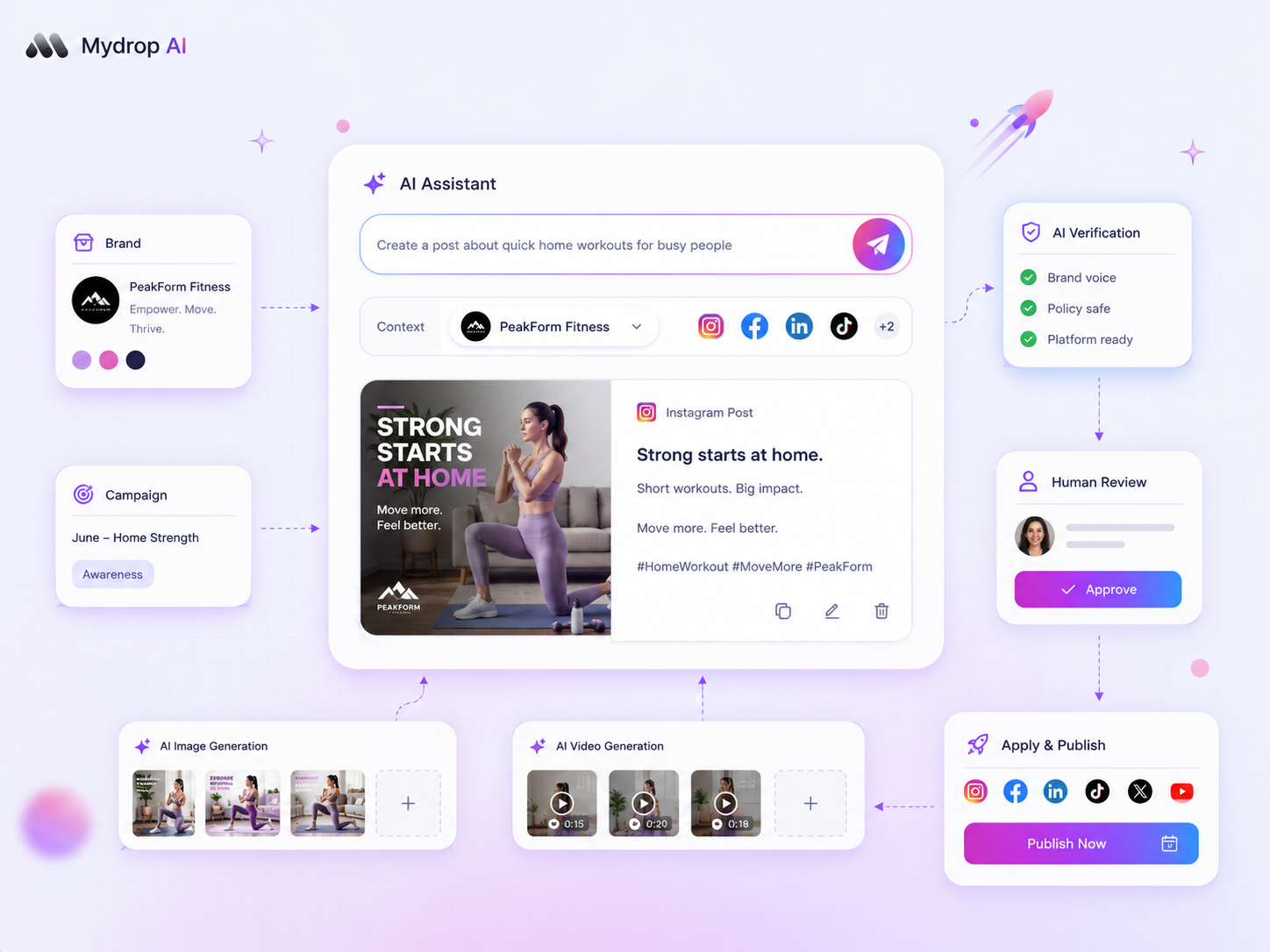
At Mydrop, we realized that an AI assistant is only as good as its ability to move from an idea to a concrete workspace object. This is why we built the Verify Draft capability. Instead of just giving you a chat response, our AI Assistant Agent creates a structured artifact that is already grounded in your workspace data. You run a verification check, see the issues, and fix them before you ever submit it for formal approval.
If you are buying a tool today, ask yourself if the AI acts as a participant in your workflow or just a draft engine. Does the system know your brand library? Can it flag an issue with a post's length or tone against your own guidelines before you can even click "send to approver"? If it cannot answer those questions, you are not buying a solution; you are buying another task for your team to manage.
How Mydrop supports this workflow
The secret to moving faster isn't faster typing; it is fewer revisions. At Mydrop, we recognized that the traditional feedback loop is broken because it happens too late. You submit a draft, a stakeholder hates it, and you are back to square one.
We built our AI Assistant Agent to flip this. Instead of acting as just another content generator that dumps text into a chat box, it functions as a workspace-aware operator. When you ask it to help with a post, it doesn't just pull from a generic training set; it looks at your existing brand assets, past high-performing posts, and your specific tone guidelines.
The real difference is the Verify Draft feature. Before you even think about showing a draft to a client or stakeholder, the agent runs a series of checks. It looks for platform-specific constraints, character limits, and alignment with your stored brand voice. It essentially performs a pre-flight check so the AI output isn't a "blind paste" that needs fixing, but a structured artifact that is ready for review.
Decision check: If your tool asks you to copy-paste AI output into a separate document for review, you have not solved your bottleneck. You have just shifted where the manual work happens.
By turning AI responses into structured artifacts, we ensure that what you see in the chat is exactly what gets applied to your post editor. If the agent makes a mistake, you can use follow-up prompts to refine it, and then run the verification check again. It turns a chaotic, fragmented process into a linear, predictable flow: you prompt, the agent drafts, you verify, and only then do you submit.
A simple shortlist checklist
When you are auditing potential tools for your agency, do not let flashy marketing distract you from the operational reality. You need to know if the tool is built to handle coordination debt or just to churn out more noise. Use this scorecard to rate your current setup and any tools you are considering for your stack.
| Feature | Manual Only | Basic AI Tool | Mydrop AI Agent |
|---|---|---|---|
| Brand Context | None | Generic | Deep (Shared Assets) |
| Draft Verification | Human Only | None | Pre-Submission |
| Artifact Output | Text/Doc | Text/Chat | Structural Object |
| Revision Cycles | High | Medium/High | Low |
If you are currently relying on manual reviews for every single draft, your team is likely burning hours on basic alignment issues that a tool should handle. When evaluating options, ask these three non-negotiables:
- Does it respect my brand history? If the AI does not know your brand colors, tone, or past campaign assets, it is useless for enterprise work.
- Does it verify before submission? A tool that alerts you to a broken link or a character violation before you hit publish saves more time than a tool that generates fifty variations of a caption.
- Is it an artifact or just text? If you have to manually copy-paste the AI's response into your publishing dashboard, your workflow is still leaking time. The output should be a structured object that plugs directly into your publishing flow.
Conclusion
Most agency teams do not have a content problem; they have a decision bottleneck. We have seen this across thousands of brand profiles: the pressure to produce more content leads to a frantic, disjointed approval process that eventually burns out your best talent.
The path forward is not to force your team to write faster. It is to force your process to be smarter. By embedding verification into the earliest possible stage of your draft workflow, you stop the revision cycle before it starts. You allow your stakeholders to focus on high-level strategy instead of catching typos or formatting errors.
At Mydrop, we treat coordination as the most important part of the stack. When you solve the structural problem of where and how verification happens, you stop fighting your own tools and start focusing on the actual work. You have enough chaos to manage; your software should be the thing that simplifies your life, not another step in the approval queue.