
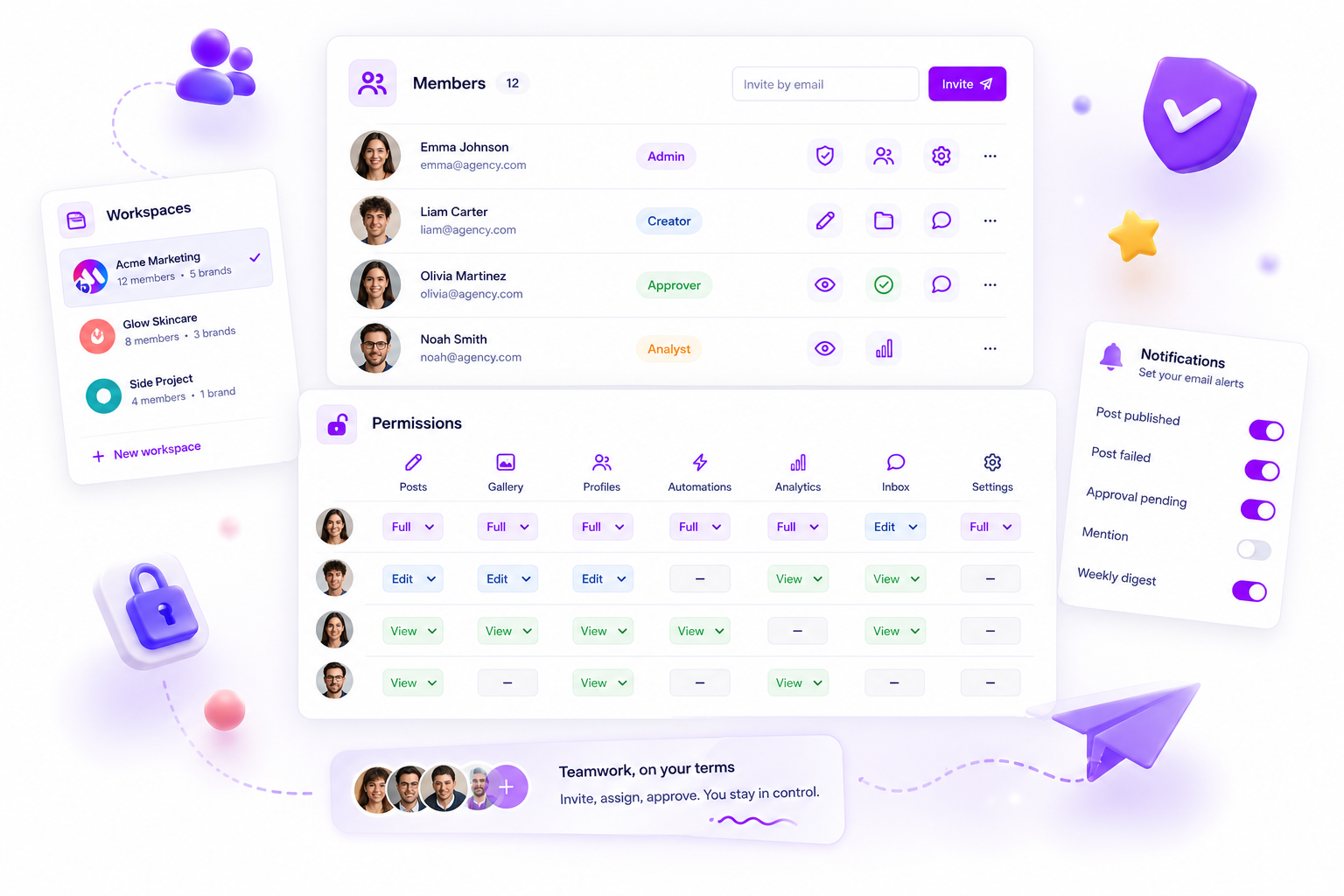
Most social media handoffs fail because of a Permission Gap where the technical permissions in your workspace do not actually match the human responsibility of your team members. It is not that your team isn't communicating or that your Slack channel is too noisy; it is that the person who needs to hit "Approve" literally doesn't have the button. When content stalls between a draft and a live post, it is usually configuration debt, not a lack of creative direction. You fix this by aligning your software resource action maps with your actual operating habits.
We have all been there on a Friday afternoon. The creative is brilliant, the client gave a thumbs up in a comment, and everyone is ready to sign off. But the post sits in limbo because the only person with the posts:approve toggle is currently on a flight or stuck in a meeting. It makes the team look disorganized, it frustrates the client, and it is an exhausting way to spend your final hour of the week. You are not alone in this, but you also do not have to live this way. By auditing your Mydrop resource action maps, you can identify exactly where permissions are choking your speed and reconfigure roles so that "Handoff" finally means "Done."
What changed before the numbers moved

The awkward truth is that many managers "trust" their team to lead but keep their software permissions so locked down that they inadvertently become a 24/7 bottleneck. We call this Technical Micro-management. It is rarely intentional, but it is a silent killer of team velocity. When you are managing dozens of brand profiles across multiple markets, you cannot be the only person with the keys to the kingdom. If your approval process requires you to personally log in to fix a typo before a post can go live, you have not built a workflow; you have built a cage.
At Mydrop, we see this pattern often: teams have the creative talent to move fast, but their technical roles act like a speed limiter. Before you can see your engagement numbers or reach move, your "velocity to publish" has to improve. This requires moving away from generic titles like "Editor" or "Contributor" and looking at the specific actions required at every stage of the handoff.
The Handoff Audit Checklist
| Workflow Stage | Resource | Required Action | The Bottleneck |
|---|---|---|---|
| Agency Drafting | posts |
create, update |
Manual copy-pasting from external docs |
| Asset Management | gallery |
create, read |
"Can you upload this for me?" Slack pings |
| Client Review | posts |
approve |
Friday 5:00 PM stalled drafts |
| Team Growth | workspace |
inviteMembers |
Freelancers sitting idle for 48 hours |
This is the part most teams underestimate. A simple rule helps: permissions should follow the "last mile" of the job. If someone is responsible for the final look of a post, they need the toggle that makes that look permanent. Moving from a culture of "ask for permission" to "task-based permissions" is the first step toward getting your Friday afternoons back.
The failure patterns to check first

Handoffs do not break because your team is lazy or disorganized. They break because the software is telling a different story than the org chart. In our experience, these breakdowns usually fall into four "clogged pipes" that you can spot in about five minutes.
The Approval Bottleneck is the most common velocity killer. Your team fixed the typo, swapped the link, and the creative is perfect. But because they lack the specific posts:approve permission, that thirty-second fix has to go back into a manual review queue for a manager who is currently in a back-to-back meeting. We call this "Technical Micro-management." It is rarely intentional, but it ensures that nothing moves without a high-level sign-off on the smallest details.
The Gallery Gatekeeper produces a different kind of friction. If you see "Quick, can someone upload this PNG for me?" messages in Slack, you have a permission gap. When creative teams are blocked by gallery:create restrictions, they stop using your central library. Instead, they start sending assets via DM or email, and suddenly your version control becomes a crime scene.
The Invitation Lag is an onboarding tax. A new freelancer starts on Monday, but they do not get into the workspace until Wednesday because the lead operator lacks workspace:inviteMembers access. If your day-to-day leads cannot manage their own team's access, your operational velocity will always be 48 hours behind reality.
Notification Blindness is the final hurdle. Sometimes the permissions are perfect, but the lights are off. If notificationsSettings:email are toggled off for critical events, your content sits in the "Ready" state for hours simply because no one got the digital tap on the shoulder.
Operator rule: If a task takes longer to hand off than it does to execute, your permission map is the bottleneck, not your team's talent.
The proof that separates signal from noise
To fix a failing handoff, you have to stop thinking about generic "Roles" like Manager or Contributor. A job title does not get a post published; a specific resource action does. You need to align your technical "can perform action" logic with the actual human responsibility of each team member.
Here is the audit matrix we use to help teams diagnose where their speed is leaking. Use this to check your current setup against the reality of your daily workflow.
| Workflow Stage | Required Permission | Diagnostic Check (The "Pain") |
|---|---|---|
| Content Drafting | posts:create, gallery:read |
Are drafts living in Google Docs because the platform feels too "locked down"? |
| Asset Management | gallery:create, gallery:update |
Does your design team have to ask someone else to upload the final files? |
| Stakeholder Review | notes:create, posts:read |
Are you still chasing feedback in email threads instead of directly on the post? |
| Final Sign-off | posts:approve, posts:update |
Are "Ready" posts sitting in limbo for 4+ hours waiting for a specific person? |
| Ops Maintenance | workspace:inviteMembers |
Do you have to wait for a VP to grant access to a new freelancer or agency partner? |
Most teams realize they have been inadvertently gatekeeping the very actions their team needs to be autonomous. By auditing your Mydrop resource action maps, you can move away from the "Trust vs. Toggle" paradox. You can trust your team to lead while giving them the technical toggles they need to actually do the work. When the "Approve" button is held by the person actually responsible for the deadline, "Handoff" finally starts to mean "Done."
What to fix this week
Stop looking at job titles and start looking at your Action Map. In a high-speed agency or enterprise environment, "Marketing Manager" is a title, but posts:approve is a capability. If those two things do not line up in your workspace settings, your handoff will fail every single time.
We have seen this across hundreds of workflows: teams lose 48 hours not because people are lazy, but because the software is literally preventing them from being helpful. You can fix most of this in about ten minutes by running a targeted audit of your permissions.
Here is the 60-second audit you should run on your Settings > Members and permissions screen this week:
| Workflow Stage | Required Resource Key | The "Symptom" of a Gap |
|---|---|---|
| Creative Sync | gallery:create |
"Can you upload these assets for me?" messages in Slack. |
| Final Review | posts:approve |
Content is marked "Ready" but no one can click the schedule button. |
| Last-Minute Edits | posts:update |
A typo is found, but the editor is "View Only" and can't fix it. |
| New Hires | workspace:inviteMembers |
Freelancers sit idle for two days waiting for an invite link. |
| Crisis Management | profiles:delete |
The team can't disconnect a compromised account without a lead. |
If you find a gap, do not just "give everyone Admin." That is the digital equivalent of giving every house guest a master key to the building. Instead, update the specific member resource map for that role. When a freelancer finishes a draft, they should have the permission to move it to the next stage, but perhaps not the permission to hit "Publish" on a holiday campaign.
Decision check: A handoff is only successful if the recipient has both the context to understand the task and the toggle to complete it.
When to stop diagnosing and change the workflow
Sometimes the problem isn't the software; it's the architecture of your team. If you have audited your permissions and the bottlenecks persist, you are likely dealing with Technical Micro-management. This happens when a leader "trusts" their team in meetings but refuses to grant the posts:approve permission in the tool.
You know you have reached this point when your Mydrop notification inbox is a graveyard of "Approval Requested" pings that you don't have time to open. At this stage, you need to stop tweaking buttons and start delegating authority.
Ask yourself: What is the worst thing that happens if this person clicks 'Publish' without me?
If the answer is "a minor typo," give them the permission. If the answer is "a multi-million dollar compliance fine," keep the lock on, but hire a dedicated Compliance Reviewer who has nothing else to do but click that button. The worst possible workflow is the one where the busiest person in the company is the only one who can move a post from "Draft" to "Scheduled."
Efficiency isn't just about granular permissions; it's about the courage to let go of the "Approve" button. If your workflow requires more than three pairs of eyes on a standard Instagram story, you aren't running a social team; you're running a committee. Committees do not win at social media.
Conclusion
Social media at scale is a game of coordination, not just creativity. When handoffs fail, it is usually a sign that your human trust hasn't been translated into your technical infrastructure. By aligning your resource action maps with the actual responsibilities of your team, you remove the invisible friction that turns a simple post into a week-long project.
The goal of a tool like Mydrop isn't to create more "work about work." It is to make the infrastructure of your team so seamless that the "Approve" button feels like a natural extension of a job well done, not a gatekeeper standing in the way of a Friday evening. Fix the gap, update the role, and let your team do what you hired them to do: ship great work.