
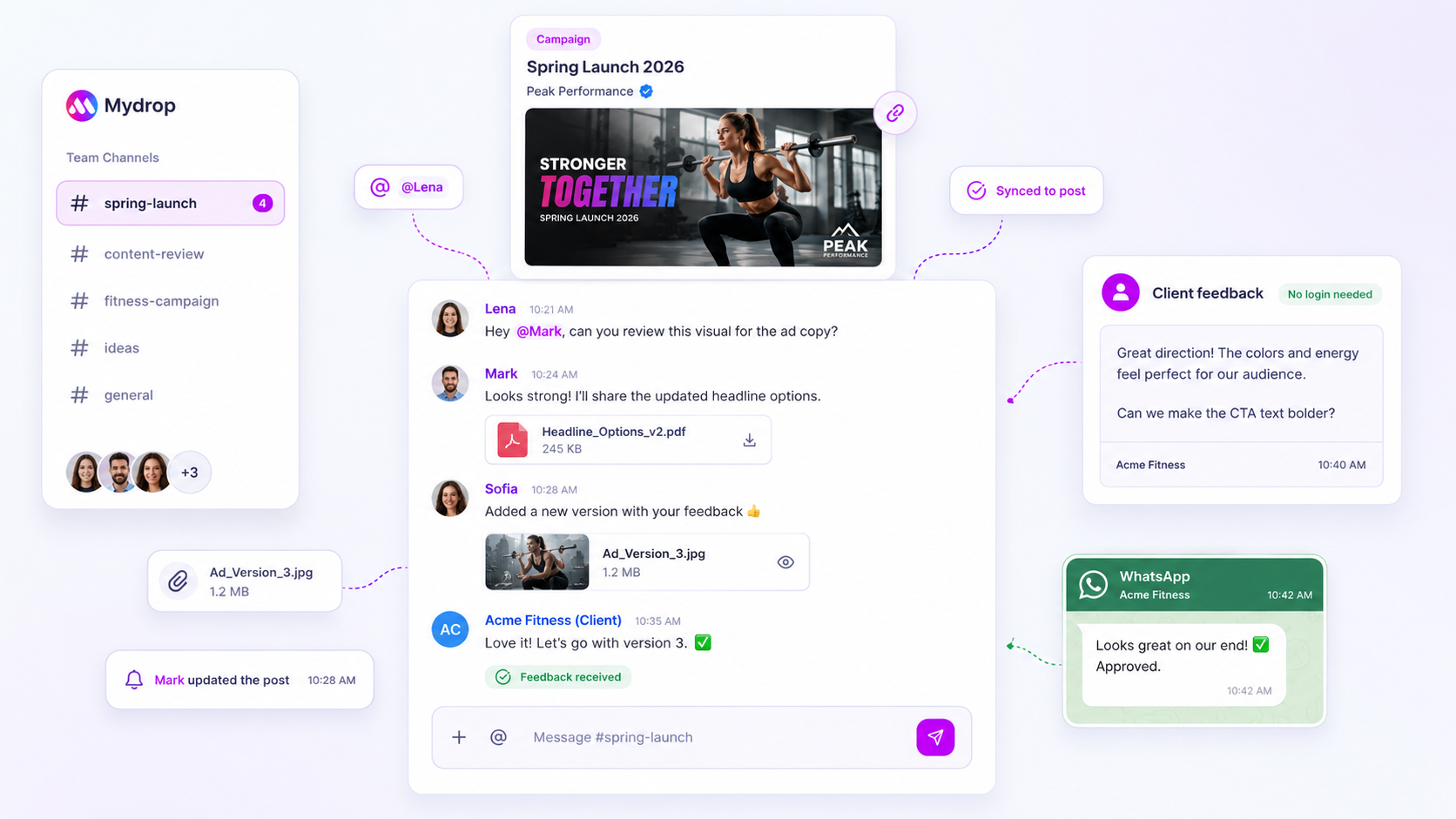
The best way to evaluate creative concepts at scale is to capture your qualitative feedback directly within the same interface where you schedule your posts. If your review notes live in a separate app or a buried email thread, you are essentially building a wall between your decision-making process and your execution timeline.
We get it. You are juggling a dozen stakeholders, brand guidelines that shift by the quarter, and a calendar that never stops. When a creative concept gets rejected at 5 p.m. on a Thursday, the "why" is clear in your head. But three weeks later, when you are staring at a revised version, that reasoning has vanished. You end up wasting time re-litigating old ground because the institutional memory of the no didn't stick to the what.
The awkward truth is that most teams treat quick notes as disposable scraps, but in enterprise creative, those notes are the only audit trail of why a campaign pivoted. If your tool separates the note from the calendar context, you are forced to spend hours manually reconciling feedback later.
What the best tools need to handle

Beyond basic text capture, your note-taking layer must function as a bridge between the abstract idea and the concrete publishing schedule.
- Contextual Proximity: A note is only useful if it is visible when you are actually working on the calendar. If you have to click away to a notepad app or search through a messaging platform, the friction is too high. You need a setup where the notes live alongside the scheduling board.
- Permission-Gated Access: Enterprise teams involve many hands. You need a system that allows senior leads to leave feedback while ensuring that external partners or agency stakeholders see only what is relevant-or nothing at all.
- Persistent State: Notes must survive beyond the immediate session. They should remain attached to the project context so that if a campaign is paused and revisited months later, the original creative critique is still there.
- Optimistic UI: When you are moving fast, you cannot wait for a server handshake to confirm every typed sentence. The best tools capture your thoughts instantly and handle the sync in the background.
Operator rule: If your feedback loop requires a context switch of more than five seconds, your team will eventually stop using it for anything other than trivial notes.
Here is how different tools stack up when you put them to the test:
| Feature | Generic Sticky Notes | Email/Messaging | Mydrop Notes |
|---|---|---|---|
| Workflow Proximity | Low (disconnected) | Low (fragmented) | High (embedded) |
| Audit Trail | None | Difficult to query | Project-linked |
| Permission Control | None | Manual/Risk-prone | Role-based |
| Searchability | Poor | High noise | Context-aware |
Ultimately, a "quick note" tool is a compliance mechanism in disguise. If you cannot link the "this doesn't match our visual identity" comment directly to the specific creative iteration in your workflow, you aren't managing a brand; you are just chasing ghosts in your inbox.
Where basic tools start to break

Here is the awkward truth: most teams treat quick notes as disposable scraps of paper, but in a high-stakes campaign, those notes are the only record of why a million-dollar pivot happened. When you rely on generic note apps or email threads, you inevitably end up with a "Note-Taking Graveyard." You capture the feedback, but it lives in a silo, completely divorced from the active creative asset.
When the time comes to check if a change was actually applied, your team has to play digital detective. They are switching apps, searching through endless thread histories, and hoping they find the right version of the feedback before the deadline hits. This constant context switching is where your team’s momentum quietly dies. It creates a massive visibility gap-when notes aren't linked to the project, they cease to be institutional knowledge and instead become unsearchable clutter.
Common mistake: Relying on tools that don't support contextual proximity. If you have to leave your calendar to find the note, your team will eventually stop checking the note at all.
The buying criteria that matter
Stop evaluating tools based on their "design aesthetic" or "feature count." Instead, judge them by how they minimize the friction between your brain and your calendar. For an enterprise team, the tool is only as good as its ability to keep the intent visible right at the point of decision.
The Creative Feedback Scorecard
Use this rubric to pressure-test your current stack. If your tool scores poorly on Auditability or Sync Speed, you are leaking time on every single creative review.
| Feature | Low-Value Tool (e.g., Docs/Slack) | High-Value Tool (e.g., Mydrop) | Why it matters |
|---|---|---|---|
| Contextual Proximity | Separate app/tab | Live in Calendar | Feedback must hit you when you are scheduling. |
| Permission Control | All or nothing | Granular/Stakeholder-gated | Prevents unauthorized feedback cycles. |
| Auditability | Lost in threads | Persistent, searchable log | Proves why decisions were made post-campaign. |
| Sync Speed | Manual re-entry | Optimistic real-time updates | Keeps the team in sync, not waiting for refreshes. |
When you look at this, the goal isn't just "taking notes." It’s maintaining a persistent audit trail for your creative intent. At Mydrop, we see this pattern constantly: teams that keep their notes as "connective tissue" directly within their planning workspace are the ones who move faster and encounter fewer compliance surprises.
Decision check: A note without an anchor is just a guess. If your tool doesn't let you attach feedback to a specific creative iteration or calendar slot, you aren't managing a brand-you are just chasing emails.
The 4-Point Note Audit
Before you commit to a new workflow, run your candidate tool through this check. If it fails even one, you will end up with an unmanageable mess within three months of a heavy campaign cycle.
- Persistence: Does the note live inside the project workspace, or does it vanish into a personal folder?
- Visibility: Can you see the note without leaving your primary planning view?
- Governance: Can you restrict edit access so only the right stakeholders influence the creative direction?
- Recall: Is the note searchable via the project or campaign name without manual tagging?
Most teams don't have a creative problem; they have a coordination bottleneck. By treating your quick notes as a core part of your infrastructure rather than ephemeral scrap paper, you regain control over the chaos.
How Mydrop supports this workflow
At Mydrop, we observed that teams managing hundreds of brand profiles often lose the "why" behind a campaign pivot simply because it is trapped in a disconnected note app. We designed our Notes feature to be the missing link in that chain. Rather than treating notes as isolated digital sticky notes, we integrated them directly into your Calendar and Home dashboard.
When you are reviewing a creative concept, you don't want to hunt through bookmarks or search history. You want to see the feedback right where you decide to approve or reject the asset. By anchoring notes to your planning interface, you ensure that the qualitative reasoning stays attached to the work itself. When your team logs in to check the calendar, they see the context-not just the scheduled date-allowing for faster alignment across distributed teams.
Workflow check: If your feedback doesn't live within one click of the calendar date, you aren't maintaining a creative history; you are building an unsearchable archive of lost context.
A simple shortlist checklist
Use this four-point audit to pressure-test any tool you are currently using for creative feedback. If you cannot check all four boxes, your creative process is likely leaking valuable institutional memory.
| Criterion | What to look for | Why it matters |
|---|---|---|
| Contextual Proximity | Does the note live inside the planning view? | Prevents "alt-tab fatigue" and context loss. |
| Permission Control | Can you limit who sees specific feedback? | Keeps sensitive internal discussions private. |
| Auditability | Is the note timestamped and linked to the concept? | Essential for resolving "why did we change this?" disputes. |
| Sync Speed | Does it save instantly as you type? | Ensures you never lose a fleeting thought during a rapid-fire review. |
Beyond the table, run this quick 4-Point Note Audit during your next sync:
- Visibility: Can your creative lead see the note without leaving their primary planning dashboard?
- Access: Does the tool automatically respect your team roles, or do you have to manually update share settings for every new note?
- Intent: Does the note capture the rationale (e.g., "rejected due to seasonal pivot") rather than just the action?
- Recall: Can you find this note in three months when a similar concept comes up for review?
Conclusion
The reality of enterprise creative work is that you are rarely fighting a lack of talent; you are fighting the friction of communication. Every time a reviewer has to switch context to explain a rejection, you lose a little more clarity and momentum. The goal isn't to capture more notes-it is to capture the right notes in the place where decisions actually happen.
If you want to stop chasing email threads and start building a reliable history of your brand's creative direction, look for a tool that treats your notes as first-class citizens in your workflow. Your creative team will appreciate the clarity, and your future self will thank you when it comes time to audit your campaigns. The best creative review is one where the context is as visible as the deadline.