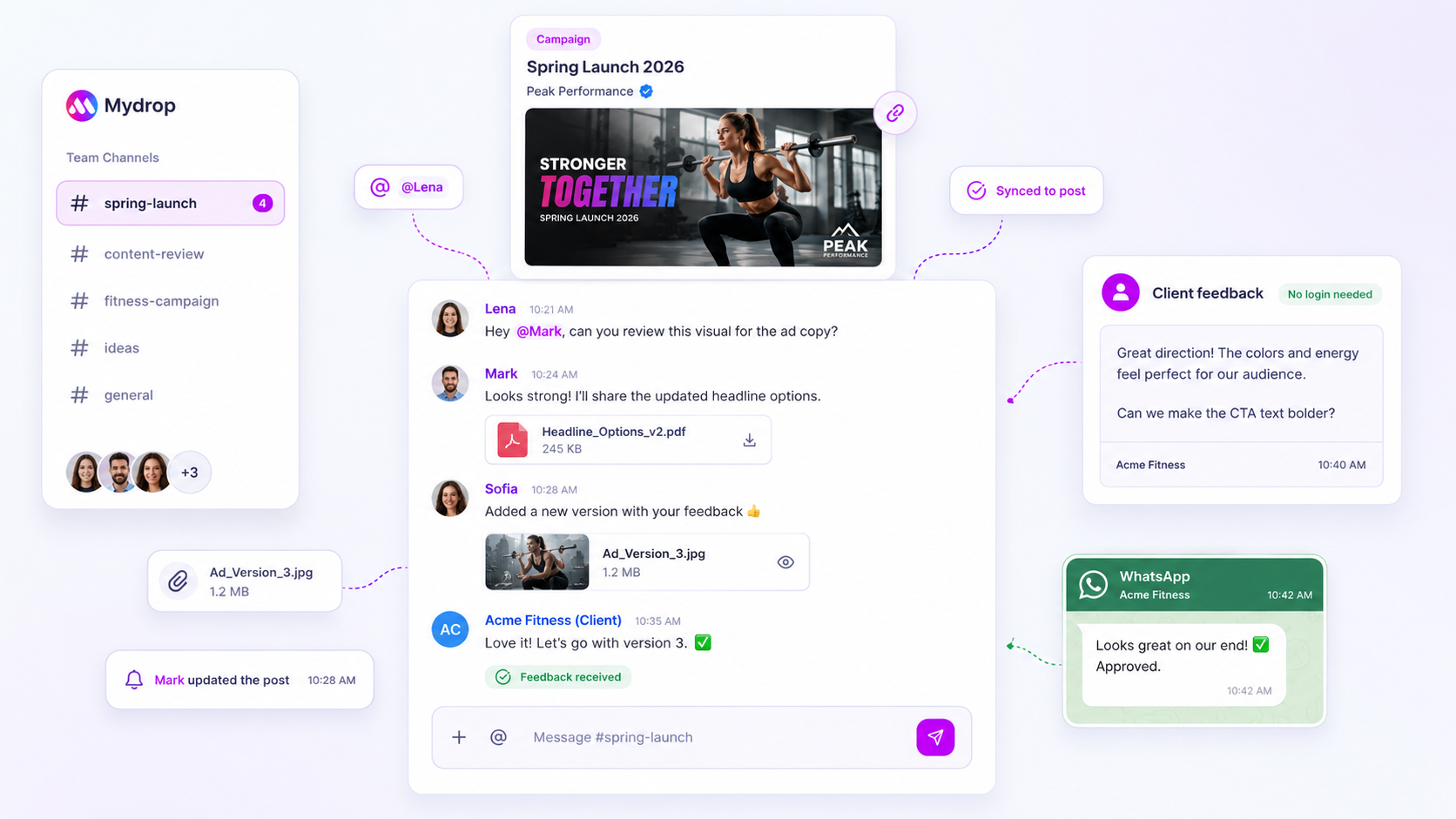
The best way to stop losing brilliant campaign ideas is to move your note-taking out of generic, disconnected apps and directly into the heart of your execution calendar. When you are managing high-frequency social feeds for multiple brands, the biggest threat to your velocity is not a lack of creativity, but the "coordination debt" created by jumping between tools to log an idea. If you have to switch tabs, wait for an app to load, or copy-paste text between a scratchpad and your planning board, you have already lost the moment.
We know the feeling of scanning your calendar for a gap, having a sudden realization about a new content angle, and then watching that spark fade while you struggle to find the right document or Slack channel to store it. This work is inherently messy, and your tools should act like a safety net, not a hurdle. By anchoring your capture workflow to your primary workspace, you turn "quick notes" from a source of clutter into a reliable asset for your next brainstorming session.
What the best tools need to handle

The goal of a creative capture tool in an agency setting is simple: minimize the friction between a raw thought and a usable plan. If your tool fails here, your team is likely dealing with "idea rot," where excellent concepts are buried in fragmented storage because they were too cumbersome to organize at the time.
A high-performance capture loop requires more than just a text field. It demands a workflow that respects how creative work actually happens in a fast-paced agency.
Operator rule: If your team has to leave the calendar to capture an idea, that idea will eventually become a ghost. It stops being actionable and starts being an item on a "to-do" list that no one has time to clean up.
When auditing your current setup, look for these three critical operational signals:
- Zero-latency entry: You should be able to trigger a note from your current view without closing your browser tab or losing your scroll position on the calendar.
- Persistent visibility: Notes shouldn't just disappear into a database. They need to live where your planners look every day-usually on a home board or directly pinned to relevant campaign dates.
- Contextual readiness: Ideas often arrive in a vague state. The best tools let you capture the "what" now, while providing an easy way to attach the "who" and the "where" (brand or campaign) later, without moving the data to a new file.
Most teams struggle because they treat notes as a separate bucket, isolated from the reality of the publishing schedule. At Mydrop, we built our notes to live as a native extension of the Calendar and Home board because that is where the decision-making actually happens. By keeping notes in the same ecosystem as your assets and approvals, you ensure that a passing thought stays tethered to the project it belongs to, rather than becoming just another line item in a disconnected document.
Where basic tools start to break

Here is the awkward truth: generic note apps are coordination graveyards. We have all been there-you draft a brilliant hook for a campaign, save it in a general-purpose tool, and two weeks later, you cannot remember which folder it is in, or if it was even approved.
The trouble isn't the app itself; it’s the context gap. When your brainstorming tool is disconnected from your execution calendar, every note requires a mental "gear shift." You aren't just capturing an idea; you are manually logging a task to copy that idea into the calendar later.
This is where agency teams fail. They treat notes as passive storage rather than active campaign fuel. When ideas live in a silo, they inevitably lose their urgency. By the time someone manually moves the note into the content calendar, the spark is gone, the timing has shifted, and the "coordination debt"-the energy spent just moving information between tabs-has ballooned.
Common mistake: Using a single, universal "master notebook" for every client. Across hundreds of profiles, this quickly becomes an unsearchable mess where high-value campaign concepts are buried under random meeting minutes.
The buying criteria that matter
Stop looking for more "features" and start looking for proximity. The only way to move at the speed of social is to collapse the distance between thinking and planning. If you have to switch windows to save an idea, you have already lost.
When evaluating your current stack, apply this simple audit. If your tool fails these three tests, you are paying a hidden tax in lost velocity every single day.
| Criteria | The "Tab-Switcher" Penalty | The "Proximity-First" Standard |
|---|---|---|
| Capture Latency | 3-5 clicks, multiple windows. | Single-click from the calendar view. |
| Idea Visibility | Hidden in folders or search bars. | Always surfaced on your primary dashboard. |
| Stakeholder Access | Requires "copy-paste" or emails. | Permission-gated read-only sharing. |
The Operating Scorecard
Use this scoring rubric to pressure-test your current setup. Rate your tool from 1 (broken) to 5 (native flow). If you score below a 15, your creative team is fighting their own infrastructure.
- Calendar Integration (1-5): Can you create a note directly from the calendar slot without losing sight of the monthly view?
- Home Board Recall (1-5): Are your most recent ideas automatically waiting for you on your home page when you log in?
- Collaborative Hygiene (1-5): Can you grant read-only access to external stakeholders without them seeing your messy, unpolished draft notes?
The winning move is to treat notes as a lightweight layer on top of your calendar. At Mydrop, we built our Notes feature specifically to solve the "lost spark" problem. Because they live inside the same environment as your publishing workflow, you can capture an idea while looking at a Tuesday post and know exactly where it belongs. It removes the need to maintain a separate "idea bank," turning your planning board into a living, breathing creative engine.
Decision check: If your current "quick note" tool requires more than three seconds to find and open, it isn't an efficiency tool-it’s an obstacle to your team's creative output.
How Mydrop supports this workflow
At Mydrop, we built our Notes feature because we watched too many teams waste thousands of hours switching between "idea storage" apps and their actual work calendars. When you are coordinating across dozens of brand profiles and hundreds of stakeholders, the friction of clicking into another tool-only to copy-paste an idea back into a social calendar-is exactly where creative momentum dies.
Our approach is built on proximity. You can create a note directly from the Calendar view or the Create menu, meaning your scratchpad lives right next to your publishing schedule. It is designed to be lightweight, persistent, and accessible. You aren't managing another document repository; you are simply capturing the "raw material" of your next campaign without leaving your workspace. Because these notes surface automatically on your Home board, you stop losing track of those high-intent ideas that usually get buried in Slack or long-form docs.
Decision check: If your team has to open a separate app to remember what you discussed in a meeting, your planning tool isn't fully integrated.
A simple shortlist checklist
Use this framework to evaluate whether your current setup is actually serving your creative velocity or just adding another layer of administrative overhead. If you cannot check off at least four of these, your creative workflow is probably leaking value.
| Capability | Requirement for High-Frequency Teams |
|---|---|
| Calendar Mapping | Can you attach or view a note while looking at your live publishing schedule? |
| Instant Capture | Does the tool capture inputs instantly, without loading heavy document editors? |
| Permissioning | Can you keep ideas visible to the wider team in read-only mode to maintain alignment? |
| Centralized Recall | Does your home screen automatically surface recent ideas without a manual search? |
| Optimistic Sync | Does the tool save your progress immediately, even if your connection is momentarily spotty? |
Conclusion
The difference between a frantic social team and a high-functioning one rarely comes down to better brainstorming. It comes down to coordination hygiene. When you remove the friction of capturing ideas, you stop treating creative strategy as a separate, detached task and start treating it as part of the daily operational flow.
Stop letting your best ideas evaporate into the void of disconnected apps. Audit your current workflow this week, identify where the "tab-switching" tax is hitting you hardest, and move your capture process closer to the point of execution. Your campaign calendar is the source of truth for your brand; your notes should be the living, breathing, and easily accessible heartbeat of that same calendar. Start small, stay close to the work, and stop building silos where your best content is meant to be born.