The best collaboration tool isn't the one with the most bells and whistles; it’s the one that eliminates the "where was that feedback?" tax by anchoring every comment directly to the asset, whether the stakeholder is an internal team member or an external client. We’ve all been there: you’ve spent three days crafting the perfect campaign, only to have the approval process turn into a scavenger hunt through scattered email threads, frantic Slack messages, and hidden spreadsheet comments. It’s exhausting, messy, and the primary reason creative momentum dies.
You aren’t alone-most teams are running on a broken loop. If your feedback isn't happening in the same digital space where the creative lives, the approval loop will inevitably stall. This audit helps you identify the specific communication leaks in your current process and provides a framework for selecting a tool that bridges the gap between client feedback and actionable creative updates.
| Leak Point | Symptom | Impact |
|---|---|---|
| Fragmented Channels | Feedback split across email/chat/PM | 2-4 hours lost manual reconciliation per week |
| Auth Barriers | Client must register to view/approve | 24-48 hour delay per feedback cycle |
| Detached Comments | Text notes decoupled from specific asset | 30% increase in revision requests |
| Vague Alerts | Generic "comment added" notification | High probability of missed critical feedback |
What the best tools need to handle

The awkward truth is that most tools actually increase friction. They force stakeholders to jump through authentication hoops or switch platforms just to say "make the logo bigger." This creates silos that kill your turnaround speed.
To fix this, you need Contextual Collapsing. Feedback must live exactly where the creative lives. If an external client or a busy stakeholder has to log into a portal, remember their password, and navigate a complex dashboard, they simply won’t-or at least, not fast enough.
Here is what you should demand from your collaboration stack:
- Unauthenticated Participation: The tool must allow external stakeholders to leave feedback via a secure, shared link without requiring a full user account. At Mydrop, we see this constantly; the moment you remove the account barrier, feedback speed often triples because you are meeting stakeholders where they are, not forcing them into your login flow.
- Asset-Linked Conversations: Comments cannot be generic. They must be tethered directly to the post, asset, or video timestamp. If you have to ask "what post are you talking about?" you are losing, not collaborating.
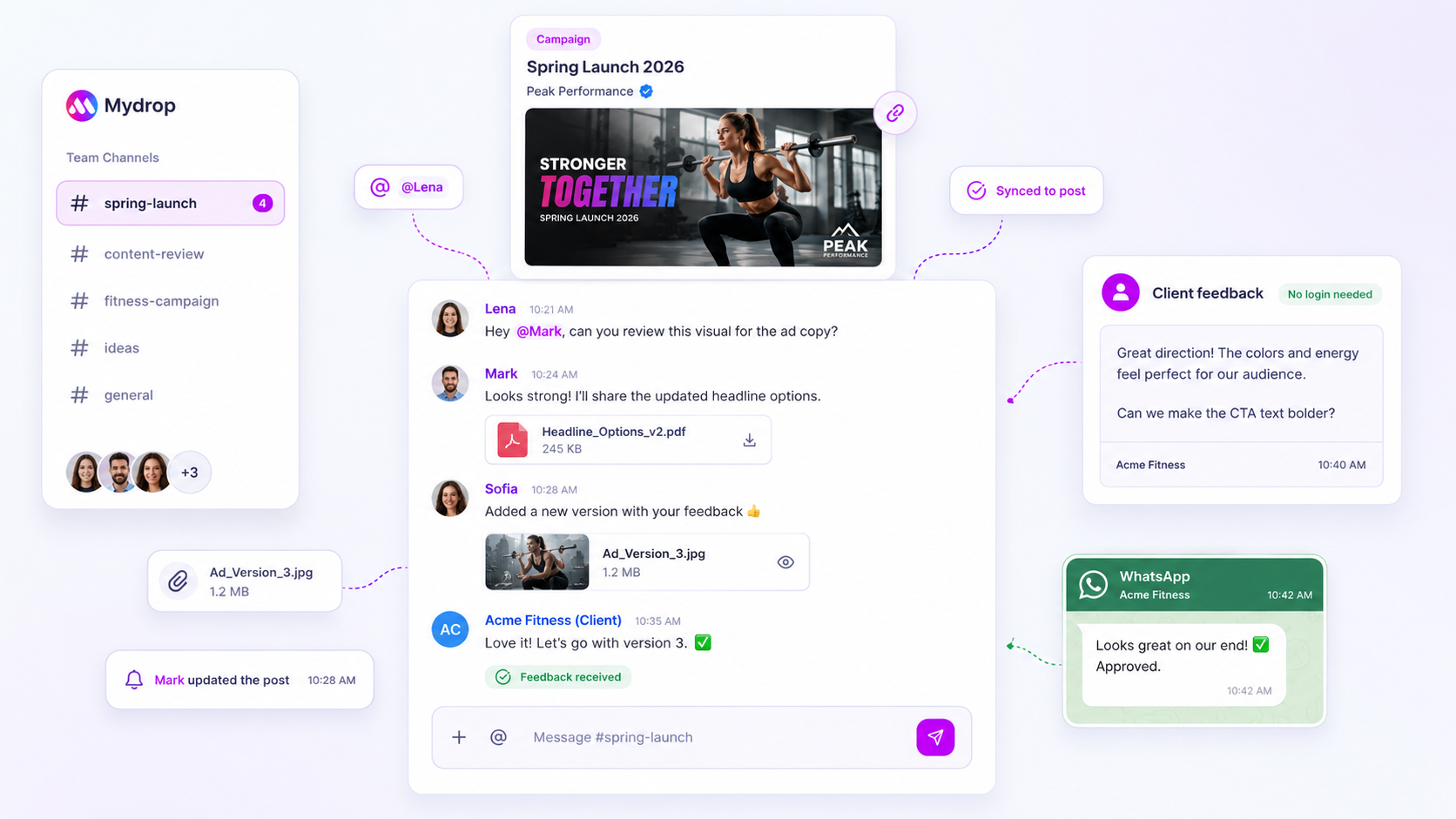
- Unified Conversation Stream: Your internal team’s chat should not live in a separate bucket from the client’s feedback. Ideally, these threads merge seamlessly. When a client comments on an approval link, that feedback should land directly in your workspace dashboard, ready for immediate action, with automated notifications ensuring no one misses the update.
This setup transforms your approval process from a game of tag into a simple, linear workflow. If your current tool forces you to manually move comments from an approval document into a task board, you aren't using a modern collaboration tool-you are effectively acting as a very expensive courier service for your own feedback.
Where basic tools start to break

When the approval process relies on email threads, Slack pings, or spreadsheet comments, the creative lifecycle doesn't just slow down-it fractures. You end up with "feedback silos" where the decision-maker, the creative team, and the external client are all looking at different versions of the truth.
The most common failure mode is context detachment. A client leaves a comment like "needs more energy" in a spreadsheet row that vaguely references "Campaign_V3_Final.mp4." Your team then spends thirty minutes trying to figure out if that comment applies to the current cut, the previous cut, or a cut that doesn't even exist yet. The account manager is stuck in the middle, playing a high-stakes game of "translation tag," trying to turn vague client requests into actionable creative briefs while the clock runs down toward a scheduled publish time.
It gets worse when you force stakeholders to log in. Requiring an external client to create a new account just to view a social draft creates an instant wall. They will either stop leaving feedback entirely, or they will bypass your process and send feedback via their own, unmonitored channels-usually just minutes before you were scheduled to publish. The result is almost always a frantic, last-minute panic to reconcile the "real" feedback with the "official" feedback document.
The buying criteria that matter
If you are evaluating tools to fix these bottlenecks, stop looking at features like "chat" or "comments" in a vacuum. Those are just table stakes. You need a platform that understands contextual collapsing: the act of merging communication, asset review, and approval into one persistent digital space.
Here is how we rank the impact of different collaboration features on your turnaround speed.
| Feature | Impact on Speed | Why it matters |
|---|---|---|
| Direct Asset Tethering | High | Prevents "Which version are we talking about?" debates. |
| No-Login Participation | Critical | Eliminates friction for external clients/approvers. |
| Smart Notification Fan-out | Medium | Keeps stakeholders updated without flooding inboxes. |
| Unified Internal/External Chat | High | Keeps one version of the truth across teams. |
When you look at this through an operational lens, the goal is simple: reduce the number of clicks between a client seeing a draft and the team executing a change. At Mydrop, we see the most successful teams prioritize portal accessibility and asset-linked conversations. This allows a client to click a link, see the post, leave a comment, and have that feedback instantly appear as a task for your team-without a single manual copy-paste job by an account manager.
Beyond just the mechanics of leaving a note, consider notification intelligence. A system that sends an email for every message is noisy; a system that groups notifications by asset or conversation thread is actionable. You need a setup that notifies the right stakeholders exactly when they need to see something, not one that inundates them with general alerts that get ignored by default.
If a tool doesn't bridge that gap between the external feedback surface and your internal workspace, you aren't really fixing the bottleneck; you are just moving the pile of work to a different platform. Don't fall for the trap of buying "more features." Buy the workflow that keeps the creative conversation from ever leaving the asset's side. If the feedback isn't happening right next to the creative, it’s not really collaboration-it’s just another form of administrative overhead.
How Mydrop supports this workflow
We designed Mydrop's Conversations feature with one goal: kill the scavenger hunt. When your designer, community manager, and client are all looking at the same asset, the feedback should not live in three separate apps or an endless email thread.
When you use Mydrop to share an approval link, your client does not need to hunt for a password or register for an account to leave a comment. They just click, see the post, and start typing. Those comments drop directly into your workspace dashboard in real time. Your team sees the feedback attached to the actual asset, not a detached cell in a spreadsheet.
This contextual collapsing-keeping the discussion in the exact same place where the creative work sits-is how you shrink a 48-hour approval loop into a 30-minute win. If the feedback is about a specific image element, the conversation is right there. If the client wants to change the copy, the comment anchors to the post draft. At Mydrop, we have seen thousands of marketing teams stop chasing down emails and start focusing on moving the campaign forward because the feedback is there the moment it lands.
Plus, you are not manually notifying anyone. When a client adds a comment in the brand portal, our system automatically fans out notifications to the relevant team members. It is not just about getting the feedback; it is about knowing exactly when the creative team needs to react, so they can keep the momentum going without waiting for you to copy-paste feedback into a Slack message.
A simple shortlist checklist
If you are assessing your current stack or shopping for something new, use this audit to decide whether a tool will actually make your life easier or just add another tab to your browser.
| Feature | The "Frictionless" Test |
|---|---|
| Client Access | Can they contribute feedback without a login hurdle? |
| Context | Are comments anchored to the specific asset? |
| Alerts | Do notifications link directly to the discussion? |
| Unified View | Is client and team feedback in one shared space? |
If you cannot check all four boxes, your process is leaking time. You can also run this quick manual check:
- Direct-to-Asset Feedback: When I click a comment, am I seeing the asset, not a vague task description?
- Guest Contribution: Can an external stakeholder participate without creating an account or managing a seat?
- Notification Clarity: Do alerts tell me exactly what needs attention before I click?
- Centralized History: Are all previous rounds of feedback still visible right next to the creative, rather than buried in a chat history?
Conclusion
Most teams do not have a content problem. They have a decision bottleneck.
If you are still asking your team to summarize feedback from an email thread into a task, you are manually creating work that your software should be doing for you. The goal is to spend less time managing the process and more time crafting the actual creative. Stop paying the "where was that feedback?" tax and start unifying your creative workspace. It changes everything-from your team's burnout levels to the speed of your campaign launches.