The only way to stop feedback bottlenecks is to move your conversations out of email and into a centralized, context-aware space that brings your external stakeholders directly into the work. You cannot solve a coordination problem by adding more communication channels. If your team is still juggling disjointed email threads and stray comments, you have not actually built a feedback system. You have built a bottleneck.
We have all been there. It is 4:45 PM on a Friday, staring at a campaign that should be live, but you are stuck in a frantic email thread searching for that one specific edit the brand manager requested on Tuesday. The stress of digging, the fear of missing a critical detail, and the inevitable last-minute rush are clear signals that your workflow is broken.
What the best tools need to handle

To end the cycle of chasing comments, you need a system that treats feedback as an asset, not a chore. The best tools do not just store comments. They anchor feedback to the specific post or asset, allow external stakeholders to chime in without forcing them through an authentication gate, and automate the notification loop so nobody has to manually chase down an approval.
Most teams do not have a content problem. They have a decision bottleneck.
When choosing a tool, you should audit your current leakage points. If you cannot answer these questions, you are likely losing time every single day.
The Feedback Fragmentation Audit
| Category | Failure Mode | Impact on Launch Velocity |
|---|---|---|
| Workflow Silos | Feedback is separated from the creative asset | 2 to 4 hours lost per campaign |
| Access Barriers | Approvers require account setup to comment | 12 to 24 hour delay in feedback loop |
| Context Loss | Comments arrive without visual reference | Frequent misinterpretation and re-work |
| Accountability Gaps | Decisions are scattered and unrecorded | Compliance risk and scope creep |
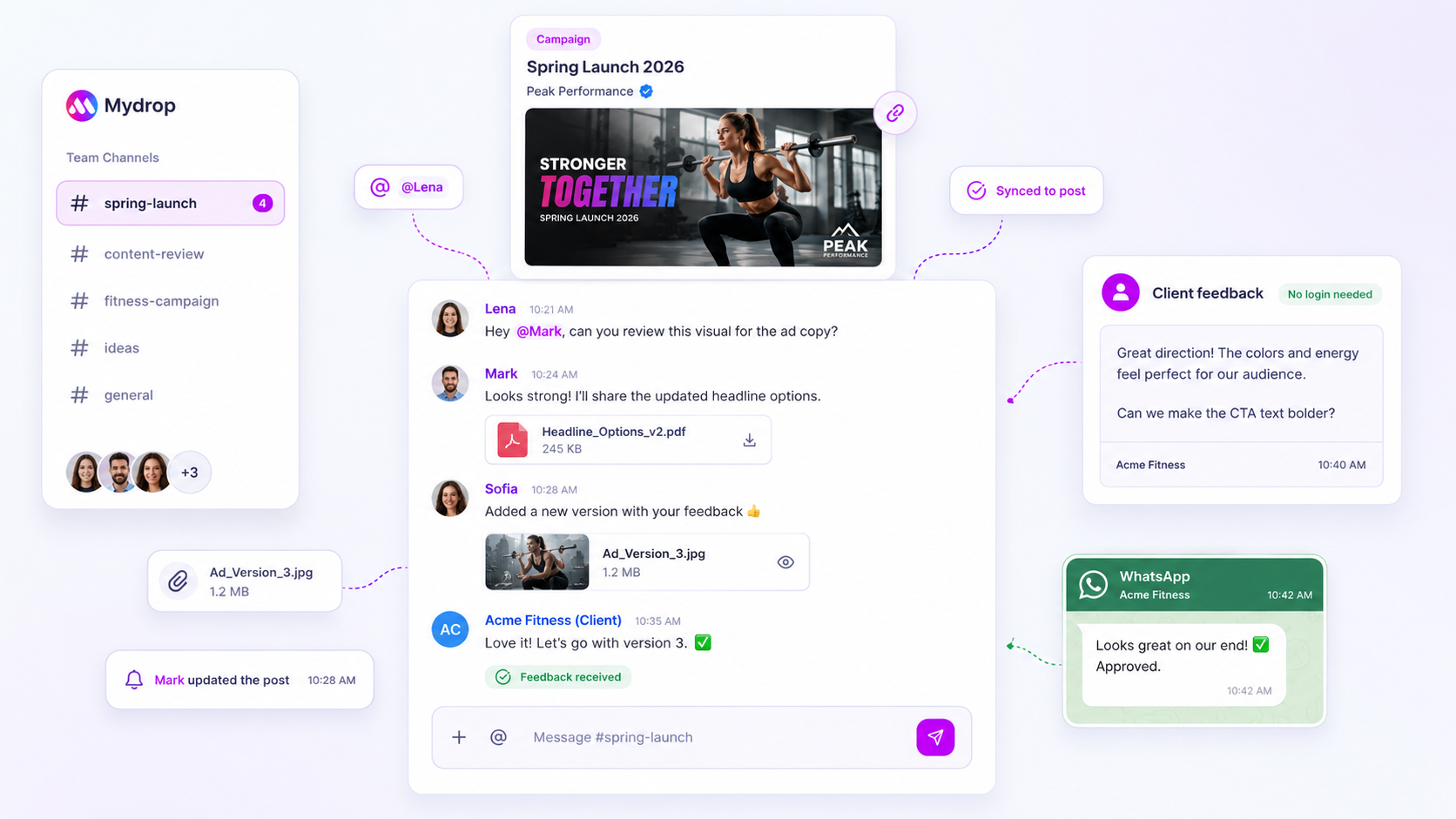
The goal is to move from collecting feedback to managing collaboration. This is where Mydrop’s Conversations feature changes the game. By allowing teams to bridge external approval feedback directly into the workspace without requiring clients to have a full account, it removes the biggest barrier to getting a final sign-off. When a collaborator leaves a note in the brand portal, it appears right alongside your team's internal discussion.
No more email threads. No more digging. Just a clear, timestamped record of exactly what needs to change, where, and why. This simple shift turns a chaotic, fragmented process into a structured, reliable pipeline. If a tool forces you to juggle multiple platforms, it is not serving your workflow; it is adding to it.
Where basic tools start to break

We have all lived the Friday 4:45 PM panic: a campaign post is stuck in limbo, and you are frantically searching through three different email chains, a dozen Slack messages, and a shared spreadsheet that has become a complete crime scene.
The problem is not that you lack communication tools; the problem is that you have too many of them. When your team relies on disparate channels to track approvals, you are effectively creating an untouchable feedback loop.
Here is where the breakdown usually happens:
- Context Stripping: When feedback happens in a generic chat app, the asset disappears. You get "Make the headline punchier" without a reference to which version of the asset or which specific frame they mean.
- Access Frictions: If your reviewer needs a login, they will avoid the tool. If they avoid the tool, they go back to email, and the feedback loop is severed again.
- Decision Ghosting: Decisions made in DMs are impossible to audit. When the brand manager claims they never approved the copy, you have no timestamped record to point to.
This is not just about inefficiency. This is coordination debt. Every time someone has to manually copy-paste comments from an email back into a content calendar, you are paying interest on that debt, and eventually, the cost is a missed launch.
The buying criteria that matter
When you stop looking for a "chat tool" and start looking for a collaboration framework, the buying criteria become clear. You need a system that forces structure without adding friction for the people who actually need to sign off.
If you are assessing tools, prioritize based on this Feedback Maturity Scorecard. You need the right-hand column for any platform to be viable at enterprise scale.
| Feature Category | Basic Approach (The Bottleneck) | Enterprise Approach (The Solution) |
|---|---|---|
| Feedback Location | Scattered (Email, Slack, Spreadsheets) | Unified Context (Linked to the asset) |
| Approver Access | Requires account/login | Guest-ready (Link-based, no login) |
| Decision History | Buried in chat history | Threaded & Audit-ready |
| Team Notification | Manual tagging (often missed) | Automated & Integrated |
Your tool must do more than just facilitate a message. It must anchor the conversation to the deliverable.
At Mydrop, we see the highest-performing teams prioritize client-safe collaboration above all else. This means your external partners or legal stakeholders should be able to comment on a draft via a secure link without needing a full-seat license. They should feel like they are "in" the conversation, while your team maintains the governance of the workspace.
If your current solution makes it harder for the reviewer to give feedback than it is for you to receive it, the bottleneck will never close.
Operator rule: If a stakeholder needs an instruction manual to leave a comment, you are not using a collaboration tool; you are using a request queue.
When you demand a centralized, frictionless model, the "Friday 4:45 PM panic" transforms. Instead of chasing ghosts in your inbox, you have a single source of truth that shows exactly who asked for what change, and exactly where that change sits in the production pipeline.
How Mydrop supports this workflow
The reason Mydrop fixes these bottlenecks is simple: it stops treating feedback like an afterthought. Instead of bouncing between email, Slack, and the actual asset, our platform ties the conversation directly to the creative. When an external client needs to approve a post, they do not get an email attachment or a complex login form. They use a brand portal to see the asset, and they can leave comments right there, directly on the work.
Those comments do not just sit in a vacuum. They bridge directly into workspace conversations, notifying your team instantly without requiring the client to have a full user account. This solves the primary source of the 4:45 PM panic: the feedback is where the asset lives, and the decision path is transparent. When a team member replies in the workspace, the client sees it in their portal, and the cycle continues until the post is approved.
Decision check: If your feedback loop requires a search action (finding that one email, checking that Slack DM from Tuesday), you have already lost the battle. Your tools should make the last decision visible to everyone without requiring a hunt.
At Mydrop, we see this work across thousands of brand profiles. When you remove the friction of logins and centralize the conversation, you don't just save time; you drastically reduce the chance of a "he said, she said" scenario during the final hour before a campaign goes live. You get a clear, timestamped record of every edit request and approval, which keeps your team compliant and your stakeholders happy.
A simple shortlist checklist
Most teams do not have a content problem; they have a decision bottleneck. Use this scorecard to audit your current stack. If your existing tools cannot hit the "Professional" criteria, you are essentially paying for a more sophisticated way to create friction.
| Requirement | Basic Tool (The Bottleneck) | Professional Tool (The Mydrop Standard) |
|---|---|---|
| Context Retention | Detached (Email/Spreadsheet) | Integrated (Comment on Asset) |
| External Access | Requires account/login | Secure guest link (No Login) |
| Notification Loop | Manual / Fragmented | Automatic / Threaded |
| Audit Trail | Search-dependent | Centralized / Persistent |
How to score yourself:
- 3 to 4 Professional: Your feedback process is likely scaling well. Keep refining.
- 1 to 2 Professional: You are approaching a breaking point. Expect launch delays as your volume grows.
- 0 Professional: You are operating in a high-risk zone. Every post launch is likely a frantic scramble.
If you are stuck at 0 or 1, you have a clear decision to make. You can either build a more rigorous manual process, which adds management overhead and drains your creative capacity, or you can switch to a tool that treats collaboration as a first-class feature rather than a secondary notification system.
Conclusion
The 4:45 PM panic is not a normal part of the marketing lifecycle, even if it feels like one. It is a symptom of a feedback process that has fractured under the weight of too many tools and too little context. When you move those conversations out of disjointed threads and into a centralized, context-aware space, you aren't just saving a few minutes of searching. You are reclaiming the velocity your team needs to actually hit their goals.
Don't wait for the next failed launch to realize your feedback process is broken. The difference between a smooth launch and a chaotic one is usually just a few fewer email threads.