The single mostYou shouldn’t be finding out your brand profiles are disconnected from a client’s angry email at 9 AM on a Monday. The fix isn't more prayer-it’s changing how your team measures connection health. The most effective metric for agency teams isn't just "connected or not"; it’s proactive time-to-expiry tracking combined with automatic sync frequency monitoring.
We’ve all lived through the 9 AM scramble, and honestly, it’s exhausting. When you're juggling dozens of client channels, waiting for a token to silently expire before you act is inviting unnecessary chaos. Let's get you out of the reactive cycle and into a predictable, manageable rhythm.
What the best tools need to handle

If your current tool only alerts you after a publishing failure, you’ve already lost. That’s a classic reactive bottleneck. To manage social operations at enterprise scale, you need a platform that treats OAuth tokens as live, expiring assets-not static credentials.
The best tools in this space do more than just facilitate the initial connection; they provide continuous, transparent visibility into the health of every single link in your network.
Here is the baseline checklist for evaluating whether your management platform is actually protecting your uptime or just waiting for the next breakage.
The Connection Integrity Checklist
| Feature | Why it matters |
|---|---|
| Proactive Expiry Alerts | Get notified before the token hits zero, not when posting fails. |
| Portal-Based Re-auth | Allows clients to re-connect profiles via a secure portal without sharing social passwords. |
| Multi-Profile Handling | Automatically handles OAuth provider responses that return multiple accounts via a safe staging area. |
| Permission Scope Stability | Detects when platform-side permission changes affect your publishing rights. |
At Mydrop, we see teams struggle most when they rely on manual spreadsheets to track token health. The spreadsheet becomes a crime scene after just a few weeks. Instead, we built pendingProfileConnections to handle those messy OAuth responses, ensuring you can review and confirm new accounts without cluttering your main dashboard.
The goal is to move from "firefighting mode" to "operational stability." You need to see the token owner status and have a clear path to re-authenticate without requiring a client’s direct login credentials. If your tool requires you to ask a client for their Instagram password, you’re not managing their social media; you’re managing a security risk.
Most teams do not have a content problem. They have a decision bottleneck-and that bottleneck starts the moment an account disconnects.
Where basic tools start to break

Most standard social media tools are designed to send you an email the moment the house is already on fire. They wait until an API token is officially dead before they notify you, which is the exact opposite of what you need when managing high-stakes client campaigns. You end up in a frantic, manual scramble to re-authenticate profiles while your team stands by, unable to publish. This reactive approach is where the coordination debt really piles up.
When you manage dozens or hundreds of channels, a single expired token is not just a nuisance. It is an operational bottleneck. You spend more time chasing down clients for access and re-running failed syncs than you do on strategy. If your tool does not provide granular visibility into when a token is approaching its expiration, you are effectively flying blind. The spreadsheet where your team tracks login credentials quickly becomes a crime scene, out of date and prone to security risks.
At Mydrop, we see teams struggle most when they treat OAuth as a binary: either it works, or it does not. The reality is that connection health exists on a spectrum. A token might be technically active, but if its permissions scope has been silently modified by a platform policy update, your publishing pipeline could still fail. Basic tools do not see these subtle shifts. They wait for a hard failure, forcing you to troubleshoot under pressure.
The buying criteria that matter
If you are evaluating tools for an agency or large team, you need to look past the core publishing features and examine the underlying governance model. You should be looking for a system that treats your client relationships with the same importance as your publishing schedule. The best tools move away from the "collect passwords" model entirely.
To make the right choice, evaluate prospective platforms against this capability scorecard.
OAuth Management Capability Scorecard
| Capability | Basic Management Tool | Enterprise-Grade Standard (e.g., Mydrop) |
|---|---|---|
| Expiry Visibility | Reactive alerts (only after failure) | Proactive monitoring (alerts 7, 3, 1 day out) |
| Auth Workflow | Requires password sharing | Portal-based (client connects via secure link) |
| Multi-Profile Handling | Manual one-by-one import | Bulk pendingProfileConnections review |
| Sync Integration | Disconnected (requires manual refresh) | Automated propagation to Inbox/Analytics |
| Scope Management | Opaque (permissions hidden) | Transparent (scopes verified on import) |
Decision Rule: If the tool requires you to ask a client for their social media password at any point, stop the evaluation. In an enterprise context, that is not a workflow; it is a security liability.
Your team should prioritize platforms that support portal-based connection flows. This allows your clients to authorize their own profiles directly through your branded interface, using their native OAuth provider consent screens. They never share a password with you, and you get the benefit of a clean, authenticated connection.
Furthermore, look for intelligent handling of multi-account OAuth returns. When a client connects a parent profile, some platforms return dozens of pages, groups, and sub-channels. A mature tool must allow your team to preview and confirm these imports using a staged workflow, like pendingProfileConnections, rather than forcing you to accept every profile returned by the API by default.
The final test is how the tool handles the "side effects" of a connection. When a profile is re-authorized, the system should automatically trigger a refresh for downstream services, including your analytics dashboard and the team inbox. This proactive propagation is what separates tools built for scale from those built for single-creator workflows. Most teams do not have a content problem; they have a connection maintenance problem. If your infrastructure does not automate the boring stuff, your best people will spend their best hours managing tokens instead of building brand value.
How Mydrop supports this workflow
At Mydrop, we built our connection layer with a single, unglamorous goal in mind: removing the human from the middle of the credential exchange. We have seen firsthand that password sharing is not just a security risk, it is an operational bottleneck that halts work the moment a client updates their security settings.
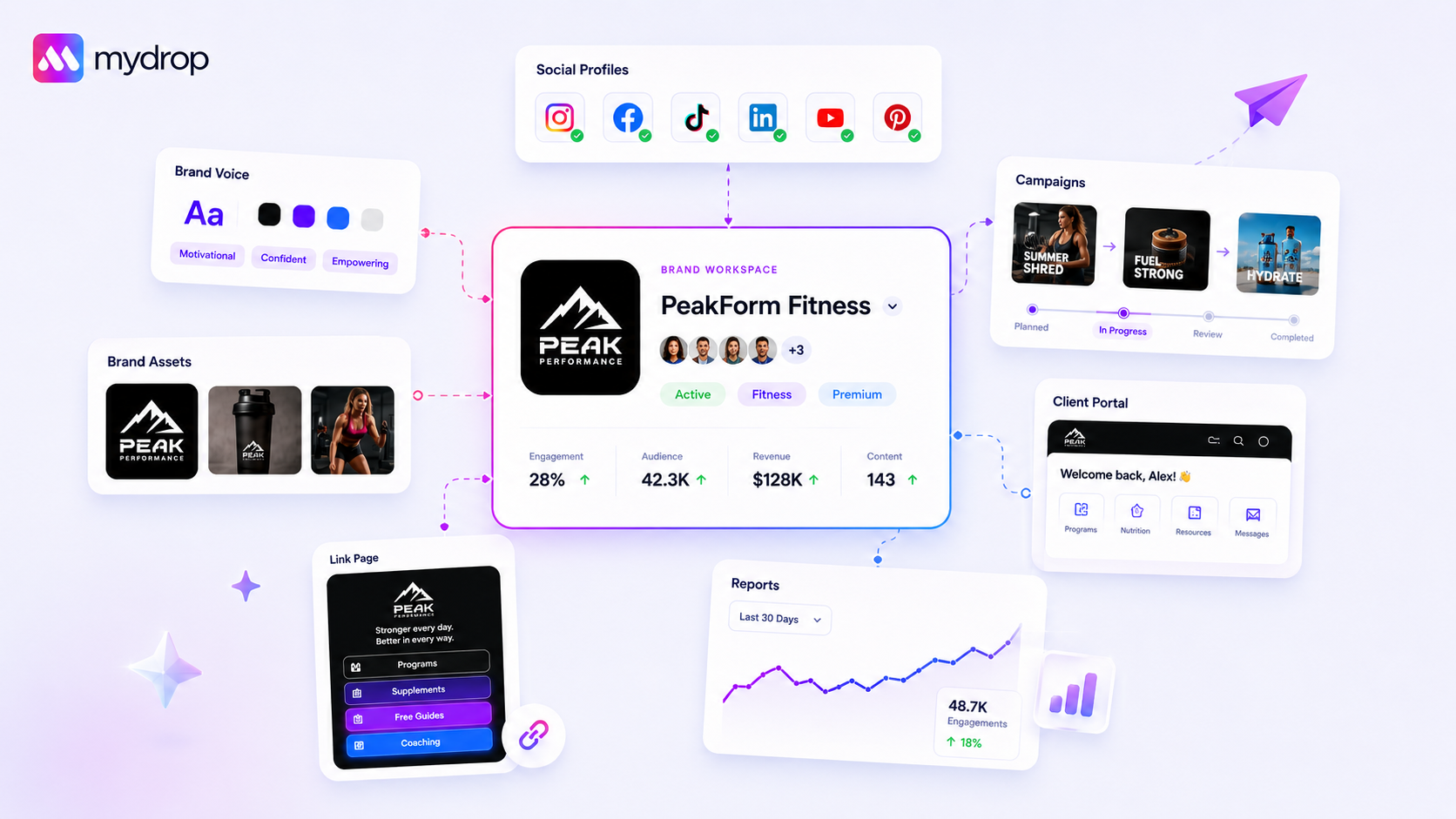
We address this through portal-based OAuth. Instead of your team chasing passwords, you send a link to your branded client portal. The client authenticates directly with the platform, and their permissions flow securely into your management suite. We handle the technical heavy lifting, like token storage and OAuth state, so you never have to ask for a password again.
To avoid the common issue of accidentally importing personal profiles or unused pages, we use pendingProfileConnections. When the provider returns a list of dozens of accounts, Mydrop pauses the import flow. You or the client get a clear, dedicated screen to preview and confirm exactly which profiles to activate before any record is created in our system.
We also treat token status as a first-class citizen. If a token is nearing expiry, it is not just a silent failure; the status propagates instantly. This alert surfaces across the analytics, inbox, and publishing modules. Your team knows exactly which client report or response thread is at risk before a single deadline is missed. This shift from reactive to proactive monitoring is how enterprise teams keep their operations humming across hundreds of brands.
A simple shortlist checklist
When evaluating new tools for your agency, use this scorecard to distinguish between reactive platforms and those built for operational scale.
| Feature | Reactive Tool | Proactive Platform |
|---|---|---|
| Token Refresh | Requires manual re-auth | Automated handling |
| Password Sharing | Often required | Never required |
| Account Selection | Bulk import (risky) | Preview/confirm via pendingProfileConnections |
| Expiry Alerts | Only after failure | Proactive (pre-expiry) |
| Client Onboarding | Email-based manual auth | Portal-based self-service |
Use this quick checklist to audit your current onboarding process before taking on your next client.
- Audit permissions: Does your current tool require client passwords to connect profiles?
- Define the workflow: Can clients self-onboard their profiles via a secure portal?
- Check the import: Does the tool allow you to preview and select accounts before creating profiles, or does it bulk-import everything?
- Establish a cadence: Who is responsible for reviewing token expiry alerts on a weekly basis?
- Test notification: Does the tool alert you before a token expires, or only when it goes dead?
Conclusion
Social media management is not supposed to be a game of digital whack-a-mole. The panic of a failed connection at 9 AM is not a cost of doing business; it is a signal that your tooling is working against your operational goals.
If you are serious about managing many brands at scale, stop relying on manual monitoring and stop accepting password-sharing as a standard practice. The right architecture makes connection health a background process rather than an active task. Your team should be spending their time building strategy and creating content, not frantically refreshing authentication tokens. Find a platform that treats your uptime as a priority, and reclaim those hours for the work that actually moves the needle for your clients.