

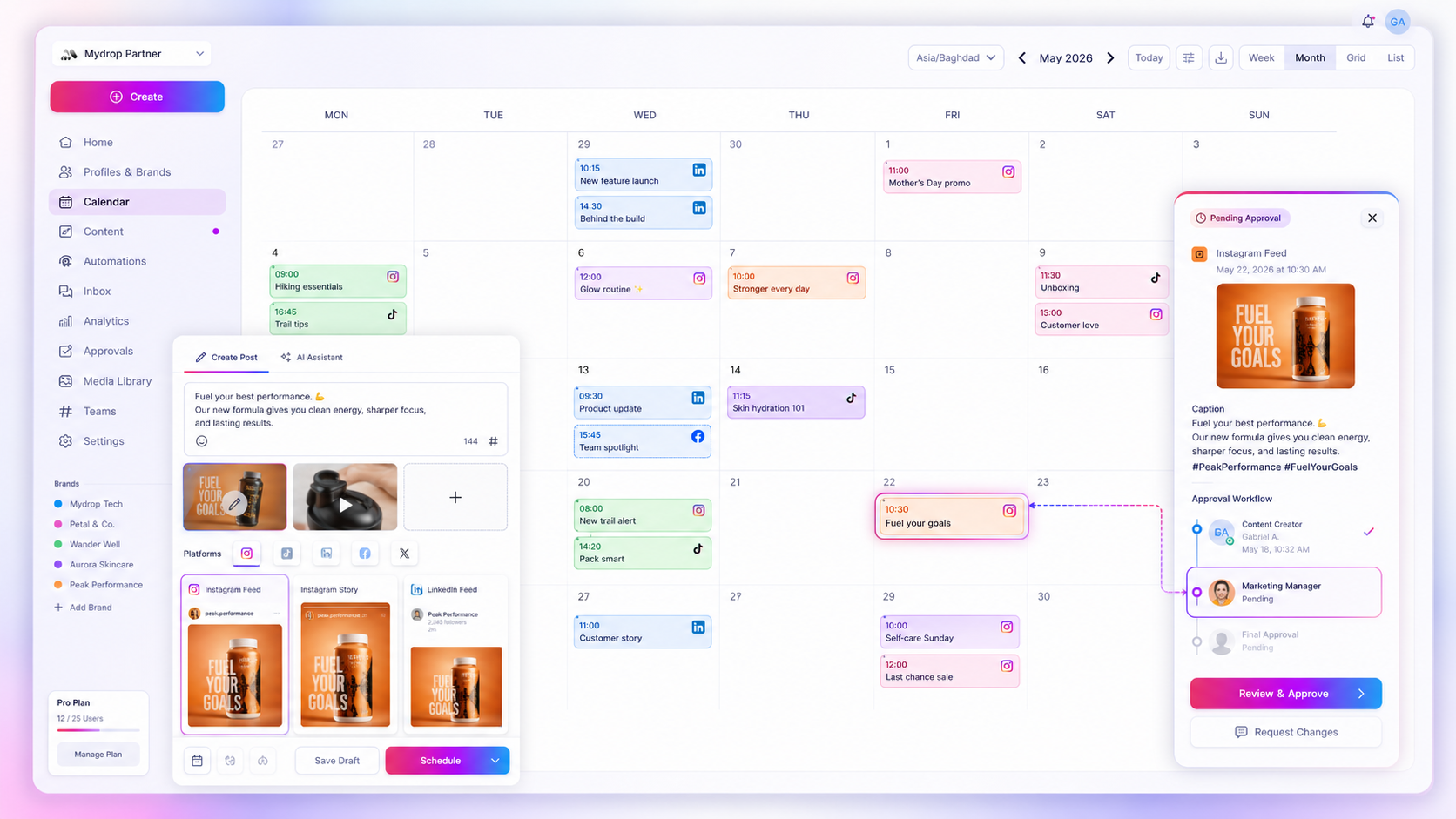
Your team’s social media operations are failing not because of the content, but because manual "reminder" tasks live in a siloed platform, disconnected from the central calendar where your team actually lives. If your social media team is still manually transferring dates from your scheduling tool to their calendars, you have already lost the battle against missed deadlines and fragmented accountability.
We get it. Your calendar is already a chaotic collage of internal meetings, client deadlines, and project launches. Adding a separate "social schedule" that doesn't sync is just begging for a dropped post or a missed operational reminder. The real cost isn't just the few minutes spent copy-pasting dates; it is the systematic erosion of team awareness when "done" states in your scheduling tool never make it into your shared calendar view.
What the best tools need to handle
Most scheduling platforms treat calendars as a one-way street: they push a date, and that is where the interaction stops. For enterprise teams managing dozens of channels and complex approval loops, that unidirectional handshake is essentially a coordination debt waiting to be paid.
To stop the leaks, you need a workflow that treats your calendar as a live, bi-directional interface for your operations. If you are auditing your current stack, here is how to spot the difference between a real integration and a glorified notification bot.
Operator rule: If an operational task-whether a scheduled post or a creative reminder-isn't visible in the team's primary calendar service, it doesn't exist for the team.
| Feature Check | Manual/Basic Tool | Calendar-Native Platform |
|---|---|---|
| Visibility | Requires app login to see status | Full sync with team calendar |
| Task State | Reminders live in the app only | Mark "done" in GCal to sync status |
| Refresh | Requires manual "Refresh" button | Real-time webhook watch channels |
| Context | Just a date and time | Deep link directly to the work |
When evaluating your tooling, look for the following non-negotiables:
- Systemic Webhook Watching: Does the tool automatically monitor your calendar for changes, or does it require a manual force-sync every time someone moves a meeting? High-performing teams need the latter to handle themselves, while the former is just manual work in disguise.
- Recurring State Sync: If you have a recurring Friday recap reminder and your team lead marks it "done" in their shared Google Calendar, does your scheduling app know the work is finished? If the answer is no, your status reporting is always behind by a day.
- Flexible Profile Filtering: Large marketing operations rarely want every single brand update clogging the executive calendar. You need the ability to sync only specific, high-priority project profiles while keeping the noise to a minimum.
At Mydrop, we see teams that move from manual cross-referencing to calendar-native planning suddenly find hours of time back in their week. By using Google Calendar as the actual planning bridge-syncing posts and reminders directly to where the team lives-you stop chasing updates and start executing them. Most teams do not have a content problem; they have a decision bottleneck caused by siloed data. When the calendar becomes the single source of truth, the bottleneck clears itself.
Where basic tools start to break
The real headache begins when your scheduling software treats the calendar as a one-way street. Many tools push a post title to your Google Calendar and call it a day. But social media operations are rarely that static. A post gets delayed for an hour, a creative asset is swapped out, or a platform-wide trend shifts your strategy overnight.
When your tool lacks a robust webhook watch channel, those updates never make it to your team's view. You end up with a "ghost schedule" in your calendar that contradicts the reality inside your app.
Here is where the friction turns into a full-blown bottleneck:
- The Metadata Decay: When a tool pushes a link to an event, but that link breaks or leads to a "page not found" because the post was moved, your team stops trusting the calendar. They revert to manual, high-effort cross-checking.
- The Recurring Reminder Trap: Most basic schedulers can sync a post, but they ignore the operational tasks attached to it. If you have a recurring reminder to "Review Community Sentiment" or "Boost Post Performance," and your tool cannot sync that "done" state, your shared calendar remains cluttered with zombie tasks that aren't actually pending.
- Token Stale-mate: Cheap integrations often lose authentication, and they rarely tell you until you have already missed a crucial deadline. A professional setup needs to handle token renewal quietly in the background without requiring manual intervention from your IT or marketing lead.
Decision check: If your calendar sync doesn't support bi-directional status updates-like marking a recurring reminder "done" and seeing that state reflected across your entire team's dashboard-you are not saving time. You are just managing two different lists of lies.
The buying criteria that matter
When evaluating enterprise tools, stop asking if they have "Google Calendar Integration." Every tool does. Start asking if they have calendar-native planning. You need to verify if the tool is designed to work inside your existing ecosystem rather than forcing your team to work inside its walled garden.
Use this scorecard to evaluate whether a platform is built for serious operations or just casual creators.
| Feature Check | Why It Matters for Scale | Mydrop Approach |
|---|---|---|
| Sync Granularity | Prevents calendar clutter by syncing only relevant client or market profiles. | Selective profile mode with granular sync toggles. |
| Operational Sync | Ensures "done" states for reminders are reflected in the team view. | Real-time status sync for recurring reminders. |
| Webhook Reliability | Eliminates stale data and ghost events caused by sync failures. | Integrated webhook watch channels for auto-refresh. |
| Event Link Integrity | Keeps team members connected to the live asset, not a dead path. | Deep-linked metadata for instant access to post states. |
If you are managing a large team across multiple brands, your criteria should be simple: visibility, state-sync, and reliability. If the tool forces you to open a separate dashboard just to confirm if a task is actually finished, it has failed the "Single-Source-of-Truth" test.
The best tools act as a silent utility. They bridge the gap between your strategic calendar and your tactical execution without requiring constant maintenance. If you find your team constantly verifying the calendar against the app, you don't need a calendar update. You need a platform that understands that social media is a team sport, not a solo production.
How Mydrop supports this workflow
If your calendar tool is currently a digital graveyard for stale tasks, it is time to stop pushing data and start building a live bridge. At Mydrop, we approach this by treating your Google Calendar not as a static destination for post titles, but as a dynamic operational surface.
When you connect a calendar service, Mydrop doesn't just dump a list of dates. It sets up a two-way conversation. If you update a post date or mark a recurring team reminder as "done," that status reflects instantly in your team's shared view. You no longer have to jump between your scheduling dashboard and your calendar to confirm if a task was actually completed by the content team.
We see teams managing hundreds of brand profiles lose hours every week simply checking "is this done yet?" across different windows. Our sync logic uses webhooks to watch for changes, ensuring that when an operational task-like a cross-market compliance review or a recurring asset refresh-is marked as finished in Mydrop, it updates your Google Calendar event to match. It turns your calendar from a passive calendar into an active control room.
Workflow check: A calendar that does not reflect real-time progress is just a glorified to-do list that eventually gets ignored. If your sync is only one-way, you are still doing the manual labor.
A simple shortlist checklist
Before you commit to a long-term enterprise contract with a new social tool, run this quick audit against your current or prospective calendar integration. If they cannot hit these four points, you are buying a headache.
| Feature Check | Why it matters |
|---|---|
| Bi-directional Sync | Does marking a task "done" in the app update the calendar? |
| Webhook Reliability | Does the tool automatically refresh when webhooks fail or tokens expire? |
| Profile Selectivity | Can you sync only the high-stakes brand accounts instead of the entire clutter? |
| Shared Visibility | Do events include live links that drop team members directly into the post draft? |
If you are currently evaluating your options, ensure you test the "force sync" capability. You want the ability to manually trigger a refresh of your entire calendar landscape if you suspect a webhook missed an update.
Conclusion
The secret to scaling social operations isn't finding a tool that lets you post faster; it is finding a workflow that removes the friction of manual cross-referencing. Coordination debt-that silent tax on your team's energy when they have to confirm status updates across three different platforms-is the real enemy.
Stop treating your calendar as a display-only billboard for your team. By forcing your scheduling and operational tasks into a single-source-of-truth calendar, you reclaim the hours currently wasted on "did you do that?" Slack messages.
Your calendar is where your team already lives. It is time your content operation moved in, too.
