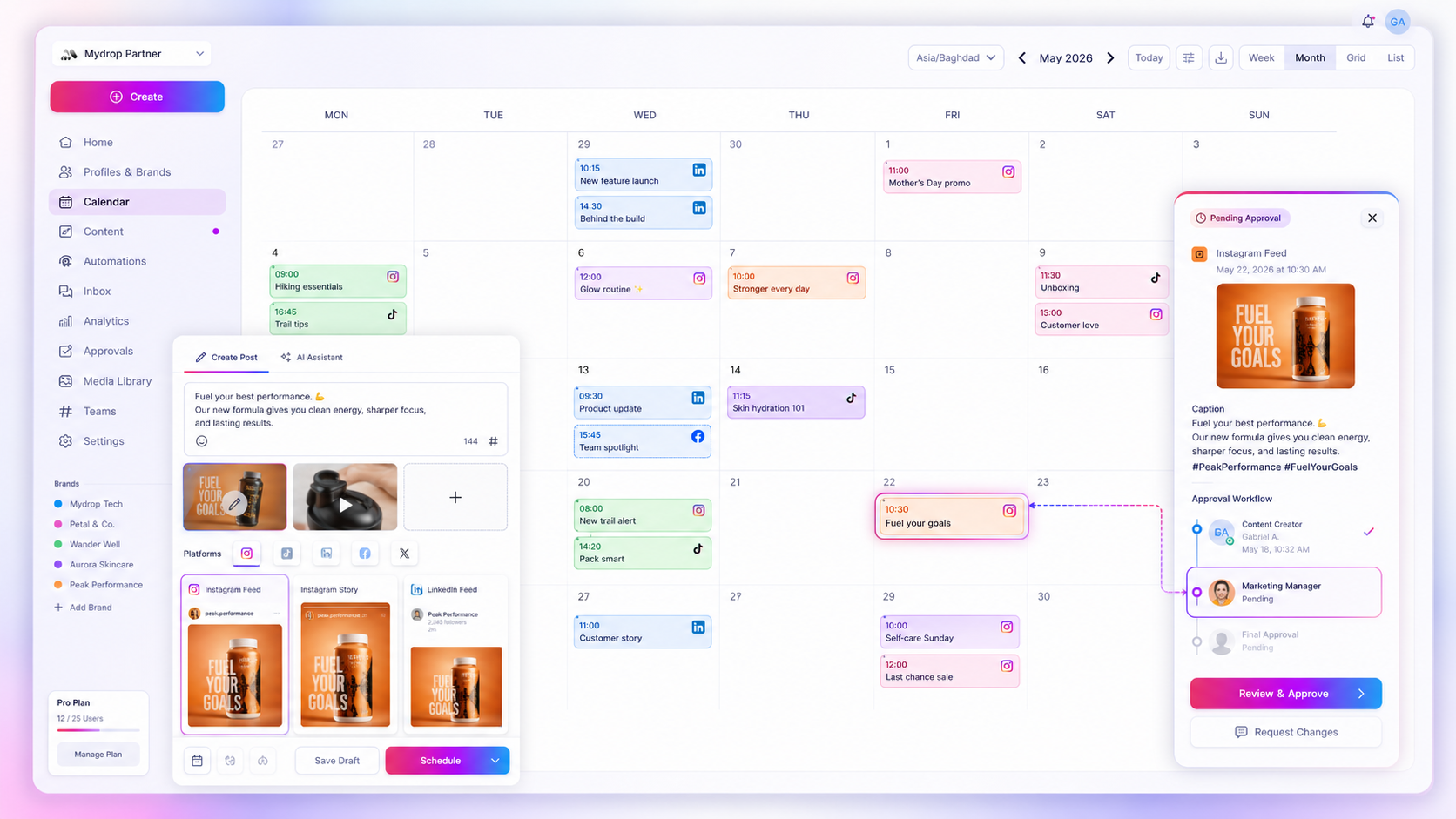
Stop treating your recurring social media planning as an administrative side-hustle. When your content calendar is decoupled from your execution tasks, you are not just losing time; you are losing the context needed to maintain consistent brand quality at scale.
We get it: the content calendar looks organized, but your actual workflow is a graveyard of sticky notes, forgotten follow-up emails, and recurring tasks that live nowhere near the assets they belong to. It is messy, frantic, and exactly why your team feels like they are constantly chasing their tails rather than executing on strategy.
The real culprit behind the burnout isn't the volume of content. It is the hidden friction of manual tracking-the endless tab-switching between your project management board, your asset folder, and the actual social calendar.
What the best tools need to handle

When you are managing dozens of stakeholders or hundreds of brand profiles, the software you use must act as the nervous system of your operation, not just a passive display board.
The best operational tools treat planning tasks as first-class citizens linked directly to the content, not as orphans living in a separate spreadsheet or task manager. If your current tool forces you to copy-paste a post title into a secondary app just to track its review status, you have already lost.
Here is the rubric for what your team should look for:
| Requirement | Why it matters for large teams |
|---|---|
| Object Linking | Tasks must be physically attached to posts, media, or profiles. |
| Done State Visibility | Leads need to see task status on the calendar without asking for status updates. |
| Calendar-Native Sync | The task must exist where the work is scheduled, not just where it is tracked. |
| Recurrence Logic | Recurring tasks (e.g., monthly compliance audits) must handle exceptions automatically. |
Where basic tools start to break
Most entry-level platforms assume your planning tasks are linear and independent. But in a real enterprise environment, a single planning task-like verifying brand rights or checking for updated compliance disclaimers-is usually tied to a specific set of assets.
When your tool is just a simple calendar, these tasks inevitably become "ghost items" that float around your workspace. You see the post, but you have no visibility into whether the associated operational check was completed.
Common mistake: Relying on separate task-management software to track "social media work." This forces your team to update two systems simultaneously, ensuring that one of them will eventually be wrong.
The buying criteria that matter
Your goal is to eliminate the manual "ping" culture-the endless Slack messages asking "Hey, is that video cleared for posting?" A superior tool should bridge that gap.
Look for platforms that allow you to create task layers directly inside your calendar view. When a task is marked "done" in the system, it should immediately signal to the rest of the team that the campaign is ready for the next stage. If you are using Mydrop, for instance, you can create recurring reminders that are tethered to specific media or posts. When you mark that reminder done, the system updates across your shared view-and even pushes that state to your integrated Google Calendar, keeping your stakeholders in the loop without a single manual email update.
This is the shift from "tracking work" to "executing workflows." Your team should be spending their energy on high-level content strategy, not serving as human glue between disconnected software platforms.
Where basic tools start to break

The real trouble begins when your "don't forget" list outgrows a sticky note. Most teams start with a generic calendar or a project management board, but these tools act like silos. They hold the task, but they have no idea what the task is actually for.
When you have to copy a link from your project board, paste it into a spreadsheet, and then manually check your social calendar to see if the post actually went live, you are performing unnecessary manual labor. This is where most content operations lose their rhythm.
Here is what happens when your planning surface is disconnected from your execution:
- Orphaned Tasks: You have a recurring task like "Review influencer assets" that lives in a project board. It has no connection to the actual media files or the profiles involved. When the asset is updated, the task remains stale.
- The Sync Gap: When someone marks a planning step as "Done" in a task tracker, that status change doesn't ripple to the calendar. You are left asking, "Is this ready?" while the calendar remains ambiguous.
- Context Scavenger Hunt: You spend more time hunting for the right asset or the latest version of a brief than you do actually planning.
Watch out: Relying on tools that treat content as just another "item" to be checked off, rather than a live object that changes state, requires approvals, and demands specific calendar timing.
When your tool lacks awareness of your actual social media campaigns, you stop being an operator and start being a glorified copy-paste machine.
The buying criteria that matter
If you are auditing your current stack, focus on how much manual heavy lifting is required to keep your calendar honest. If you are constantly moving data between tabs, the tool is the problem, not the team.
Use this scorecard to evaluate whether your current setup is built for scale or just holding on by a thread.
| Feature | Low-maturity Tool (The Trap) | Enterprise-ready Tool (The Standard) |
|---|---|---|
| Object Linking | Tasks are text fields with no links. | Tasks link directly to posts, profiles, and media. |
| Done State | Manual update in a separate app. | Instant status change that ripples across views. |
| Sync Logic | Periodic manual re-entry. | Native two-way sync with your team's primary calendar. |
| Recurrence | Simple repeats; hard to skip a week. | Smart logic: skip, override, or edit specific occurrences. |
| Visibility | Hidden in a task list. | Tasks appear as calendar-native objects alongside content. |
Decision Check: The 5-Point Audit
- Does the task live with the asset? If you have to search for the post after reading the reminder, you are wasting cycles.
- Can you trust the calendar view? If the calendar only shows published content but not the work required to get there, it is incomplete.
- Is the "Done" state accurate? Can a team lead look at the calendar and know if a task is finished without opening a side-tool?
- Does it handle real-world messiness? Can you skip a single instance of a recurring task without deleting the whole series or breaking your calendar feed?
- Is the sync passive or active? Does the tool push updates to your team's Google Calendar automatically, or does someone have to manually move events?
Most teams do not have a content problem. They have a coordination bottleneck that prevents them from moving faster. If your tool requires a manual process to bridge the gap between "task" and "published," you are hitting the ceiling of what your team can handle.
At Mydrop, we see this pattern constantly. We built our reminder system to function as a native operational layer. Instead of keeping planning tasks in a separate silo, you attach them directly to your profiles, media, and posts. When you mark a task done, that state is reflected everywhere-including your synced Google Calendar. It turns planning from a background chore into a visible, integrated part of your daily workflow.
How Mydrop supports this workflow
At Mydrop, we see the most successful teams stop treating their planning tasks as orphans. Instead, they treat them as essential campaign objects, right alongside the videos, copy drafts, and approval logs. When you use Mydrop Reminders, you aren't just creating a digital sticky note; you are building an operational bridge.
The tool lets you link a reminder directly to the posts, profiles, or specific assets involved in your campaign. This turns a generic "post this" reminder into a context-rich task that lives where the work actually happens. Because these reminders can recur-hourly, daily, weekly, or monthly-they handle your predictable operational load without you having to manually re-create the same calendar entry every time the cycle repeats.
More importantly, the done state syncs directly to your connected Google Calendar. When you or a team member marks a recurring occurrence as done, that status updates globally. You get real-time visibility into what’s actually finished without needing to host a status check meeting to confirm the basics. If a specific campaign pause requires you to skip a week, the system handles the exception, ensuring your calendar stays clean and your team doesn’t waste time on irrelevant tasks.
Operator rule: Never track a task in a silo if the asset it serves lives in your calendar. If the task doesn't link to the media or post, it will inevitably drift away from the campaign timeline.
A simple shortlist checklist
Use this rubric when evaluating whether a tool can handle your team's operational load. If your current setup fails on more than two of these, you are likely losing more than five hours a week to manual synchronization.
| Criterion | Why it matters |
|---|---|
| Object Linking | Can you attach a task directly to a specific post or media asset? |
| Persistent Context | Does the task preserve description and metadata across recurrences? |
| Done State Sync | Does marking a task complete update external calendars (e.g., Google Calendar)? |
| Exception Handling | Can you skip or override a single occurrence without deleting the whole series? |
| Team Visibility | Can leads filter tasks by assignee or status without leaving the content calendar? |
Conclusion
The goal isn't to create more tasks; it is to create a clearer map for your team. When you integrate your planning layer directly into your execution workflow, you stop managing the process and start managing the content.
Most teams do not have a content production problem. They have a decision bottleneck, and it usually starts with a forgotten follow-up. By choosing tools that treat your operational tasks as first-class citizens, you give your team the breathing room to focus on the work that actually grows your brand. Stop chasing status updates. Start building a pipeline that runs itself.