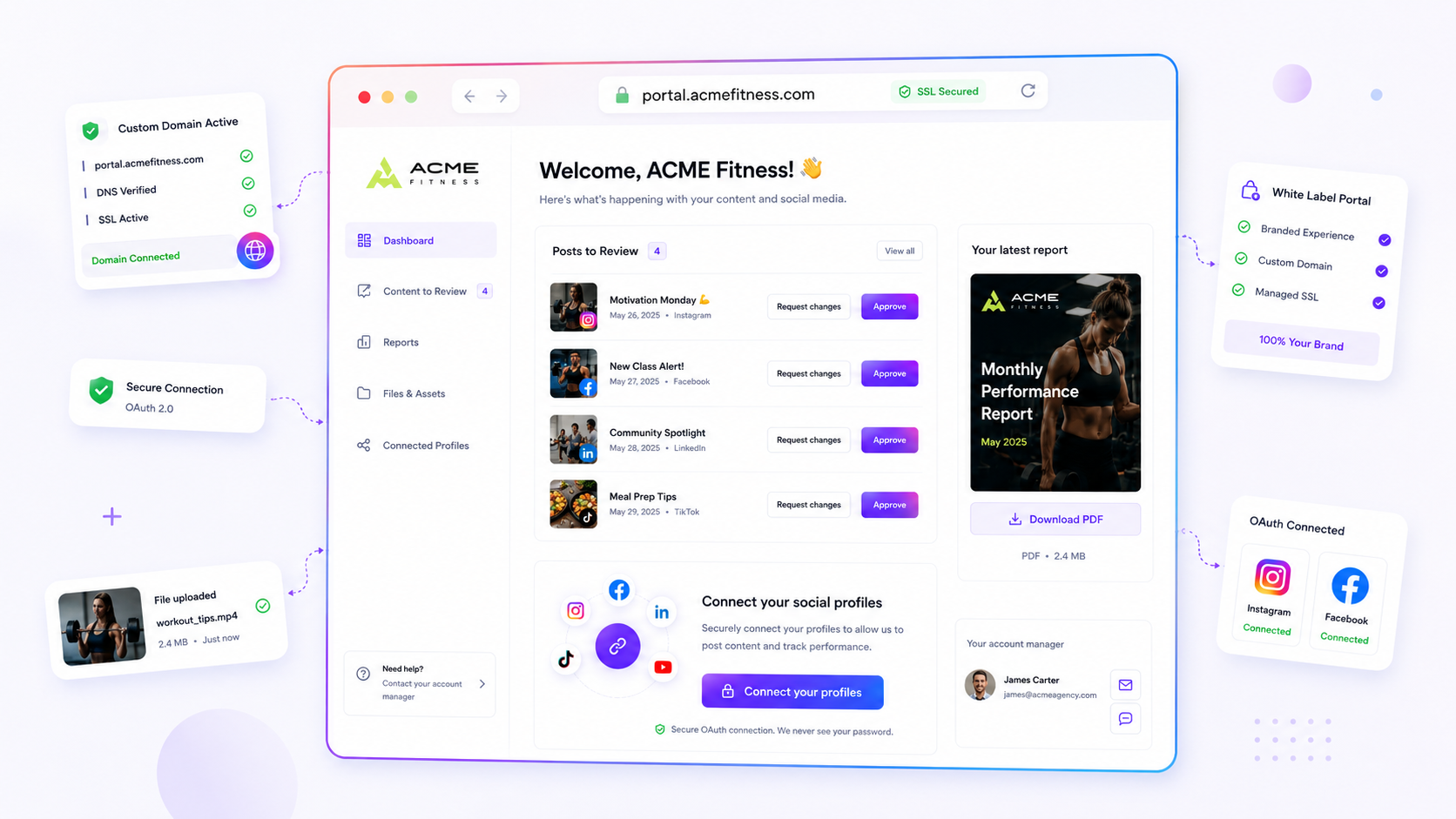
To scale agency client portals without accumulating coordination debt, you must move beyond generic platform URLs and adopt a custom, white-label domain infrastructure. The moment your client lands on a generic URL, you lose professional authority. It is not just a branding annoyance; it is a silent, persistent friction that signals "temporary vendor" instead of "integrated partner."
We have seen this across thousands of agency workflows: the "portal friction tax." Every time a client has to navigate away from their own brand ecosystem to interact with yours, you introduce unnecessary context switching and doubt. That doubt is where coordination debt lives, slowing down approvals, confusing stakeholders, and turning simple deliverables into support tickets.
Most agencies struggle with this because their delivery pipeline is inadvertently amateurish:
- Workflow: Forcing clients to visit agency-branded URLs causes context switching and confusion.
- Technical: Platforms without integrated, automated SSL management force you into high-maintenance manual certificate renewals.
- Brand Perception: Using generic subdomains signals "temporary vendor" rather than "integrated partner."
- Operations: Lack of seamless host-target switching makes managing separate portals for different clients a configuration nightmare.
To scale, you need to stop treating custom domains as a "nice-to-have" polish step and start treating them as foundational operational risk management. When portals live on client-owned domains, you remove the platform noise and replace it with a seamless, high-trust experience that feels like it belongs to them.
What the best tools need to handle

If you are still manually managing SSL certificates or chasing clients to update DNS records every time you launch a new portal, you are drowning in avoidable maintenance. The best infrastructure is invisible. It should handle the complexity of the web while you focus on the actual work.
At Mydrop, we approach this with a "set it and forget it" philosophy. DNS verification and SSL provisioning should be background tasks that complete without a single support ticket. If a platform requires your team to intervene during the domain setup process, it is not built for agency scale.
Operator rule: If your domain setup workflow takes more than five minutes or requires a manual email chain, it is broken.
Here is the technical sanity checklist you should use to audit any portal platform. If a tool fails more than two of these, your team will spend more time configuring URLs than managing client work.
| Feature | Operational Impact | What to look for |
|---|---|---|
| DNS Verification | Prevents configuration errors | Automatic validation, not manual support |
| Managed SSL | Security is non-negotiable | Automated provisioning, zero manual renewal |
| Host Dispatch | Flexibility is key | Intelligent routing between links and portals |
| Target Assignment | Reduces fragmentation | Seamlessly re-assign domains to different surfaces |
The goal is to eliminate the coordination debt created by platform-imposed branding. A robust domain implementation allows you to map your agency’s delivery engine directly onto the client's existing infrastructure. This means when you deploy a new client-facing experience, it is live, branded, and secure in minutes-not days. When the technology handles the heavy lifting, your team stops acting like a DNS registrar and starts acting like the strategic partner your clients hired you to be.
Where basic tools start to break

The real headache begins when your "professional" tool forces you into a high-maintenance cycle of manual certificate management. You sign up for a service, map your DNS, and everything looks pristine-until 90 days later when the connection drops because you missed a renewal notification in your spam folder.
If your platform requires you to generate, track, or manually upload SSL certificates, you aren't using a tool; you're running an IT helpdesk. Every hour your team spends troubleshooting a Certificate Invalid error is an hour lost on actual client strategy.
Beyond the manual overhead, basic tools often lack intelligent host dispatch. If you manage multiple brands, you need a system that can take a single domain and intelligently route traffic to the right surface-whether that's a client's link-in-bio page or a full brand portal. When a tool can only map one domain to one static page, you end up with a cluttered, unmanageable mess of subdomains and configuration sprawl that confuses both your internal team and your end clients.
Common mistake: Treating DNS verification as a one-time setup step rather than a lifecycle process that requires ongoing monitoring and automated SSL renewal.
The buying criteria that matter
When you are ready to stop managing infrastructure and start scaling, your evaluation needs to shift from "does it work?" to "how does it fail, and who fixes it?" You aren't just buying a landing page builder; you are buying reliable, invisible routing.
Use this scorecard to audit your current stack before you invest more time in a platform that doesn't respect your operational bandwidth.
| Feature | The "Scale-Killer" (Low Maturity) | The "Ready-to-Ship" (Enterprise Standard) |
|---|---|---|
| SSL Provisioning | Manual upload/renewal (ticket-based) | Fully automated, background provisioning |
| DNS Management | Requires frequent manual re-validation | Auto-checks, self-healing status updates |
| Host Dispatch | One domain = one target page | Dynamic routing based on domain rules |
| Client Experience | Redirects to platform URL (e.g., brand.platform.com) |
Full white-labeling (stays on client.com) |
| Error Handling | Generic browser warnings for end-users | Proactive notifications for internal ops teams |
Decision Rule: If a platform requires more than two manual clicks to add a new client domain, it will become a bottleneck at scale.
For us at Mydrop, we see custom domain infrastructure as a service, not a static setting. We designed our white-label domain infrastructure to handle DNS verification, managed SSL lifecycle, and target assignment asynchronously. This means your team focuses on the client strategy, while our system handles the background host dispatch, ensuring that whether a client hits a link-in-bio page or a full portal, the experience remains seamlessly their own.
When you remove the platform's fingerprints from the delivery, you aren't just polishing the brand-you are systematically eliminating the small, nagging points of friction that turn a simple project delivery into a marathon of status updates. You are building trust by making the technology disappear.
How Mydrop supports this workflow
At Mydrop, we built our domain infrastructure because we watched agencies waste hundreds of hours manually chasing SSL renewals and fixing broken DNS records. We operate on the belief that your tools should disappear, not become a new layer of technical debt. When you connect a client-owned domain to Mydrop, we don’t just host a landing page; we manage the entire lifecycle of the experience as an extension of their own infrastructure.
We automate the heavy lifting so you don't have to touch a certificate or a terminal. Once you map your DNS to our target, our system automatically initiates SSL provisioning in the background. You don’t need to coordinate with IT teams on certificate expiration or stress about a "Not Secure" warning popping up right before a client presentation.
Because we treat domain infrastructure as code, we also handle the host dispatch seamlessly. Whether you need a link-in-bio page for a social campaign or a full-blown brand portal for asset distribution, the same white-label domain can shift targets instantly. You update the assignment in our dashboard, and the routing updates globally in seconds.
A simple shortlist checklist
Before committing your agency's reputation to a new portal provider, run this "Sanity Checklist" against your candidates. If they can’t check these boxes without a support ticket, keep looking.
| Capability | Why it matters |
|---|---|
| Zero-Touch SSL | Automatic provisioning and renewal; no manual cert uploads. |
| Async DNS Validation | Platform checks DNS status continuously so you don't have to refresh. |
| Instant Host Dispatch | Immediate routing changes between link-in-bio and full portals. |
| Configurable Fallback | Control where users go if DNS or target assignment is misconfigured. |
| Workspace Isolation | Ensures client domains are securely partitioned, even when managed centrally. |
Watch out: Treating DNS and SSL as a one-time configuration task. The reality is that these resources drift. If your tool doesn't monitor SSL state and alert you before a certificate expires, you are effectively accepting downtime as a feature.
Conclusion
The difference between an agency that looks like a high-end partner and one that feels like a temporary contractor often comes down to the URL in the browser bar. It is a small detail that carries massive psychological weight. When you control the domain, you control the narrative, the security perception, and the client's confidence in your delivery.
Stop letting generic platform subdomains signal to your clients that they are just another line item in a vendor's database. Audit your current stack, identify where the friction is actually hidden in your setup, and move toward an infrastructure that treats your client's brand as the primary host. Your team spends enough time worrying about the quality of the creative; don't make them spend the rest of their time defending the delivery vehicle.