You are likely spending more time chasing client feedback on status updates and digging through email threads for assets than you are actually crafting strategy. If your client reporting workflow still relies on sending files via email or granting full app access to stakeholders, you aren’t just losing time-you’re eroding client trust. The smartest move for any high-volume agency is to stop treating the client like a guest in your workspace and start providing them a dedicated, secure, and permission-based Brand Portal.
We get it. You are the bridge between high-stakes brand strategy and chaotic execution. You are juggling multi-platform campaigns, tight deadlines, and the constant fear of a miscommunication slipping through. It is messy, it is frantic, and the "email-everything" grind is a silent killer of your margins. You are not alone in this; we have seen this across hundreds of agencies where coordination debt-not a lack of creative ideas-becomes the primary reason teams stop scaling.
What the best tools need to handle
The goal isn't just to "centralize" information; it is to remove the friction that keeps your clients from seeing the value you provide. A modern portal should function as a self-service hub that respects your security protocols without turning into a technical barrier for the client. If they need a password manager just to view a report or approve a post, you have already lost them.
When evaluating your current setup, look for these three non-negotiables:
- Zero-friction authentication: Your clients should be able to view assets, reports, and campaign status without needing a full seat or an account. If they have to remember a login, they won't use it.
- Granular, scope-limited access: Not every stakeholder needs access to every setting. You should be able to toggle what is visible-like letting a client download a finished PDF report while keeping your draft campaign notes hidden.
- Secure asset and identity management: Password sharing is a liability. Your portal should support secure profile connections via OAuth, allowing clients to connect their own social accounts without you ever touching their credentials.
Common mistake: Teams often default to "everything or nothing" access. They either send raw files via email-making version control impossible-or give the client full admin rights to their management tool, which introduces unnecessary risk.
| Workflow | Legacy Email/Attachment | Heavy CMS/Membership Site | Mydrop Brand Portal |
|---|---|---|---|
| Asset Delivery | Email attachment (Lost versioning) | Login required (Friction) | Secure link (Version controlled) |
| Reporting | PDF via email (Static/Dated) | Portal login (High barrier) | Live, secure dashboard access |
| Security | Password/Credential sharing | Complex user management | OAuth-based profile linking |
| Collaboration | Fragmented email threads | Internal-only tools | No-login, in-portal chat |
The difference between a high-growth agency and one drowning in administrative overhead is the transition from those manual, email-dependent reporting loops to a secure portal environment. At Mydrop, we see the most successful teams treat their portal as a product-a clean, white-labeled experience that signals professional competence rather than just another link in an endless email chain.
Where basic tools start to break

Your agency workflow hits a ceiling the moment you force clients to sign in. When you use standard, "login-required" CMS tools or general-purpose project management platforms, you effectively create a wall between the client and the work.
We have all seen the fallout. A stakeholder ignores your invite email for three days because they forgot their password, can not remember which of their five accounts they linked to your tool, or simply finds the interface too heavy for a quick thumbs-up. By the time they actually log in, your posting window has closed.
When software requires a password, it forces your client to act like an administrator. They are not interested in managing settings, configuring profiles, or navigating a dashboard; they just want to see the creative and give you the green light. Every extra click, every authentication prompt, and every "forgot password" reset is a micro-friction event that drains your momentum.
Watch out: Using a general project management tool that requires full account creation for every stakeholder. It turns a ten-second approval into a ten-minute IT ticket.
The buying criteria that matter
Stop evaluating portals based on their feature list and start evaluating them on the barrier to entry. A portal is only as useful as the ease with which your most distracted client can engage with it.
If your client is managing five different brand lines, they cannot handle managing five different portals, each with its own login and unique interface. You need a solution that bridges the gap between secure governance and frictionless access.
Client Portal Efficiency Scorecard
Use this rubric to score your current setup. If your total is below 12, your coordination debt is likely costing you hours per week in unnecessary administrative overhead.
| Criteria | Score 1 (Manual/High Friction) | Score 2 (Mixed/Moderate) | Score 3 (Integrated/Seamless) |
|---|---|---|---|
| Authentication | Email, PDF, and manual threads | Password-protected portal | No-login access via secure link |
| Asset Delivery | Attached files in email | Upload to shared cloud drive | Integrated file preview and approval |
| Profile Setup | Sharing passwords in plain text | Manual profile configuration | Client-managed OAuth connection |
| Review Cycle | Back-and-forth email chains | In-app comments with login | Direct, authenticated-free approvals |
- Formula: Sum the scores (4 to 12).
- Threshold: 11-12 is efficient. 7-10 is serviceable but risky. 4-6 is a business bottleneck.
When you look for your next portal, prioritize OAuth-based profile connections. This allows clients to connect their social channels to your agency dashboard without ever handing over their actual account credentials. It is the gold standard for compliance and security in an agency setting.
Finally, look for granular permissioning. You should be able to toggle what a client sees on a per-brand or per-project basis. Some clients want to see the full analytics report, while others just need a post-approval feed. At Mydrop, we have found that giving clients a tailored, clean view-one where they only see what is relevant to their specific role-dramatically increases the likelihood that they will actually use the platform instead of reverting to email.
The real test: If you cannot onboard a new client to their dashboard in under two minutes without an IT support call, you aren't using a portal; you're using a digital filing cabinet.
How Mydrop supports this workflow
At Mydrop, we have seen this across hundreds of brands: the biggest bottleneck isn't the creative process; it is the coordination debt that piles up when stakeholders are forced into a system they don't understand.
We built our Brand Portal to break this pattern. Instead of dumping a pile of files into a shared drive or sending a calendar link that requires an enterprise login, you create a private, branded space for every client.
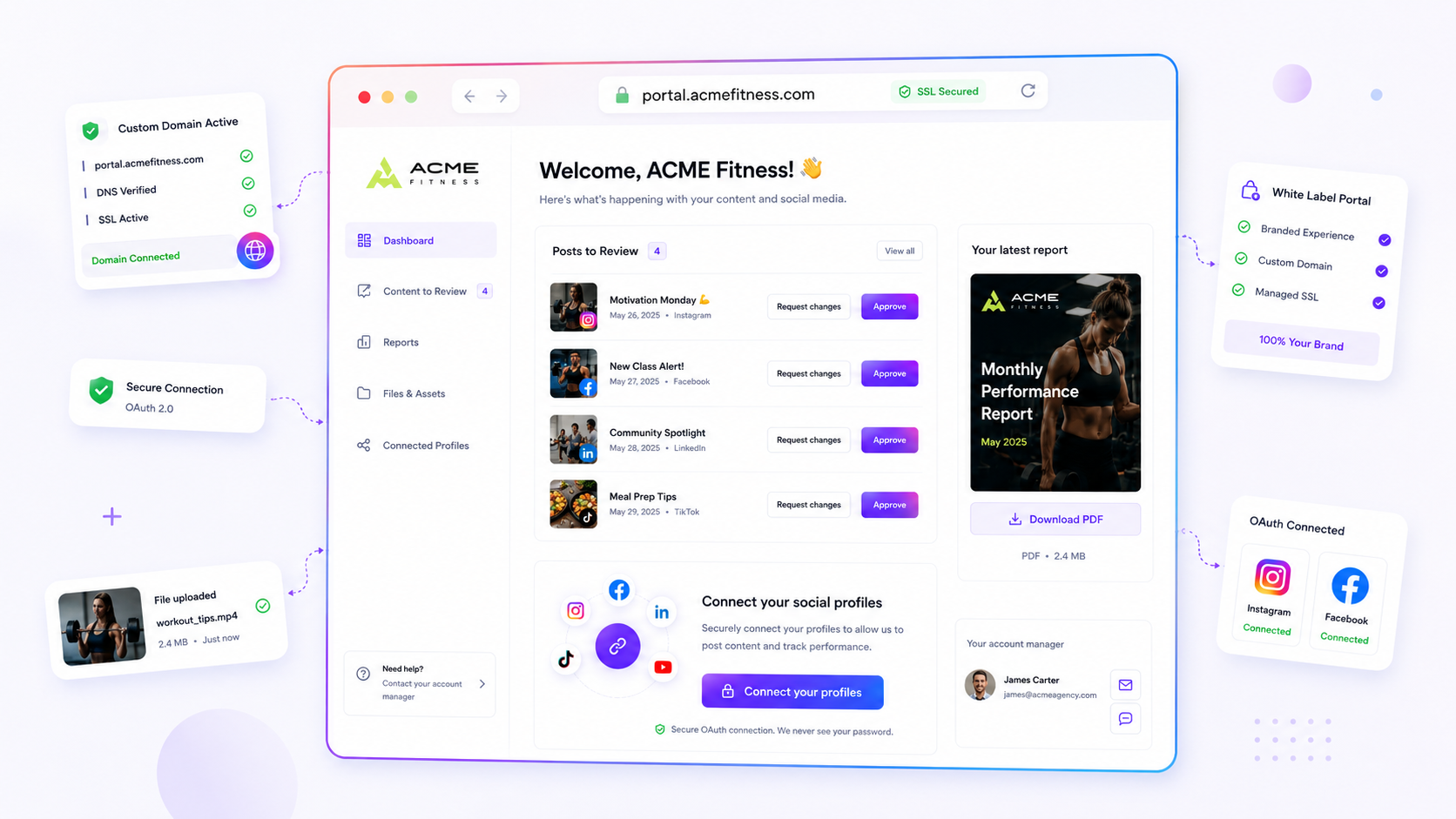
Clients get a clean, simple dashboard where they can actually see what matters: upcoming campaigns, posts ready for approval, and finished reports. They don't need a password manager for their team because they don't need a Mydrop account to interact with the portal. You set the permissions, choose the slug, and share the link.
When a client needs to connect their social profiles to a campaign, they use their own native OAuth logins directly within the portal. You get the connection permissions you need without ever seeing or handling their actual passwords. It is cleaner, faster, and frankly, safer for everyone involved.
Operator rule: Never force a client to manage an extra set of credentials just to give you a green light on a post. If they can't approve it from a link in their inbox, your process is effectively broken.
A simple shortlist checklist
Before you commit to a portal solution, audit your current process against these five non-negotiables. If you cannot check all of these, your current "solution" is likely costing you more than it saves.
- Zero-login access: Can the client view reports and approve content without creating an account?
- Scoped visibility: Can you control exactly which sections (e.g., Reports, Posts, Files) a specific client can access?
- Password-free connection: Can clients connect their social accounts via OAuth rather than sharing sensitive credentials?
- Centralized feedback: Is there a dedicated space for comments on specific assets, or are you still parsing email replies?
- Downloadable deliverables: Can the client grab a professional-grade PDF report or high-res asset directly without bugging you?
If you find yourself saying "no" to these, you are managing a tool rather than a relationship.
Conclusion
The transition from email-dependent reporting to a modern client portal is rarely about software features; it is about reclaiming your team's time from administrative friction. The goal is to move your agency from a "delivery-and-chase" model to a true partnership model. When you remove the barriers between your team's strategy and the client's visibility, you stop fighting the process and start focusing on the actual work. Audit your current setup, strip out the friction points that demand extra logins, and give your clients a space that respects their time as much as you respect your own.