If your agency’s Friday ritual involves assembling spreadsheets and hunting for email threads to deliver last month's performance, you are already fighting a losing battle against client trust. Stop treating analytics delivery as a manual task and start treating it as a product feature. Delayed analytics delivery isn't a bandwidth problem: it is a structural workflow failure. If you are still emailing PDFs, you are not just losing time, you are devaluing your own data.
We get it: the reporting crunch is a messy, thankless cycle that eats your team's best hours. You are trying to add value, but you are stuck playing digital mailman instead of being the strategic partner your clients hired.
Operator rule: Data as a destination, not a delivery. Clients should have a persistent, branded space to visit, not a cluttered inbox.
This guide will help you audit your current reporting bottlenecks and show you how to move from manual delivery to an on-demand, branded client portal experience.
What the best tools need to handle

The best tools do not just show charts. They replace the entire manual communication loop. If you are evaluating a portal, it must solve for three core friction points: identity, access, and security.
At Mydrop, we see hundreds of teams struggle because their reporting pipeline requires manual password sharing or, worse, they rely on unsecure public link sharing. A real portal handles this differently.
Reporting Friction Audit
Before you buy, run this check against your current process. If you answer "Yes" to two or more, you are bleeding time.
| Friction Point | Question | Impact |
|---|---|---|
| Versioning | Does the client have to ask for the latest version of a report? | Manual overhead |
| Access | Does the client need a login for each tool to see progress? | Friction or churn |
| Credentials | Do you share social platform passwords to let clients connect profiles? | High risk |
| Delivery | Is report delivery tied to a manual email trigger? | Scalability death |
The best tools handle this through secure permission tiers. You should not have to choose between "everything" and "nothing." You need to be able to expose sanitized analytics, pending posts, or brand files without giving clients access to your internal settings.
Another non-negotiable is OAuth-enabled profile connections. Never exchange passwords to connect a client's social account. A robust portal lets the client securely handle that connection on their end, giving them control without compromising your security perimeter.
Finally, the product is not just the report; it is the experience of the report. On-demand access means the client stops asking "how are we doing?" because they know exactly where to find the answer.
Where basic tools start to break

Most teams start with what they have: email threads, shared drives, and manual spreadsheet trackers. It feels manageable when you are managing one brand and two channels. But once you move into enterprise territory-managing dozens of profiles, multiple agency partners, and complex approval chains-these "free" tools stop being infrastructure and start becoming bottlenecks.
The hidden cost here is not just the lost time; it is the version control nightmare. When you email a PDF report, you lose control the second you hit send. If you realize an hour later that a metric was miscalculated, you are stuck sending a correction email, hoping the client sees it before the board meeting.
Basic file-sharing sites are not much better. They lack the context and security that enterprise teams require. You end up with a folder structure that looks like a digital graveyard, and you are forced to share login credentials just so the client can access their own data. That is not collaboration; that is a major security risk.
Decision check: If your reporting workflow requires you to share a password via an email or a chat tool, your reporting workflow is fundamentally insecure.
We see this pattern constantly: teams spend more time managing access and fixing file permissions than they do analyzing the actual performance data.
The buying criteria that matter
When you are ready to stop playing mailman and start acting like a strategic partner, look for a tool that treats your data as a product, not a file attachment. Your portal should be the home base for your client relationship, not just a place to dump PDFs.
Here is how to weigh your options against the realities of enterprise-scale agency work.
Reporting Friction Audit: Scoring Your Current Setup
| Feature | Manual Delivery (Email/Drive) | Generic File Share | Dedicated Client Portal |
|---|---|---|---|
| Data Security | High risk (No auth control) | Medium (Shared links) | High (Auth + Permissions) |
| Version Control | None (Static files) | Manual management | Automatic/Real-time |
| Client Experience | Cluttered inbox | Fragmented links | Centralized Hub |
| Credential Safety | Requires PW sharing | Requires PW sharing | OAuth/Password-free |
| Time per Report | 30-60 minutes | 15-30 minutes | < 5 minutes |
What to prioritize in your search
- Granular Permissions: You need the ability to control exactly what a client sees. Can they view analytics? Sure. Should they be able to edit the campaign configuration? Probably not. A mature portal lets you toggle these sections by role.
- OAuth Profile Connections: Stop asking clients for their social passwords. A professional tool allows clients to connect their own profiles using OAuth. They retain control, and you gain access without the security liability.
- On-Demand Access: The "Friday reporting crunch" should vanish. With a proper portal, the client can log in whenever they need the data. You aren't creating a new report; you are granting access to a living, breathing dashboard.
- Branding: If the portal looks like a generic tech product, the value you provide gets lost. Ensure the platform allows you to apply your agency or client brand identity, making it feel like an extension of their internal workspace.
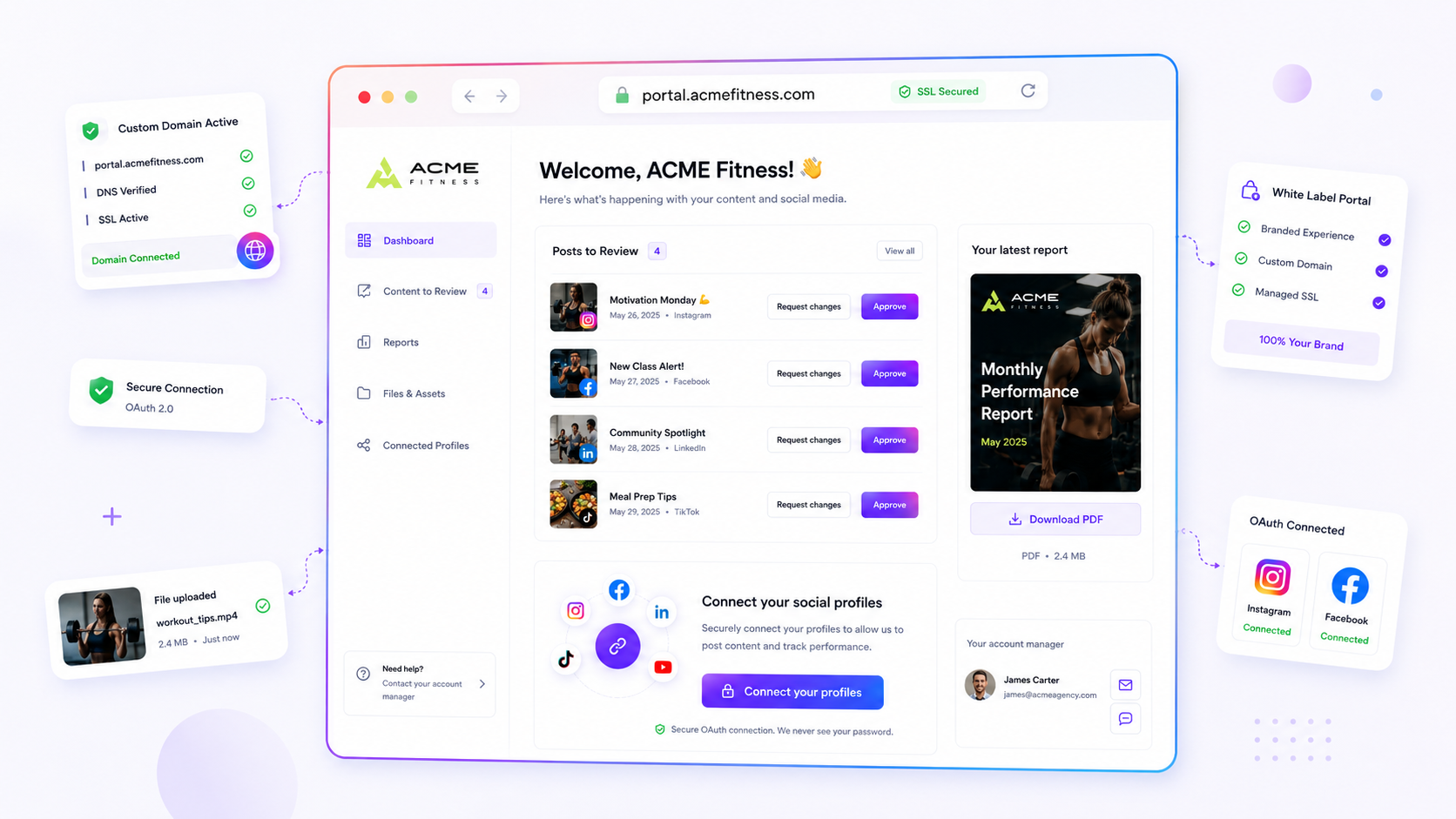
At Mydrop, we built our Brand Portal specifically to solve this. It provides a secure, branded environment where clients can inspect reports, download approved assets, and even connect their own profiles via OAuth-all without needing a full seat in the workspace. It turns the report from a one-time static document into a persistent asset the client actually wants to visit.
Ultimately, your goal is to reduce the friction between "data exist" and "client understands the data." Everything else is just overhead.
How Mydrop supports this workflow
At Mydrop, we see many agencies stuck in that Friday afternoon email struggle. They have the data, but it is trapped in a dashboard the client cannot access, or worse, buried in an unread message. We designed the Brand Portal specifically to bridge that gap.
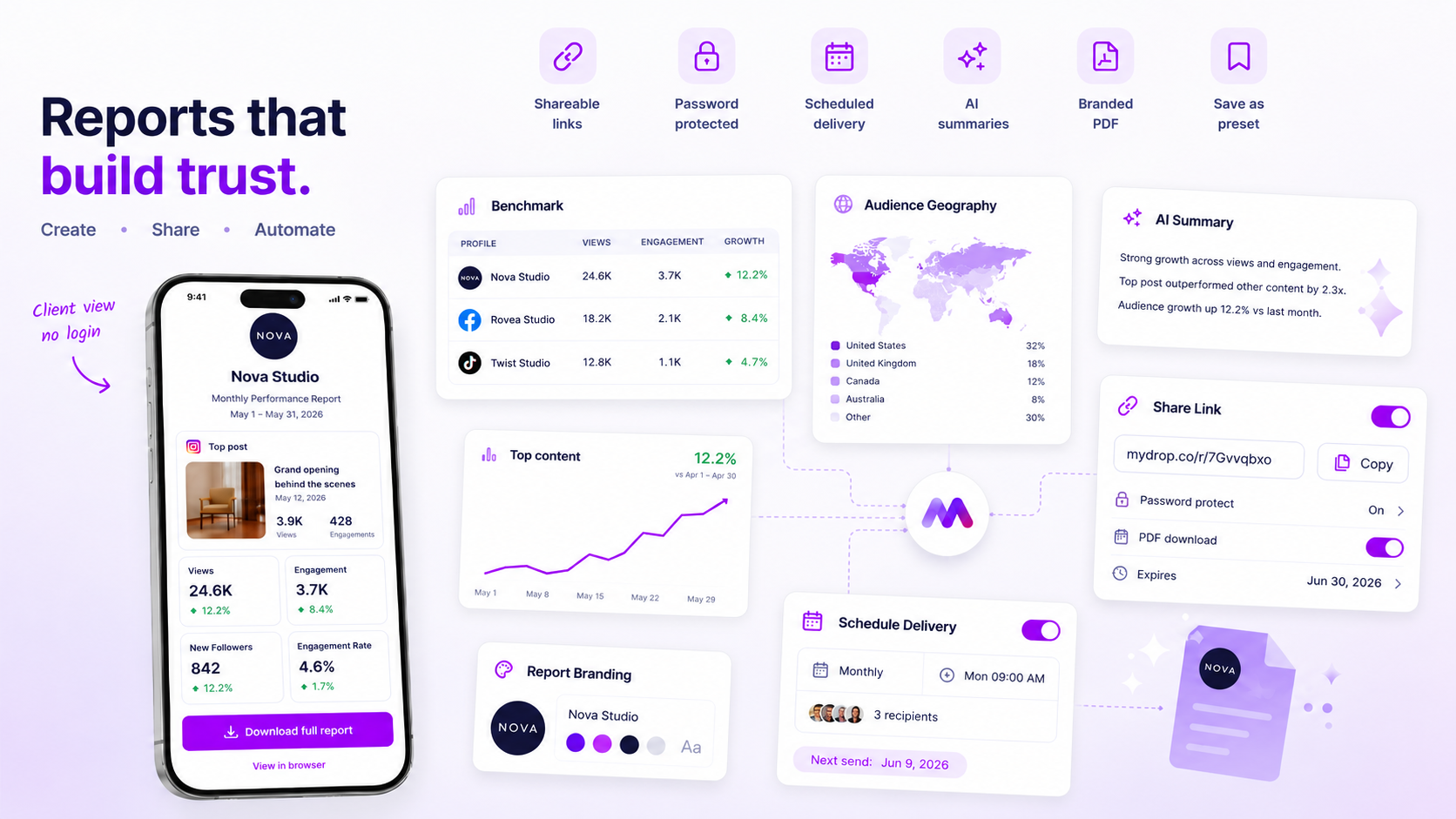
Instead of pushing files at your clients, you create a dedicated destination. When you enable the portal for a client, they get a password-protected space that feels like it belongs to your agency. You decide exactly what they see.
The real power is in the sanitized access. You can grant them view-only access to specific analytics reports or allow them to download PDFs without ever giving them full account access. They get the insights they need, and you keep your operational workspace secure.
- Secure sharing: Control exactly which sections-like campaigns, posts, or analytics-are exposed per portal.
- No-login collaboration: Clients view reports and provide approvals without needing a Mydrop login, removing friction from your review cycles.
- OAuth connectivity: If your clients need to connect social profiles, they do it via the portal. No more exchanging passwords in unsecure emails.
This turns reporting from a chore into a persistent resource. The client checks the portal when they have a question. You stop being the middleman and start being the strategist. Instead of chasing approvals or status updates, you know the data is already waiting in their portal for when they need it.
A simple shortlist checklist
When you are evaluating a portal tool, do not just look at the branding. Look at the administrative overhead. A tool that adds more friction than it removes is not a solution, it is just a different kind of problem.
Use this checklist to pressure-test any portal solution before committing your team to a new workflow.
| Criterion | What to demand | Why it matters |
|---|---|---|
| Security | Password-protected, per-section access | Keeps sensitive data away from unauthorized eyes |
| Branding | Fully white-labeled URL and domain | Professionalism; removes third-party confusion |
| Friction | No mandatory client logins | Higher adoption rates for reports/approvals |
| Profile Sync | OAuth integration for profiles | Eliminates password sharing risks |
| Delivery | On-demand access vs. static PDFs | Shifts from "delivery" to "destination" |
If a tool requires your client to jump through hoops just to see a chart, they will eventually stop looking. The best portal is the one they visit instinctively when they need context.
Workflow check: If a client has to ask for permission to view a report, your portal is not actually doing its job.
Conclusion
The transition from manual reporting to a persistent portal is not about upgrading your software. It is about upgrading your agency’s relationship with its clients.
When you stop treating analytics like a package to be shipped and start treating it like a shared source of truth, the conversation changes. You move from defending your results in a Friday email to discussing your strategy in a shared workspace.
If your team is still spending hours compiling data that clients barely have time to open, take a hard look at your process. The goal is to spend less time on administration and more time on the insights that actually move the needle for your clients.
Stop playing mailman. Start building the portal. Your margins, and your clients, will thank you.