Analytics reporting often fails not when the data is calculated, but the moment it leaves your hands. If you are chasing email bounces, managing massive PDF attachments, or explaining version control to a client, you are fighting a distribution problem, not a reporting one.
We have all been there. The insights are ready, but they are buried in an email thread while the client is pinging you on Slack. It is messy and unnecessary. The only way to stop this is to move from push-based delivery, where you hope the email lands, toward pull-based visibility. A purpose-built client portal is the only infrastructure that reliably closes this gap.
What the best tools need to handle

Most teams assume they need an app account for every stakeholder. That is the quickest way to kill adoption. If your client has to remember another password or navigate a complex workspace just to see a report, they will not do it. They will keep asking for that email.
The best tools prioritize frictionless access while maintaining professional standards. Here are the core capabilities you need to look for when evaluating your portal.
| Capability | Why it matters |
|---|---|
| Password Protection | Keeps sensitive client data secure without requiring individual user accounts for every viewer. |
| No-Login Access | Allows clients to view data or download reports immediately, increasing engagement. |
| Branded Workspace | Ensures the portal feels like an extension of your agency, not a third-party tool. |
| Contextual Chat | Bridges the gap between the data and the discussion, keeping feedback inside the report loop. |
| Self-Service Downloads | Enables clients to grab the data they need, when they need it, at 6 p.m. or 6 a.m. |
When you are assessing potential tools, do not look for "analytics features." You already have data. Look for distribution features.
A common mistake is choosing a platform that forces your client into a rigid, complex setup. You want a tool that acts as a conduit, not a barrier. If the portal forces a complex onboarding process, the client will ignore it. At Mydrop, we designed our own portal with this specific bottleneck in mind, focusing on ensuring that the client interface remains a simplified, secure space, separate from the full team workspace.
The goal is to make the report available in a place they already feel comfortable visiting, with security that protects the brand but does not obstruct the work.
Where basic tools start to break

Let us be real. Email was built for quick messages, not analytics delivery. When you email a 50MB PDF report on a Friday afternoon, it doesn't get read. It gets stored. Your client might open it, but the moment they need to reference that data a week later, they are searching through threads or pestering you for a re-send. The tool is not the bottleneck; the workflow is.
Most teams rely on a combination of email, shared drives, and maybe a basic task management tool. It feels secure in the moment, but it creates a massive amount of "coordination debt." You are effectively paying a hidden tax in the form of manual labor just to ensure the client has the right version of the document.
The biggest offender is the mandatory login tax. If you use a generic project management or asset tool that requires the client to create a new, separate account, you are creating friction. They already have too many tools. If they forget the password, or if their internal IT department flags the site as a security risk because they don't recognize the domain, you are back to square one: email.
Then there is the issue of stale data. When you email a file, that document becomes a static snapshot the second it lands in their inbox. If you realize an hour later that a chart was off or a data point was missing, you have to send a "Correction-v2-final.pdf" email, and suddenly the client doesn't know which file is the source of truth. The spreadsheet has effectively become a crime scene.
The buying criteria that matter
When evaluating a portal, do not get distracted by flashy features. Focus on friction reduction. You need a tool that bridges the gap between your dashboard and the client's screen without adding unnecessary steps.
Here is a checklist for evaluating potential tool purchases:
- Friction-Free Entrance: This is non-negotiable. Look for tools that allow you to set up password-protected links or private portals that do not force the client to create a proprietary account just to view a report or approve a post.
- Unified Context: The portal should not just be a repository for files. It needs to hold the conversation around those files. If a client has to leave the portal to ask a question about a report, you have lost the benefit of the integration.
- Branded Continuity: The tool should disappear. If the portal looks like a generic third-party service, it undermines your authority. It needs to feel like an extension of your own brand.
- Secure Profile Connections: Your portal should allow clients to connect their own social profiles via OAuth without forcing them to share their actual account passwords with your team. This is a massive compliance and security win.
To help you visualize how a purpose-built tool stacks up against standard workarounds, use this scorecard.
| Capability | Traditional (Email/Drive) | Purpose-Built Portal |
|---|---|---|
| Security | Low (attachments forwarded) | High (password-protected access) |
| Accessibility | High-friction (login required) | Low-friction (direct access) |
| Context | Disconnected threads | Integrated (chat/files/posts) |
| Update Loop | Manual / Static | Real-time / Dynamic |
| Brand Trust | Low (generic branding) | High (custom domains/branding) |
At Mydrop, we see teams that move from email threads to a dedicated portal instantly stop chasing report versions because everyone is looking at the same live link. When you remove the friction of email and login walls, you are not just delivering reports faster. You are changing the dynamic from "vendor sending files" to "partner providing self-service access."
Operator rule: If a client has to search their email to find your data, you haven't solved the reporting problem. You've just shifted the burden of organization onto them.
How Mydrop supports this workflow
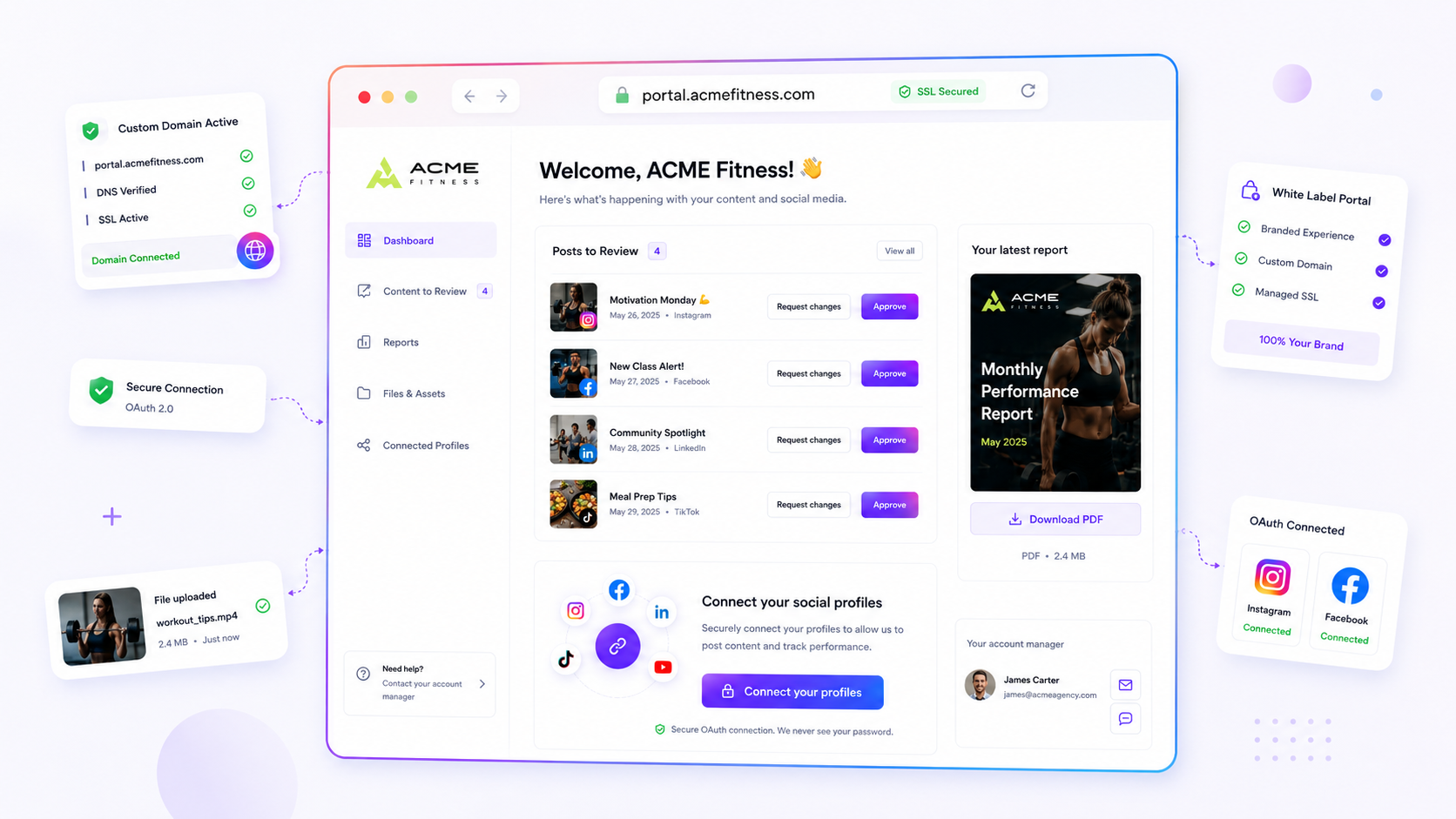
We built the Mydrop Brand Portal to solve the distribution bottleneck directly. Instead of acting as a manual file-transfer service-the "send, bounce, resend" cycle that drains your Friday afternoons-you shift to a self-service model.
At Mydrop, we see teams use the Brand Portal to consolidate everything a client needs in one place. You configure the portal permissions so the client can access exactly what they need, and nothing they don’t. They get a secure, branded dashboard where they can download their analytics reports, review pending posts, or connect their social accounts via OAuth without anyone ever needing to share a password.
It changes the dynamic from "I am waiting on your email" to "I can access my performance data whenever I want." When the client is empowered to get the data on their own, they stop pinging you on Slack, and you get your time back to actually optimize the strategy instead of managing the file transfer.
A simple shortlist checklist
When you are evaluating a tool to solve your reporting distribution issues, look past the shiny dashboard demos. Focus on the mechanics of the client experience. If it takes more than one minute for the client to get to their data, your distribution problem remains.
| Evaluation Criterion | What "Good" Looks Like | The Red Flag |
|---|---|---|
| Authentication | Secure access without requiring the client to have a full platform account. | Forcing every client to create a paid or managed workspace account. |
| Visibility | Granular permissions (e.g., allow analytics access, hide internal comments). | All-or-nothing access to the internal workspace. |
| Integration | Secure OAuth profile connection. | Asking clients to hand over social passwords. |
| Delivery | Self-service access to live links and PDF downloads. | Dependence on email attachments or external file-sharing links. |
| Context | Branded portal with consistent look and feel. | Generic, unbranded interface that confuses the client. |
If a tool forces your clients into a complex onboarding flow just to see a report, you haven’t solved the problem; you’ve just moved the friction to a different stage in the pipeline.
Conclusion
The bottleneck in your reporting isn't the depth of your analysis; it's the friction in your delivery. If you are still relying on email to send reports, you are working against your own infrastructure.
Stop treating analytics delivery as an afterthought or a manual task. By moving to a dedicated, permissioned portal, you stop being a file-transfer service and start being the strategic partner your clients are paying for. The technology to make this seamless exists, and the shift is purely operational. Audit your current workflow this week, identify the specific point where you lose time, and move that asset into a self-service environment. Your clients will appreciate the access, and your team will finally be able to reclaim those lost hours.