Replace manual password collection for social media onboarding immediately with portal-based OAuth. If your team is still emailing around spreadsheets to start onboarding, you aren't just creating friction-you are inviting a preventable security incident. The best client portal tools prioritize secure OAuth workflows, ensuring clients retain total ownership of their credentials while granting your team authorized access. This isn't just about utility; it’s about compliance, trust, and risk mitigation.
We get it: onboarding a new client is a chaotic mix of spreadsheets, email chains, and intense pressure to go live immediately. Asking for a password often feels like the "fastest" path through that mess, but it is a dangerous shortcut that creates significant, long-term security debt for both your team and your client.
Access ≠ Credentials. The most secure workflows decouple the act of granting access from the possession of secrets.
What the best tools need to handle

You need a system that treats connection as a formal, audited exchange, not a "give us the keys" conversation. When a platform handles OAuth correctly, it shields you from the liability of storing master passwords while giving your team the granular access required to manage complex brand structures.
The best tools bridge the gap between "we need access to your LinkedIn page" and "we have your entire password history."
| Feature Requirement | Why it Matters for Security |
|---|---|
| Portal-based Flow | The client authenticates directly with the provider; you never see a password. |
| Granular Scope Selection | Allows the client to select specific pages (e.g., only the US brand account) without granting full master access. |
| Token Health Monitoring | Automatically alerts you before an expired token disrupts a scheduled post. |
| Pending Connection Review | Handles multi-account responses (e.g., Facebook returns 20 pages) by letting the client select the right ones before they hit your system. |
At Mydrop, we have seen this across thousands of campaigns. Teams that rely on manual password entry often hit a "compliance wall" the moment they start working with larger, enterprise-level brands that mandate SOC2 or strict security protocols.
When you support dozens of stakeholders across different markets, your onboarding shouldn't just be about convenience. It should be about creating a hardened, scalable foundation for your operations. If your current tool forces a client to share a password, you are operating on a foundation built on trust rather than technical enforcement. Trust is great, but in a high-stakes social environment, you need both.
Operator rule: If a platform requires full account credentials for "system sync," consider it a technical debt indicator, not a feature requirement.
Where basic tools start to break

Most teams start by asking for a shared password. It feels easy, and it is certainly fast. But this shortcut is essentially handing your front-door key to a stranger. Basic tools that rely on manual credential collection create an unmanaged security liability the moment that login hits your Slack or email.
The "trust me" approach fails the moment your team grows beyond a## Where basic tools start to break
Password sharing isn't a management strategy; it's a massive security vulnerability masquerading as convenience. When you ask a client for their social media password, you are effectively creating a ticking time bomb. You are now the steward of their most sensitive credentials. If a team member leaves, if your systems are accessed, or if that account is compromised elsewhere, you are in the blast radius.
Beyond the raw security risk, basic tools break down because they lack granularity. You often have to choose between "everything" (full administrative control) or "nothing" (no way to publish). You cannot restrict an external agency to just LinkedIn and Instagram while hiding their Twitter or personal account access. That lack of control is how operational errors-like posting a personal update to a corporate feed-turn into headline-making PR disasters.
Furthermore, the maintenance of this "hand-me-down" access is unsustainable. Passwords expire, 2FA triggers, and suddenly you are back in an email chain trying to get a client to re-verify an account at 6:00 PM before a major launch. This isn't efficient; it is coordination debt that eventually cripples your team's agility.
The buying criteria that matter
When evaluating a client portal, you need tools that treat access as a delegated privilege, not a shared secret. You aren't looking for a tool that holds keys; you are looking for a tool that manages relationships.
Your evaluation should prioritize tools that support granular, OAuth-driven connections directly from the portal. The client stays in control of their own credentials, and you get exactly the access you need-no more, no less.
Use this scorecard to evaluate your current or potential portal provider.
| Evaluation Point | Basic Tool / Manual | Professional Portal OAuth |
|---|---|---|
| Credential Handling | Client shares password; you store it. | Client authorizes via OAuth; you store no password. |
| Scope Control | All-or-nothing access. | Granular selection of profiles/pages. |
| 2FA/Login Flow | Manual chasing when 2FA expires. | Native provider flows handle re-auth. |
| Auditability | Who saw the password? Unknown. | Logged access via authorized tokens. |
| Revocation | You must change passwords to stop access. | Client revokes via their own platform settings. |
Look for these three critical signals during your trial:
- Direct-to-Portal Authorization: Can your client connect their accounts without ever leaving your portal? If the tool forces them to create an account in your system just to hand over credentials, it is not a secure portal; it is just a password vault in disguise.
- Multi-Profile Filtering: Does the tool allow the client to select exactly which Facebook page or Instagram profile they want to connect? High-end tools, like what we've built at Mydrop, enable this by parsing the OAuth response and letting the client confirm the specific assets before your team ever gets access.
- Token Health Monitoring: Does the platform proactively notify you before a token expires? A pro-grade tool manages the lifecycle of that connection so you aren't scrambling on the morning of a campaign because a token silently died over the weekend.
When you decouple credentials from access, you stop managing passwords and start managing campaigns. That is the shift from being a reactive service provider to being a secure, scalable partner.
How Mydrop supports this workflow
At Mydrop, we decided years ago that if our tool required a password-sharing workflow, we were doing it wrong. We see the coordination debt that accumulates in large agencies and enterprise teams, and we wanted to stop the "please send us your credentials" email thread for good.
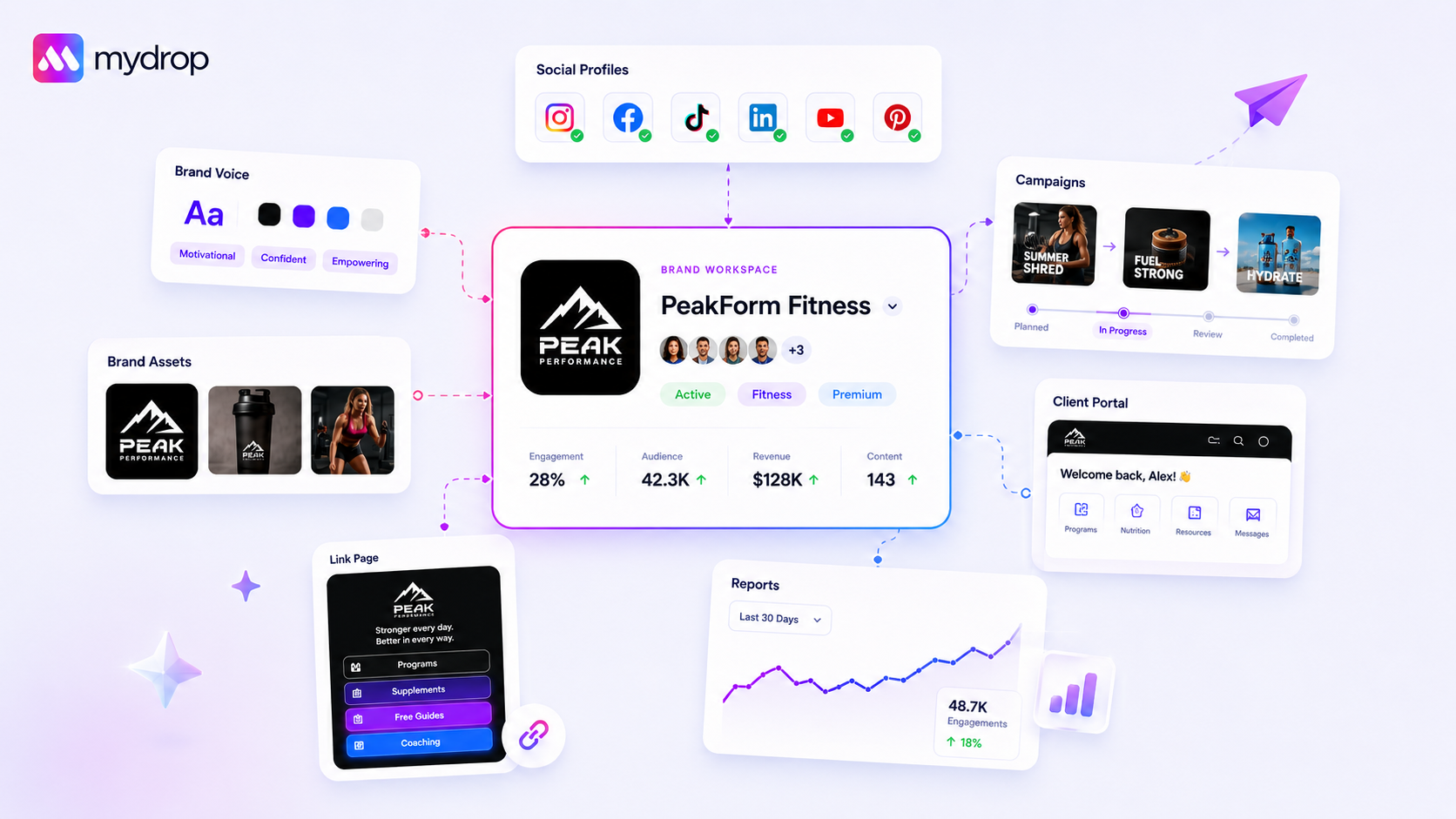
In our experience, the best way to handle this is to take the agency team entirely out of the loop during the connection phase. Instead of you chasing a client for their login, you simply invite them to their branded portal. From there, they initiate the Portal-based OAuth. They see a familiar provider prompt-Facebook, LinkedIn, X, you name it-and they log in directly on that platform's secure site.
When that OAuth handshake completes, our system receives a secure token, not a password. Crucially, the client can then see exactly which profiles they are handing over access to. If they have fifty pages but only need to connect three, they choose the three. They are in the driver's seat, and they have total clarity on what they are authorizing.
This is not just about security compliance-though your IT team will certainly appreciate the lack of password-management-by-spreadsheet. It is about building trust. When you tell a client "We do not want your password, just use this portal," it immediately frames your relationship as one that prioritizes their safety, not just your speed. It changes the tone of the onboarding conversation from "hand over the keys" to "let us connect this securely."
A simple shortlist checklist
When evaluating a client portal tool, do not take a vendor's word for it when they say they handle "secure connections." Use this checklist to audit their actual flow during your demo. If a tool fails more than two of these, it is not built for enterprise security.
- Client-Initiated OAuth: Does the client connect their own profiles directly through their portal login?
- No Password Handling: Is there any screen where your team or the tool is asked to input or store social media credentials? If yes, run.
- Granular Selection: Can the client select specific profiles or pages after the OAuth provider returns their list?
- Token Revocation: Can the client instantly disconnect or revoke access for any profile without your team needing to do anything?
- Health Monitoring: Does the tool automatically warn the client-not just you-when a token is about to expire or has been revoked?
Decision check: If a tool requires you to paste a client's password to get started, it is a legacy system. Modern tools treat credentials as radioactive-they should never touch your platform's database.
Conclusion
The friction in your onboarding process is not just an annoyance; it is a sign that your current workflow relies on outdated, high-risk practices. Every time you ask for a shared password, you are borrowing time from a future security audit or an incident you cannot afford to have.
Moving to portal-based OAuth is the single most effective way to eliminate this liability. It empowers your clients, satisfies your compliance requirements, and frees your team from the endless cycle of tracking down credentials and resetting lost passwords.
The tools exist to do this securely, and the transition is easier than most teams realize. Stop asking for passwords. Start giving your clients a secure, professional pathway to onboard. Your brand partners will respect you more for it, and your security team will finally get some sleep.