
Stop asking clients for their passwords. The moment you start collecting plaintext credentials or shuffling login tokens through email, you have already lost the security battle. For enterprise-grade teams managing hundreds of social profiles across multiple brands, secure OAuth connectivity is not a luxury feature-it is the only way to operate without accumulating massive security debt.
We get it. You have a launch coming up, the client is busy, and someone just needs to get that LinkedIn page connected now. When the pressure is on, the "share the login" shortcut looks tempting. But that shortcut turns your team into a security liability. Every password stored in a shared spreadsheet or an unencrypted document is a breach waiting to happen. If your social media management tool requires you to hold onto a client's password to post, you are not managing a brand-you are babysitting a security risk.
What the best tools need to handle

When you move to an enterprise-grade OAuth workflow, you should be looking for a platform that respects the boundary between your agency's access and the client's account ownership. The best tools handle this through granular, platform-native authorization flows that do not require password exchange.
Here is what your team should look for during any vendor evaluation:
- Granular Scope Selection: The software must allow the client to authorize only the specific profiles or pages they own. If the tool forces an "all or nothing" access level for the entire personal account just to manage one brand page, keep looking.
- Pending Connection Previews: When a client authorizes an OAuth connection, the system should allow your team to preview and confirm which specific pages or channels were returned before they go live in your dashboard. This prevents accidental imports of thousands of inactive profiles or unrelated service connections.
- Token Health Transparency: OAuth tokens are not immortal. A professional-grade tool must proactively flag expired tokens and guide you through a re-authorization flow without requiring the client to share their password again.
- Decoupled Auth State: The platform should store connection state and tokens securely, using standard cryptographic handshakes like code verifiers, rather than caching sensitive login details locally.
Operator rule: If a platform's connection flow requires a password at any point, it is fundamentally incompatible with enterprise security standards. No amount of "ease of use" compensates for the risk of a compromised primary account.
Most teams struggle because they view OAuth as a one-time technical setup rather than an ongoing maintenance workflow. In our experience, the failure is rarely in the initial connection; it is in how the tool handles the "second act"-the inevitable token refresh, the accidental de-authorization, or the need to add three new channels under a different client email.
If your tool treats every profile connection like a one-off IT ticket, you are looking at a serious distribution bottleneck. You need a system that places the power of connection in the client's hands via a secure portal, ensuring that they retain full control over their own authentication while your team manages the strategy.
Where basic tools start to break

Most software struggles the moment your operation grows beyond a single brand. You hit the wall when the platform’s OAuth flow returns ten different pages or services, and the tool treats them as one giant, unmanageable blob.
Basic tools often lack the granular intelligence to parse these responses. They might force you to connect everything in one go or, worse, they fail to distinguish between a publishable business page and a disconnected service like Google Photos or a legacy scrap-booking account. When a tool cannot preview what it is importing, you inevitably end up with a cluttered workspace full of "ghost" profiles that nobody uses, which only adds to your security overhead.
Even more dangerous is how they handle the token lifecycle. Most tools assume a connection is "set it and forget it." When a platform inevitably revokes a token or requires a re-auth, basic software simply displays a broken icon. It doesn't tell you which team member owns the connection, nor does it provide a clear path for the client to re-authorize it without logging into your dashboard. You end up back in the same old trap: emailing the client, "Hey, can you give us your login for a second so we can fix this?"
Common mistake: Treating a social profile connection as a static entry rather than a dynamic, expiring security token.
The buying criteria that matter
When you are ready to stop managing passwords and start managing access, use this decision matrix to vet your next platform. An enterprise tool must move the friction from your shoulders to the provider’s native authentication layer.
The Security vs. Friction Decision Matrix
| Approach | Security Level | Operational Friction | Password Risk |
|---|---|---|---|
| Manual Sharing | Critical Risk | High (bottlenecks) | High (plaintext) |
| Basic OAuth | Moderate | Medium (admin-heavy) | Low (token-based) |
| Portal-First OAuth | Enterprise Grade | Low (self-service) | None (client-controlled) |
The Connection Audit Checklist
If you are currently evaluating a new tool, run their connection process through this 5-point audit:
- Granular Selection: Can you select individual accounts from a multi-profile OAuth response, or does it force an "all-or-nothing" import?
- Client-Side Handoff: Can you send a portal link to a client so they authorize their own channels, or do you have to be in the room with their login?
- Token Health Transparency: Does the tool clearly surface which profiles have expired tokens and provide a "refresh" link you can forward to the client?
- Scoped Access: Does the tool limit its requests to only what is necessary for publishing and analytics, or does it demand full account management permissions?
- Auditability: Does the system log who initiated the connection and when the token was last verified?
If a tool forces you to collect passwords or manually handle the token renewal process for every client, you have not actually upgraded your workflow-you have just digitized the same broken process.
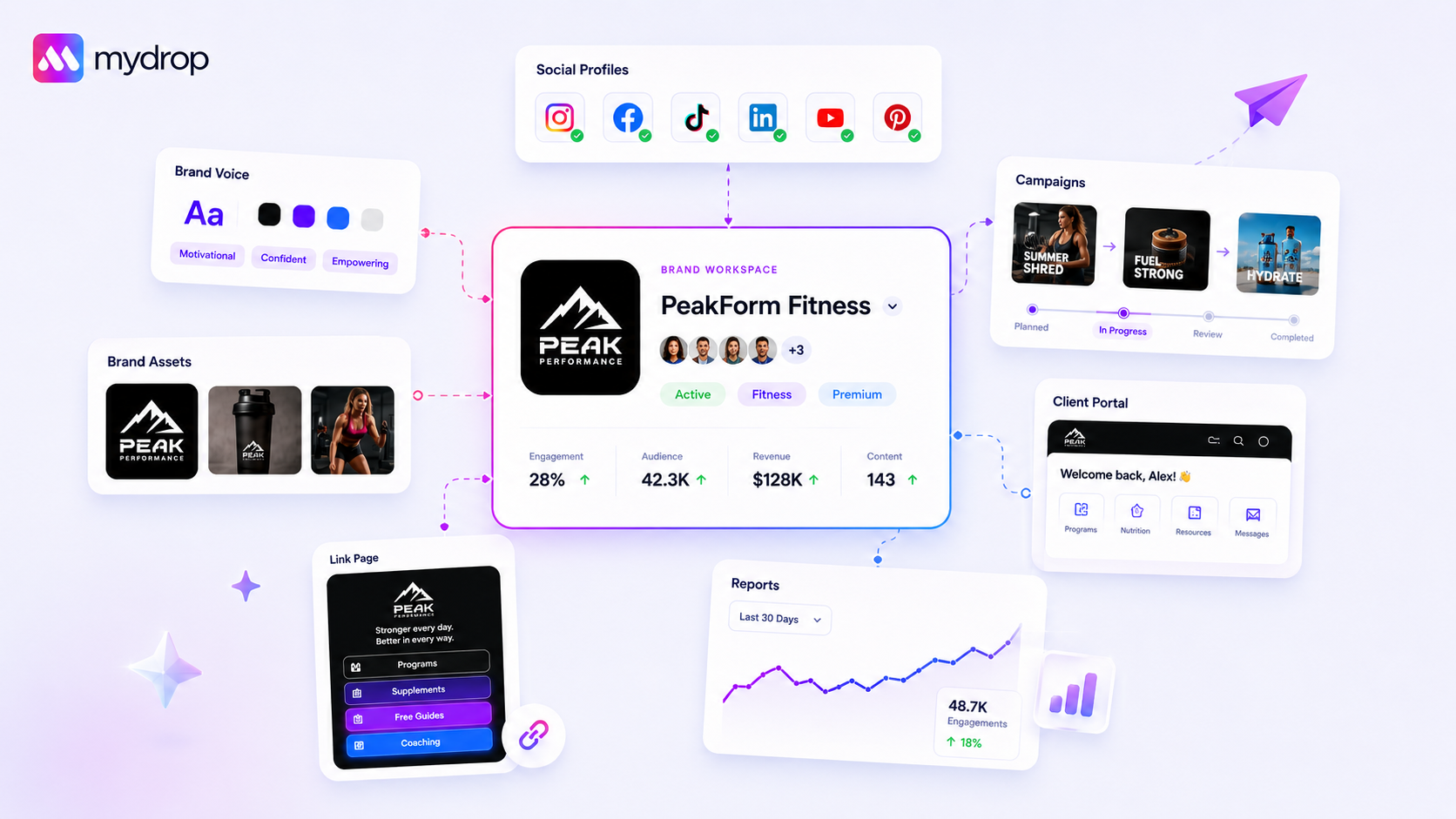
At Mydrop, we designed our Portal-First connectivity specifically to remove the agency from the middle of the credential exchange. Our Pending Profile Connection screen acts as a staging area, letting you preview exactly what is being imported before it ever hits your live workspace. This ensures you only maintain access to the channels you actually need to manage, keeping your security posture clean and your team’s focus entirely on the content.
An enterprise tool should act as a secure conduit, not a credential graveyard. If the software requires you to play "IT support" for your clients, it is failing at its primary job: enabling your team to scale without scaling your security risk.
How Mydrop supports this workflow
At Mydrop, we designed our portal-based handoff because we got tired of watching agencies lose hours to back-and-forth password resets. When you use Mydrop to manage brand profiles, you never touch a client's login. Instead, you send a secure, white-labeled portal invitation.
The client clicks through to authorize their own accounts via native provider OAuth. Once they finish, the platform uses our Pending Profile Connection flow to show you exactly what was returned. You review the list-selecting only the business pages or channels that matter-and confirm the connection.
This approach solves the three biggest headaches in agency operations:
- Security isolation: Your team manages publishing permissions, not credentials. If a team member leaves, you aren't scrambling to rotate passwords for forty brand accounts.
- Data integrity: By requiring you to preview and confirm connections, we prevent the "service clutter" common in other tools where random photo albums or calendar links get accidentally imported as social profiles.
- Operational visibility: Everything flows through a central menu (
Profiles > Connect profile). You get an instant view of token health, expiry status, and which clients have active access.
Decision check: If you are still keeping a password manager entry for a client's social media, you are running a security risk that will eventually blow up on a weekend. Move the connection to a portal-based workflow and reclaim your team's headspace.
A simple shortlist checklist
Before you commit your team to a new platform, run this quick audit against their connection flow. If a tool fails more than two of these, it is not built for the enterprise scale you need.
| Audit Point | Why it matters |
|---|---|
| Portal-based handoff | Can clients connect their own accounts without you seeing their password? |
| Pending preview | Does the tool let you select specific pages before creating profiles? |
| Token health tracking | Does the interface clearly flag expired tokens per profile? |
| Service separation | Can the tool distinguish between a publishable profile and a Google Photos link? |
| Multi-account support | Does it handle one OAuth flow returning multiple Facebook or LinkedIn pages? |
Conclusion
The goal here isn't just "better OAuth"-it is about building a professional boundary that protects your agency and your clients alike. When you replace fragile, manual processes with secure, portal-based connections, you stop being a digital locksmith and start being a strategic partner.
You do not need more credentials; you need better coordination. Focus your team on the content and the performance, and leave the authentication to a system that respects security as a fundamental part of the workflow. The teams that win are the ones that automate the mundane, lock down the critical, and move on to the work that actually grows the brand.