If your bulk tool can't provide a row-level audit before you launch, and if it doesn't let you retry failed rows without nuking the entire campaign, it is actively costing your agency more in cleanup than it saves in production. The "fast" bulk trap is real; it is the tension between speed to calendar and speed to correct. Many teams manage the spreadsheet, but few manage the failures. We get it: staring at 500 rows, wondering which ones actually made it and which ones choked on a hidden character limit, is the silent killer of agency morale. You don't need a faster launch; you need an operations center that respects the messiness of production.
What the best tools need to handle

When you are managing hundreds of brand profiles across dozens of markets, your bulk tool is either a force multiplier or a hidden source of coordination debt. Most teams don't have a content problem; they have a decision bottleneck, and that bottleneck usually appears the moment you try to scale.
For enterprise-grade quality control, look for Granular Remediability. If your tool treats a 500-post CSV as a single all-or-nothing binary switch, you have already lost control. You need an architecture that isolates failure.
Here is the short-list of what a high-performance production engine must do:
- Pre-launch validation: The tool must audit every row for platform-specific constraints before it talks to the API. If your tool does not catch a missing first comment or a broken character limit before you hit launch, it isn't saving you time. It is just deferring your work.
- Row-level retry: If 25 posts out of a 300-post campaign fail, you should be able to fix just those 25 and relaunch. Any tool that forces you to cancel the entire job, fix the file, and re-import the whole set is simply adding overhead.
- Async progress transparency: You should never wonder if a job is working. You need real-time, persistent visibility into what has succeeded, what is pending, and exactly why something failed.
The awkward truth is that most bulk tools are designed for the happy path. They love the success screen. But real work is messy. In our experience at Mydrop, we have found that the difference between an agency that scales and an agency that burns out is how they handle the unhappy path.
Operator rule: A bulk job is never truly finished until the failed row count is zero.
If your current workflow requires a project manager to manually re-post failures, you aren't using a tool; you are just paying for a more expensive spreadsheet.
Where basic tools start to break

Most bulk tools are built for the happy path, and that is exactly why they fail agencies when a campaign hits a speed bump. You upload a CSV, hit "Launch," and hope for the best-but when a single image fails or a character limit is hit, these tools often go silent, turning your calendar into a frustrating game of "find the missing post."
This is the "black box" problem. You launch 300 posts, and the tool tells you "Processing." An hour later, you check back, and it says "Done," but your calendar is suspiciously empty in spots.
Common mistake: Treating a bulk job as a monolithic action rather than a collection of independent processes.
If your tool treats the job as one big block, it can’t isolate a single failing row. You end up with 295 successful posts and five silent failures scattered across different brands and channels. Now, your campaign manager has to manually audit the entire calendar against the original source spreadsheet just to find the five ghosts. This is the definition of coordination debt. It kills morale and turns your team into manual data-entry clerks, spending hours patching mistakes that should have been caught in seconds.
The buying criteria that matter
Stop looking for the fastest launch and start looking for the fastest recovery. Your bulk tool needs to be an operations center, not just a conveyor belt. Here is the rubric we use to grade bulk capabilities. If a candidate tool can’t hit these marks, it’s not ready for an agency environment.
Bulk Quality Control Scorecard
| Metric | Basic Tools | Quality-First Tools |
|---|---|---|
| Pre-launch Audit | None or post-hoc alerts | Row-level validation before launch |
| Row-level Retry | Full job restart only | Isolate and retry failed rows only |
| Async Visibility | "Processing..." spinner | Granular row-status tracking |
Pre-launch Audit is your first line of defense. Does the tool flag schema errors before it hits the API? If it lets you queue invalid data, you are just inviting platform rejections.
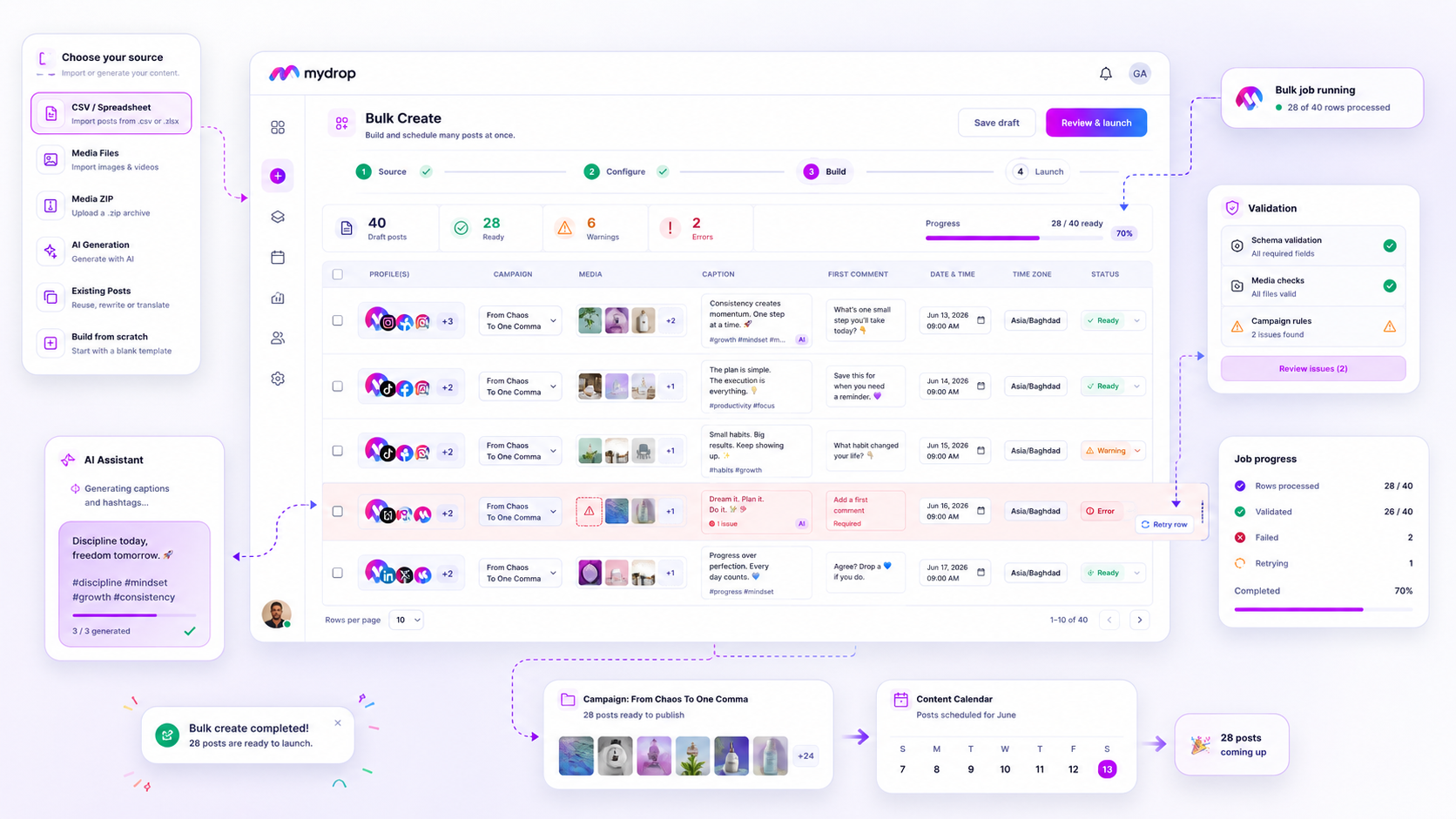
Row-level Retry is the ultimate time-saver. You should never have to nuke a full campaign because one row had a bad image link. At Mydrop, we built the Bulk Create engine around this exact pain; it validates every row, creates them asynchronously, and allows you to isolate and retry only the failures, leaving the successful posts untouched.
Async Visibility matters when you are managing hundreds of posts. You need to know not just that a job is "running," but exactly which posts are queued, processing, or failed, without having to refresh a browser tab or chase down an API response.
When you are evaluating these tools, don’t just watch the demo-ask them what happens when things go wrong. If they don’t have a clear answer for row-level remediation, walk away. You are not paying for a tool; you are paying for the ability to fix mistakes before they impact your clients. The best bulk tool isn't the one that launches fastest-it's the one that lets you fix the messiest campaigns without breaking a sweat.
How Mydrop supports this workflow
At Mydrop, we treated this like a production problem, not just another feature request. We built the Bulk Create engine specifically for the agency environment, where "move fast and break things" is a liability, not a virtue.
The core of our approach is treating your content calendar as a campaign factory. When you use the Bulk Create flow, you are not just uploading a CSV and hoping for the best. You are passing your data through a multi-step validation pipeline.
Here is what that looks like in practice:
- Intake and Validation: You choose your source-CSV, media, AI ideas, or scratch-and apply defaults. Our engine validates every row against the post schema before it launches. If there is a missing field, a character limit issue, or a format mismatch, you catch it in the audit stage, not when the API rejects the request five minutes later.
- Async Production: Once you launch, the job runs asynchronously. You do not need to keep a browser tab open or babysit the screen. The
Bulk Jobs Listenertracks the progress, handles the batching, and keeps you informed. - Granular Remediation: This is the game-changer for agency quality control. If a campaign hits a snag-say, 10 out of 500 posts fail because of a platform-side API hiccup-you don't have to restart the job or hunt down those specific rows. You open the job, see the failed rows clearly highlighted, and hit Retry only on the ones that failed.
By focusing on row-level visibility, we turn a potential "all-or-nothing" disaster into a manageable maintenance task. It is the difference between losing an entire Saturday fixing a job and spending five minutes on Monday morning retrying a handful of rows.
A simple shortlist checklist
When you are vetting bulk tools for your team, don't just look at how fast they can upload a file. Ask these four questions to see if the tool respects your operational reality.
- Does the tool offer a pre-launch error audit? If you cannot see the validation errors before the job hits the platforms, you are just shipping blind.
- Is the job processing truly asynchronous? Can you close the browser and walk away without killing the production pipeline?
- Can you retry individual rows? If a row fails, can you fix it and push it, or does the tool force you to wipe the whole campaign and start over?
- Does the job history provide actionable status? Can you easily export or filter by
Pending,Done, andFailedstatus, or is it just a "completed" vs "failed" binary?
If a vendor cannot answer "yes" to these, they are likely built for the "happy path." That is fine for a side project, but it is not built for the messy, high-volume reality of enterprise social media management.
The operational truth
The hidden cost of "fast" bulk tools isn't the subscription price; it is the coordination debt you accrue when the tool fails silently.
Most teams do not have a content problem. They have a decision bottleneck. If your software forces your team to spend hours manually patching failed posts instead of focusing on strategy, your tool is the bottleneck.
True bulk efficiency is not about how many posts you can throw at the wall. It is about how much control you retain when the wall pushes back. Find a tool that respects the messiness of production, gives you the audit trail to own your quality standards, and lets you spend your time on the work that actually moves the needle.