
The most effective approach to fixing low-engaging social media captions isn't by churning out more AI-generated text; it's by using diagnostic AI that scores your draft against your specific brand context before you hit publish. If your team is stuck in a cycle of high-effort posts that consistently underperform, you don't need a faster copy machine. You need an objective coach. We know the feeling-you’ve spent hours finessing a post, ensuring every emoji is just right, only to watch it flatline in the feed. That constant, exhausting post-mortem is a massive drain on your resources. In an industry that demands constant, high-volume output, guesswork isn't a scalable strategy. Shifting from reactive guessing to proactive, diagnostic-led optimization is the only way to break the loop and start seeing real conversion.
What the best tools need to handle

When evaluating AI tools for social media, you have to prioritize diagnostic depth over generative breadth. Most platforms will happily spin up five variations of a caption in seconds, but that's just adding to your noise-not solving your engagement drop. A truly useful tool needs to act as a hard-nosed editor, not a ghostwriter. It should look at your draft and your attached media, then tell you where the friction is. Are your hooks strong enough for the first three seconds of scrolling? Does the caption actually reflect your brand's established voice? Most importantly, does it link the text to the visual attachment, or is it just generic copy that could belong to anyone?
Here is how to distinguish between a "generative-only" tool and one that actually understands the diagnostic requirements of professional social media teams.
| Capability | Generative-Only Tool | Diagnostic-First Tool |
|---|---|---|
| Primary Action | Produces text variants | Scores draft for engagement |
| Context | Generic web data | Brand-aware context |
| Feedback Loop | None | Actionable recommendations |
| Goal | Quantity | Precision and impact |
| Workflow | Copy/Paste/Guess | Draft > Score > Iterate |
Operator rule: If your AI tool cannot explain why a post might fail based on your specific media and brand context, it is not a tool for enterprise teams-it is a toy for rapid, mediocre content creation.
To fix an engagement bottleneck, your workflow should be Draft -> Score -> Analyze -> Update. If your current tools don't have that middle layer-the scoring and the analysis-you’re essentially firing arrows in the dark and hoping you hit the target. The best tools bridge the gap between creative impulse and data-backed performance.
Where basic tools start to break

Generic AI tools are built to fill space, not to solve engagement problems. If you ask a standard generative model to "make this caption better," it will almost always default to overly enthusiastic, brand-agnostic fluff. It doesn't know your specific audience habits, your current campaign goals, or why that last post with the same image tanked.
The real trap here is context blindness. A tool that only looks at your text input is operating in a vacuum. It is like asking a copywriter to rewrite your post without showing them the image it is attached to or telling them which brand account it is for. You end up with a caption that might sound grammatically perfect but is culturally or contextually tone-deaf.
Worse, basic AI tools are black boxes. They give you a result without explaining the why behind it. When your goal is to understand why engagement is flatlining, you need a coach that highlights the friction points, not just a ghostwriter that gives you three more options that are just as likely to fail.
The buying criteria that matter
When shopping for a tool to help your team fix low-engaging posts, look for systems that prioritize diagnostic capability over raw output speed. Your team is already fast enough-what you need is better decision-making before you hit the publish button.
Here is a simple decision matrix to evaluate whether a platform is a serious diagnostic partner or just another generative toy.
| Feature | Diagnostic Partner | Generic Generator |
|---|---|---|
| Brand Context | Uses your saved style, voice, and past assets. | One-size-fits-all generic tone. |
| Diagnostic Feedback | Explains why the draft is weak (e.g., "no clear hook"). | Offers "more text" options only. |
| Media Context | Analyzes the attached image, video, or link. | Ignores attachments completely. |
| Virality Score | Scores against specific audience/platform data. | No scoring mechanism. |
At Mydrop, we have found that the most effective workflows are not about AI replacing the writer-they are about the AI validating the writer’s work. When you use a Composer AI Panel, you are not just hitting a "generate" button. You are using a system that reviews your media attachments, checks your brand context, and provides a virality score that tells you exactly where the friction is.
A serious tool must treat the draft as a living entity. If the tool does not know what you are posting with or for, it cannot tell you how it will perform.
Decision check: If your AI tool cannot tell you why a post is likely to fail before it goes live, it is not a diagnostic tool. It is just a text-spinner that adds to your coordination debt.
Do not be seduced by the volume of content an AI can produce. Focus on the refinement loop: Draft, Score, Analyze, and Update.
How Mydrop supports this workflow
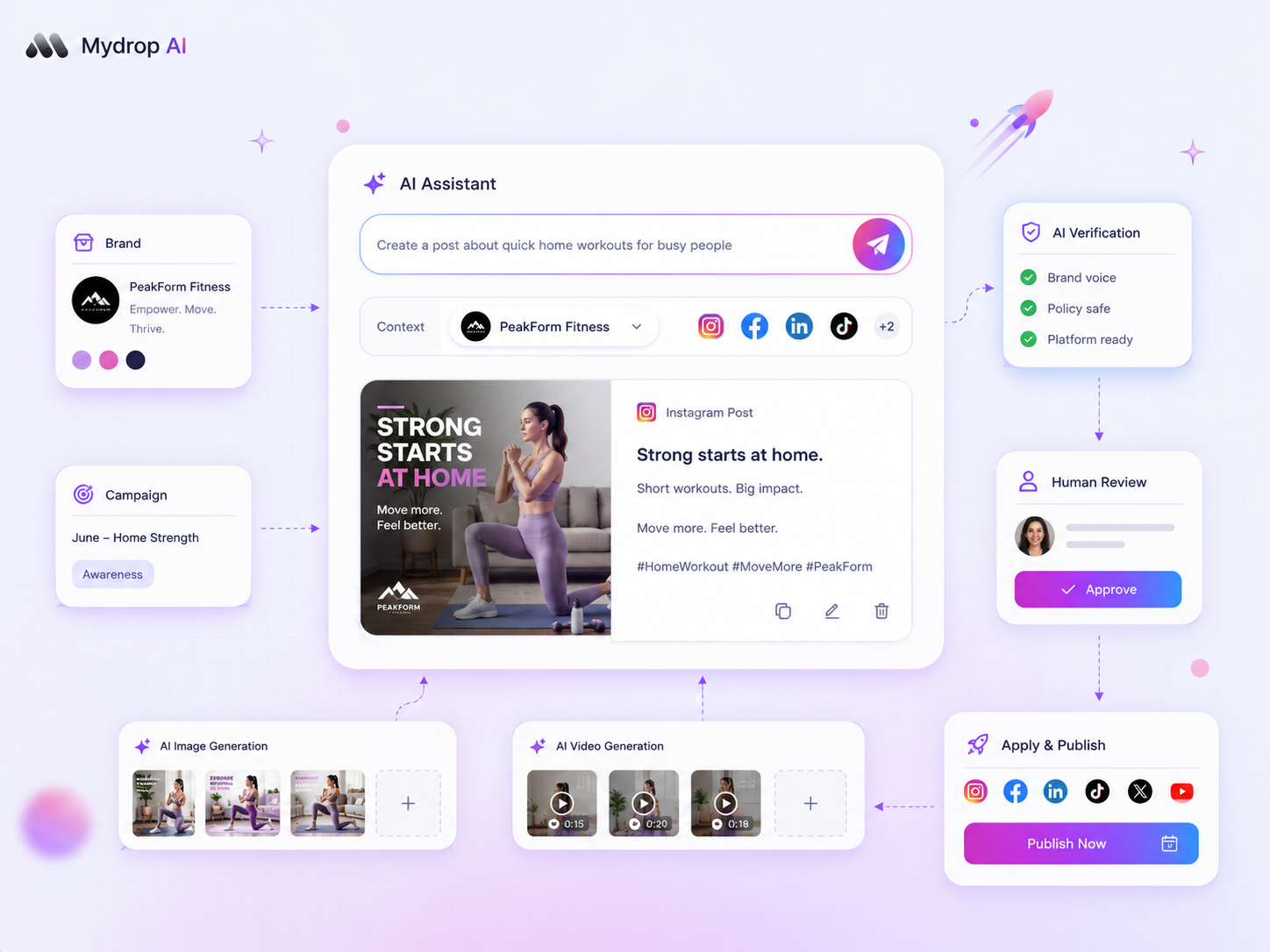
When you are deep in the editor and your post is failing to land, you need a coach, not just a thesaurus. At Mydrop, we designed the Composer AI Panel to act as that diagnostic layer. Instead of starting with a blank prompt, you begin with your draft and the specific assets attached to it.
The workflow is simple but deliberate: you draft the post, click the Virality Score button, and let the tool analyze the caption against your brand context and the media attached. If the score is low, say 42/100, the AI does not just rewrite it blindly. It gives you actionable feedback. It might point out that your hook is weak, your CTA is buried, or your tone is inconsistent with the audience you are targeting. You take that feedback, iterate on the caption, and re-score it. You are not searching for a magic button to create content; you are refining a strategy until it hits a threshold that makes sense for your campaign.
This is where the distinction matters. Generative AI alone fills space. Mydrop’s Virality Scoring uses your specific brand context to tell you why a draft might fail before it ever reaches your audience. You are still the editor, but now you are an editor armed with data, not just gut feeling. This reduces the cycle of post-mortem analysis because you are catching the issues during the creative process, not after the analytics dashboard confirms the flop.
A simple shortlist checklist
When evaluating tools to solve your engagement problems, stop looking for "better content generation" and start looking for "better content analysis." Most platforms are great at the former and terrible at the latter. Use this checklist when vetting your next marketing technology purchase to ensure you are buying a diagnostic partner, not just a text machine.
| Buying Criteria | What to look for | The Red Flag |
|---|---|---|
| Context Awareness | Can the AI see attached media and brand files? | Only sees the raw text you paste into it. |
| Diagnostic Output | Does it explain why a score is low? | Only provides a generic "optimized" rewrite. |
| Iterative Scoring | Can you re-score after making your own edits? | A "one-and-done" generation approach. |
| Brand Guardrails | Are prompts locked to your style and rules? | Lets you generate anything without constraints. |
| Workflow Logic | Does it fit into your review/approval path? | Acts as a silo outside your main dashboard. |
If a tool cannot do at least four of these five things, it is likely just an automated writer that will increase your volume without fixing your engagement issues.
Conclusion
Most teams do not have a content problem. They have a decision bottleneck. You are already creating enough content, but you are not effectively validating which of those ideas will actually work. Chasing viral trends or trying to out-generate the competition is a losing strategy because it ignores the foundational issue: consistency and context.
Stop trying to out-generate the algorithm and start out-thinking it. The goal is to move your team from reactive guessing to proactive optimization. By shifting your process to include a diagnostic phase, you turn your AI tools into a filter, not a funnel. The next time a post underperforms, do not blame the platform. Look at your creative process and ask: did we use the tools available to us to diagnose the issue before we hit send?
Your goal is to build a reliable editorial engine. Start today by making Virality Scoring a non-negotiable step in your creative workflow, regardless of which tool you use. Your future self-and your engagement metrics-will thank you.