
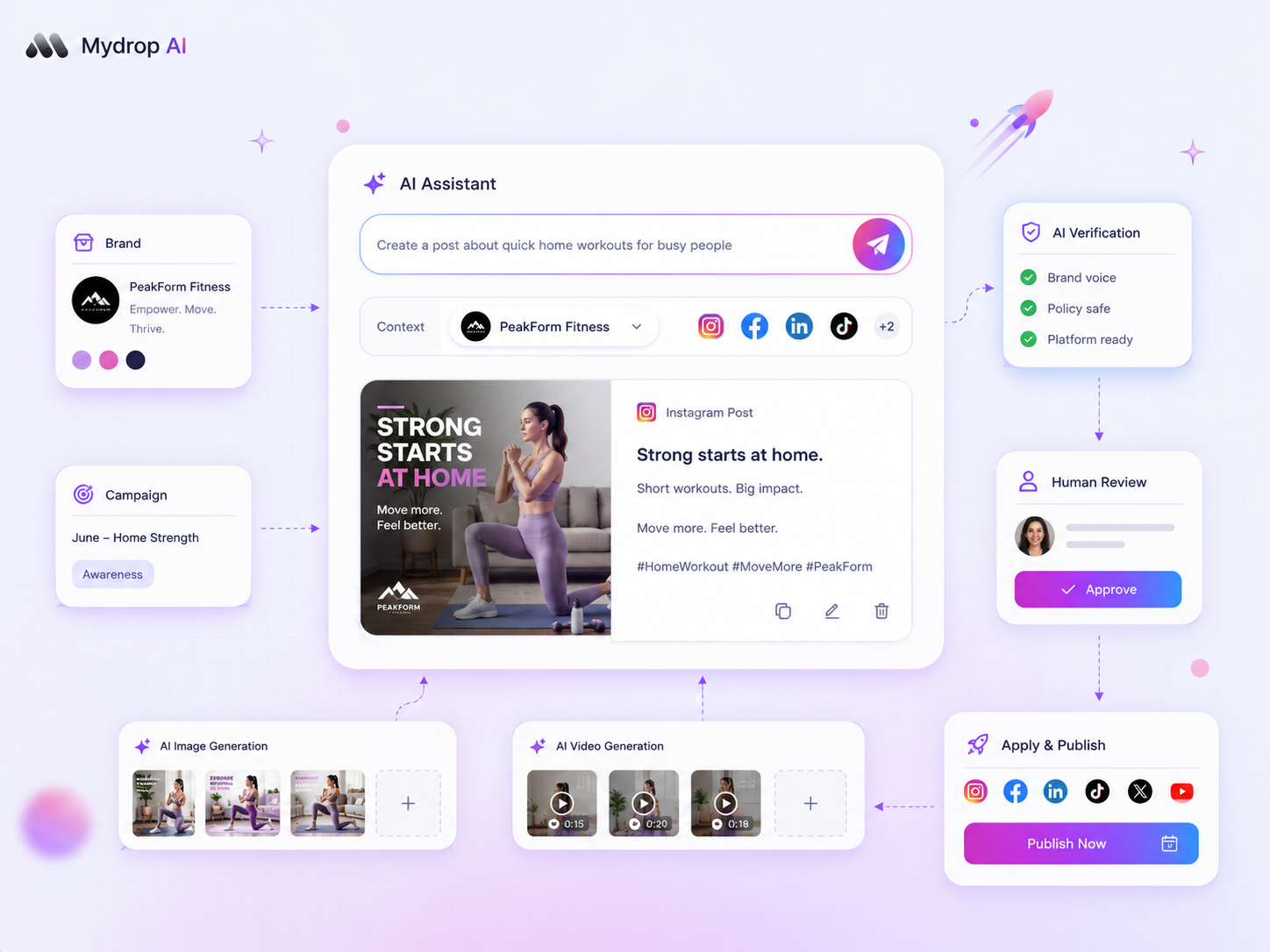
The real secret to scaling AI content isn't finding a tool that writes fast; it is finding one that stops your team from spending hours fixing "brand-blind" copy. If your current AI stack treats every brand as a blank slate, you aren't building a content engine, you are building a re-drafting factory.
We know the drill. You have five different brand voices, a dozen stakeholders with varying opinions, and a calendar that refuses to slow down. It feels like every time you fire up a new AI tool, you end up doing more work in the edit than you would have if you had just written it yourself. That is the kind of coordination debt that eventually craters a high-volume social operation.
What the best tools need to handle

The best AI generation isn't about the model's fluency; it is about its context awareness. At Mydrop, after seeing thousands of workflows across agencies, we have found that generic tools fail because they lack the "connective tissue" between the brand and the post. If the tool does not know your brand colors, historical guidelines, or the specific media context of the asset you are attaching, it is essentially throwing darts in the dark.
For enterprise-grade teams, this comes down to four non-negotiable operational requirements:
| Requirement | Why it Matters | Operational Penalty of Failure |
|---|---|---|
| Brand Context | Ensures the output actually sounds like the brand. | Constant voice-drift and manual re-writing. |
| Media Ingestion | Connects visual content to caption intelligence. | Disjointed posts; visual-text mismatch. |
| Saved Prompts | Standardizes recurring campaign structures. | Wasteful, inconsistent, "fresh-start" prompting. |
| Feedback Loops | Provides virality scoring before publishing. | High revision rates after the fact. |
When these are missing, teams inevitably fall into the re-prompting cycle. This is where someone spends ten minutes generating a caption, only to spend twenty minutes stripping away the "AI-isms" and correcting the brand voice. The AI promised to save time, but it just created a new, more annoying bottleneck.
Operator rule: If your AI tool requires you to paste your brand style guide into every single prompt, your tool is the problem, not your prompts.
You should be looking for a system that acts as a context-aware proxy. It should be able to pull from your stored brand assets-like your tone guidelines or past winning posts-to inform its suggestions, rather than relying on you to act as the primary translator. In an agency setting, this isn't just a "nice to have." It is the difference between a team that focuses on strategy and a team that is perpetually buried in a spreadsheet of pending copy edits.
At the end of the day, most agencies do not have a content generation problem; they have a decision-bottleneck problem. You need a tool that handles the heavy lifting of generation while providing the guardrails needed to make that content "publish-ready" without a three-round feedback cycle.
Where basic tools start to break

The real trouble begins the moment you move past the "single prompt" phase. When you are managing three different brands with distinct audiences, a basic generator becomes a liability because it has no memory of the nuance you fought to build.
You know the pattern: you generate a caption, read it, realize it sounds like a bubbly influencer instead of your brand's authoritative tone, and start the re-prompting cycle. After three attempts, you realize you have spent ten minutes on a task that should have taken thirty seconds. The AI isn't the problem; the lack of context is.
Basic tools usually fail because they are essentially just a text-box interface to a model. They lack the connective tissue to understand your brand's unique assets, history, or specific guidelines. If the tool can't "see" the media attachment or "read" your brand's style guide before it starts typing, you are essentially asking a stranger to write your corporate strategy based on a vague vibe check.
Common mistake: Treating AI as a standalone writer rather than a member of your existing team. If you don't feed it the same context your junior copywriter needs-brand voice, goals, and visual style-you shouldn't be surprised when the output needs a total rewrite.
When the tool doesn't know who it is speaking for, your team ends up with "coordination debt." You spend more time editing and sanitizing AI-generated output than if you had written it from scratch. For an agency lead, this turns a "productivity tool" into an unintentional bottleneck.
The buying criteria that matter
Stop evaluating AI tools based on how fast they generate text. Instead, look for integration depth and guardrail management. You want a platform that treats your brand context as a first-class citizen, not an afterthought.
If you are evaluating platforms for a multi-brand team, use this scorecard to pressure-test your options.
| Benchmark | What to look for | Why it matters |
|---|---|---|
| Brand Context | Does it ingest brand docs or style guides? | Prevents "tone drift" in your content. |
| Attachment Intelligence | Can it see and analyze your media files? | Ensures captions match the actual visual. |
| Structured Prompts | Can you save and reuse custom prompts? | Turns brand "best practices" into a repeatable workflow. |
| Virality Signaling | Does it offer objective feedback? | Reduces guesswork before the approval stage. |
| Bulk Capability | Can it map fields across many posts? | Moves AI from a single-task toy to an enterprise machine. |
When we look at how the best teams work, they aren't just using AI to "generate text." They are using it to enforce consistency.
At Mydrop, we see teams succeed when they stop viewing AI as a "creative" and start using it as an intelligence layer within their existing composer. They use the composer AI panel to pull in specific brand context-colors, tone, and file metadata-before the first word is even drafted. When your AI is already "brand-aware" because it has access to your library and your saved prompts, the difference in output is night and day.
The final test? Check if your tool allows for AI object generation. You don't just want a caption; you want a tool that can generate structured data-hashtags, first comments, and campaign fields-without you needing to toggle between five different tabs.
If the tool doesn't help you govern the output as much as it helps you generate it, you aren't really scaling. You are just creating a larger pile of work for your editors.
How Mydrop supports this workflow
At Mydrop, we see the same pattern across hundreds of brand profiles: the friction isn't the writing, it's the coordination debt. Teams spend more time hunting for the right tone guidelines or waiting on internal feedback than they do actually creating. Our approach to AI generation is built to solve this by embedding the brand context directly into the composer.
When you use the AI panel in the composer, the tool doesn't just guess; it pulls from your specific brand settings, past performance data, and even attached media files to shape the output. If you have a campaign coming up for a specific product, you can attach the creative brief or product specs, and the generation logic uses that as ground-truth context.
We also know that "getting it right the first time" is rare. That is why we added virality scoring and saved prompts. You can create a library of your best-performing brand styles and re-use them as prompts across the whole team, ensuring your junior creators sound as polished as your seasoned strategists. You aren't just generating text; you are essentially deploying a mini-brand-expert that knows exactly how your organization talks, without having to explain it every single time.
Decision check: If your AI tool requires a human to rewrite more than 30 percent of the output, you aren't using a tool; you're using a distraction.
A simple shortlist checklist
Before you commit to a new platform or renew your current subscription, run these five checks to make sure you aren't buying a liability. If the tool can't hit these, your team will eventually outgrow it.
| Requirement | What to look for | Why it matters |
|---|---|---|
| Brand Context | Does it save specific brand colors, tone-of-voice, and rules? | Prevents voice drift across multiple teams. |
| Attachment Ingestion | Can you attach a PDF or doc for the model to read? | Stops "hallucinated" facts in your copy. |
| Prompt Library | Can you save and share prompt templates team-wide? | Eliminates duplicated effort on recurring styles. |
| Virality Signaling | Does it offer feedback before you hit publish? | Replaces guessing with data-driven edits. |
| Automation Compatibility | Does the AI work in bulk-create/automation flows? | Scales output without losing quality control. |
- Test for context leakage: Can the tool differentiate between Brand A and Brand B, or does it try to force a one-size-fits-all style?
- Review the feedback loop: Is there a way for a lead to score or flag generated content for others to see?
- Check the "Reviewer Tax": How many clicks does it take to get from an AI draft to an approved, scheduled post?
Conclusion
The goal of scaling content generation is not to replace your team with a machine. It is to remove the grunt work so your people can get back to being creative, strategic, and human. When you stop chasing the "next viral post" and start building a context-aware engine, the pressure to publish more feels significantly lighter.
The most successful agency leads we work with share one simple philosophy: they treat their AI stack like a junior editor. They give it clear instructions, provide the right context, and always hold the final vote. If your current tool isn't helping you do exactly that, it’s time to move on. You don't need another writer. You need a system that actually understands your brands.