
The transition from individual brand silos to a centralized management model is inevitable for growth, but pulling the trigger too early creates stifling bureaucracy. You are ready to move to a centralized Brand Group structure the moment your team spends more time hunting for the right logo, palette, or contact detail than they do actually creating content. If you find yourself asking, "Which version of this brand file is current?" more than twice a week, you have officially hit the ceiling of your current workflow.
We get it. Managing multiple portfolios often feels like keeping a dozen spinning plates in the air. When you are in the thick of it, that chaos feels like hustle, but eventually, it becomes a hard limit on your agency's ability to scale. You are not alone, and this is much harder than it looks, but the fix is simpler than you think.
The operating problem this solves

Most teams do not have a content problem; they have a coordination debt problem. Every time a designer emails a logo, or a social manager asks which hex codes to use for a specific sub-brand, you pay a "tax" on your time. Over thousands of posts and dozens of stakeholders, this tax quietly erodes your margins and kills your velocity.
In our experience at Mydrop, we see teams managing hundreds of brand profiles treat their setup as "flexible" when they are actually just scattered. They allow each channel to maintain its own local assets and context, which works fine for a single person. But as soon as you have more than one person touching an account, the lack of a single source of truth creates a massive distribution bottleneck.
Here is where the confusion usually hits the hardest:
| Symptom | The Hidden Cost |
|---|---|
| Asset Scavenging | 10+ minutes per post spent tracking down the right logo or asset. |
| Brand Drift | Inconsistent tone or color use across profiles, requiring mid-stream corrections. |
| Onboarding Lag | Hours of manual "file dumping" to get a new team member up to speed. |
| Context Switching | AI tools hallucinating details because they lack a unified brand container. |
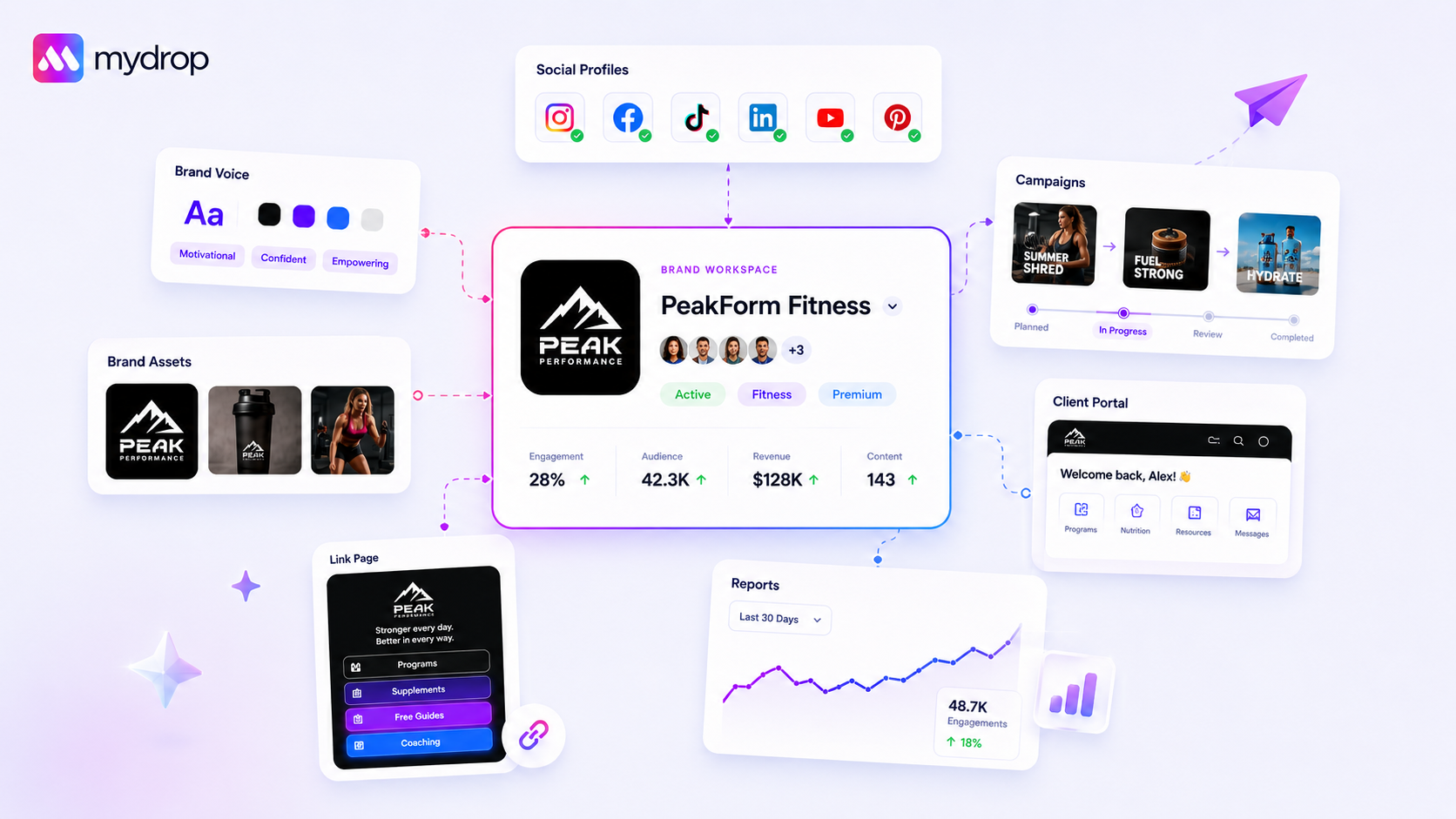
This is the part most teams underestimate: you are not just managing files; you are managing the mental overhead of your entire staff. By using a feature like Brand Groups, you aren't just filing things away-you are creating a container that lives in your composer, your AI generation tools, and your reporting suite.
When you align your profiles under a shared identity, you move from a "find-and-send" workflow to a "select-and-publish" habit. That is the moment the platform becomes an extension of your team rather than just another dashboard to manage. A simple rule helps: if your tools don't know the brand as well as your senior strategist does, you aren't centralized yet-you're just organized on paper.
The minimum system that works

You do not need a complex governance structure to start. The most effective "minimum system" is simply a container that forces you to define your identity variables in one place, rather than leaving them to the whim of a Google Drive folder that no one can find.
When you create a Brand Group in Mydrop, you are doing more than just grouping profiles. You are building a digital "anchor" for your assets. By centralizing the logo files, hex codes, font families, and AI guidance like tone or marketing goals, you stop the perpetual "re-finding" of assets that kills creative momentum.
If your team is currently toggling between five different tabs to verify if you are using the right blue on a campaign graphic, you have already outgrown a siloed approach. A minimum working system means that when a creator opens the composer, the brand's identity-colors, logos, and mission-is already there, loaded and ready.
Operator rule: If your team spends more than 15 minutes per post just gathering or verifying basic brand assets, your "flexibility" is actually just a hidden tax on every single piece of content you produce.
Where teams overbuild the process
The biggest mistake we see is teams trying to "force" centralization before the underlying workflows actually align. Just because you manage five distinct brands doesn't mean they belong in the same Brand Group.
When you force unrelated entities into one group, you create "context noise." Your AI tools might accidentally pull tone guidance from a luxury fashion brand for a casual lifestyle post, or your reports might become an unreadable mess of disparate metrics.
Here is a quick way to audit whether you are ready to centralize, or if you are simply over-engineering your workflow:
| Audit Point | Stay Siloed (Independent) | Centralize (Brand Group) |
|---|---|---|
| Asset Sharing | Unique, brand-specific assets | Shared logos, palettes, and media libraries |
| AI Context | Low crossover between brands | High crossover; shared goals and tone |
| Team Access | Different teams for every brand | Shared team members across a portfolio |
| Publishing Flow | Distinct approval cycles | Consolidated reporting and scheduling |
Common trap: Don't conflate "brand" with "client." An agency might have one client with three vastly different sub-brands that serve different markets. If those brands don't share a fundamental identity or workflow, keeping them as separate containers is not a failure-it is common sense.
You are overbuilding if you find yourself spending more time managing the permissions of the centralized group than you save by actually using the assets within it. The goal is to reach a state where the system is invisible. If you have to explain the "structure" of your brand groups to a new hire for more than ten minutes, you have likely built a cage instead of a conduit.
Focus on centralization only when the friction of not being centralized outweighs the effort of maintenance. Most teams do not have a content problem; they have a decision bottleneck. Start with a single, high-frequency portfolio, see if your feedback cycles drop, and scale only when the process becomes boring.
How to run the cadence
Transitioning to centralized Brand Groups fails when you treat it as a one-time migration rather than a permanent operational shift. The goal is to move from a "chase-and-verify" loop to a "select-and-publish" flow.
At Mydrop, we see the most successful teams adopt a weekly maintenance cycle. If you don't audit your brand context, it becomes stale, leading to the exact "brand drift" you were trying to eliminate.
Your weekly check-in:
- Asset sweep: Does the
mediaDocIdslist contain the latest seasonal photography? - Context check: Are the
groupInfosfields-like marketing goals or current tone-aligned with this month's campaign? - Membership audit: Any profiles added or removed? Do it once in the brand group, and the change cascades everywhere.
Decision check: Never update brand assets during a live launch. If it is not in the Brand Group before the 24-hour mark, it stays out of the campaign. This single rule stops the last-minute scramble and forces team discipline.
The proof that the habit is working
How do you know the coordination debt is actually dropping? You stop hearing the "Wait, which logo?" question.
We often suggest teams track the Feedback Cycle Ratio. Take the number of comments on a draft that relate to brand identity (colors, wrong font, outdated logo) and divide by the total number of posts published.
| Metric | Siloed Workflow (The Struggle) | Grouped Workflow (The Target) |
|---|---|---|
| Brand Identity Comments | 1.5 per post | < 0.1 per post |
| Asset Search Time | 10+ minutes per campaign | Under 30 seconds |
| Onboarding Time | 2-3 days of permissions hunting | Minutes to add to Brand Group |
| Compliance Risk | Manual cross-check required | Inherited brand guardrails |
If your brand identity feedback ratio is high, your team is spending too much time playing "editor" on things that should have been locked in the Brand Group settings hours ago. When you see those numbers drop, it means you have successfully moved from managing assets to managing outcomes.
Conclusion
Centralization isn't about hoarding power. It is about removing the friction that prevents your best people from doing their best work.
If you're still hunting for the right hex code at 6 p.m. or manually verifying if a logo is the 2024 version, you are carrying unnecessary coordination debt. Stop managing the files and start managing the brand. Whether you are using Mydrop to group your profiles or just cleaning up your internal folder structure, the moment you define a single source of truth-and stick to it-your team's speed will jump.
It is time to stop the scramble. Pick one client portfolio, group their profiles, extract those assets, and see how much quieter your next launch week feels.