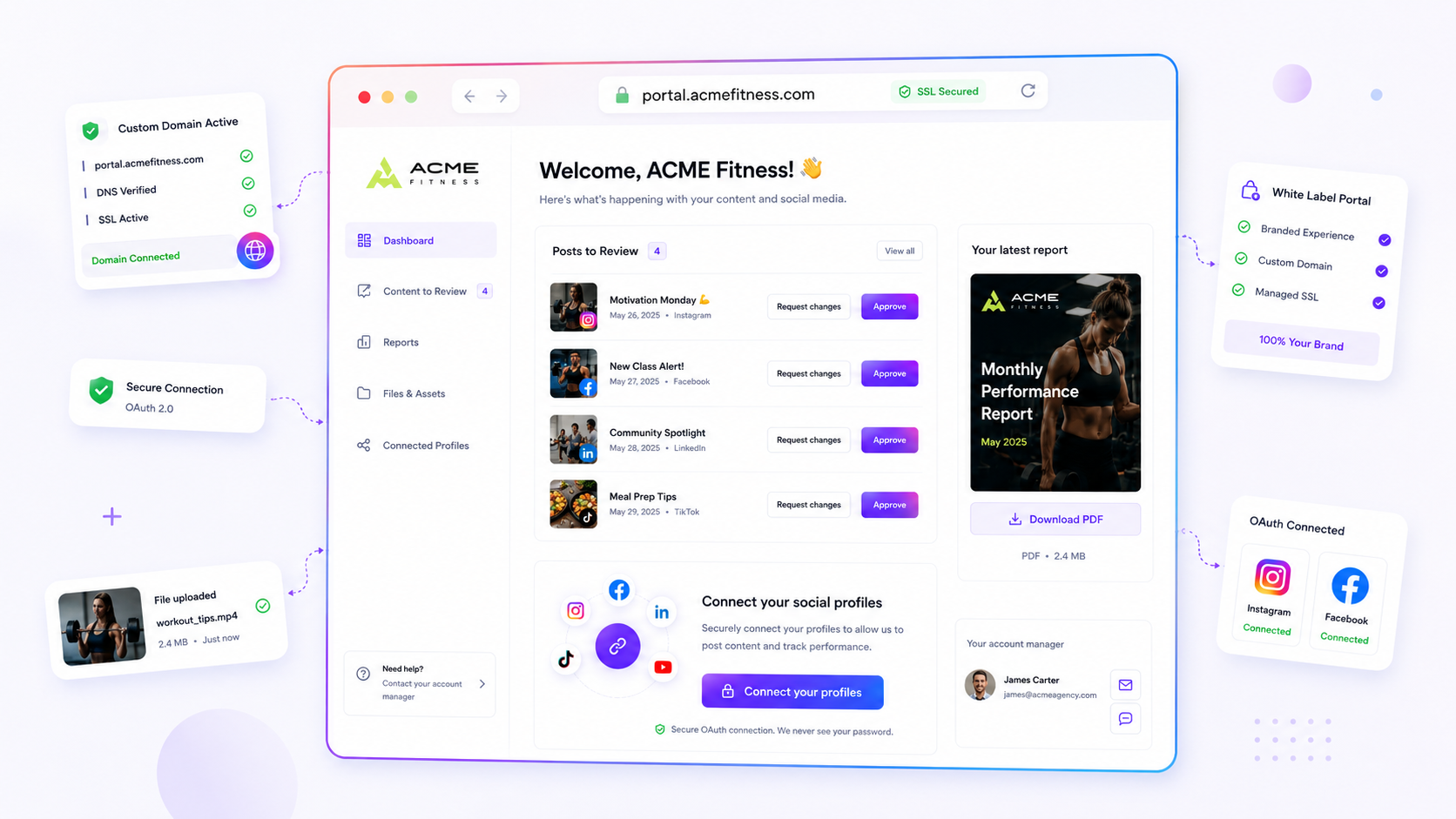
Success for a brand portal isn't measured by how much your clients love the design. It is measured by how quickly the portal makes itself invisible. You are looking for a collapse in approval windows-from forty-eight hours to forty-eight minutes-and the total replacement of manual file-chasing with client self-service. If a client is spending hours "browsing" your portal, something is usually wrong. In a high-performance workflow, you want them in, out, and back to their real job, leaving a trail of "Approved" statuses in their wake.
We have all been in the Friday evening scramble: chasing a stakeholder for a login code that expired ten minutes ago, or digging through a fifty-message email thread to find one "LGTM" on a creative asset. It is messy, it is unbillable, and it makes high-level strategy feel like low-level admin. Coordination debt is the silent killer of agency margins, and a portal is your best tool for paying it down.
Most teams fall into the Politeness Trap. They think a portal is successful if the client hasn't complained. In reality, if your team is still manually emailing attachments or "reminding" clients to check the dashboard, the system has failed. The awkward truth is that a pretty portal that doesn't solve the "password-sharing" nightmare or the "where is the logo" hunt is just another login the client will eventually ignore. We want to move the conversation from "Do you like the portal?" to "Here is how much risk we removed from your workflow this month."
The decision each metric should trigger

Data is just noise unless it forces you to change how you work. In our experience at Mydrop, the most effective teams use their portal metrics as a diagnostic tool for their client relationship. If a metric is off, you don't just "try harder"-you change the workflow.
- Approval Velocity: If the average time from "Draft" to "Approved" is creeping past twenty-four hours, the decision is to simplify the portal permissions. You likely have too many cooks in the kitchen. Reduce the required reviewers or set a "auto-approve" window for low-stakes content.
- Connection Integrity: If your percentage of profiles connected via OAuth is low, stop accepting passwords via email or Slack immediately. This is a security decision, not a technical one. A low score here means your team is still carrying the liability of client credentials.
- File Self-Service Rate: If you are still getting "Can you send me that logo?" pings, your folder structure is probably a crime scene. The decision here is to audit your portal assets and use clearer naming conventions so the client doesn't feel the need to ask.
Operator rule: A portal is a boundary, not a destination. If you have to explain where to click more than once, the interface or the permission set is too complex for that specific stakeholder.
The goal is to reach a state where the portal handles the "housekeeping" of social management, leaving your team free to focus on the actual strategy. When you see a drop in "status check" pings, you know you've won.
The scorecard that keeps reporting useful

The mistake most teams make is trying to report on a brand portal the same way they report on a marketing website. You do not want "high engagement" or "long session durations" here. If a client is spending forty minutes wandering around your portal, they aren't admiring the UI--they are likely lost, frustrated, or can't find the one PDF they need for their board meeting.
In our experience at Mydrop, the goal of a portal is to become a high-speed utility. You want the client to zip in, click "Approve," and get back to their day. To track if that is actually happening, you need a scorecard that measures the removal of friction rather than the accumulation of clicks.
The 4-Point Portal ROI Scorecard
| Metric | Calculation Method | Good | Better | Best |
|---|---|---|---|---|
| Approval Velocity | Avg. hours from "Pending Review" to "Approved" status. | < 24 Hours | < 8 Hours | < 2 Hours |
| Connection Integrity | % of profiles connected via OAuth vs. manual password sharing. | 70% | 90% | 100% |
| Self-Service Rate | Total file downloads / Total "Can you send me that?" emails. | 2:1 Ratio | 5:1 Ratio | 10:1 Ratio |
| Coordination Volume | Total manual status pings (Slack/Email) per campaign. | 5 Pings | 2 Pings | 0 Pings |
We've seen this across thousands of workflows: the moment you move to a "Best" tier on connection integrity, your security risk drops to near zero. No more expired login codes or frantic 6:00 PM calls because a social platform flagged a "suspicious login" from a new IP. When you use Mydrop to let clients connect their own profiles through OAuth, the portal isn't just a dashboard--it's a security firewall for your agency.
If your approval velocity is dragging, that is your signal to adjust. Maybe you have too many sections enabled, or the client is overwhelmed by seeing every single draft. A simple rule helps: use your portal settings to hide the "Inbox Rules" or "Campaign" tabs if they aren't strictly necessary for that stakeholder. Less noise almost always equals more speed.
What to stop measuring by default
It is time to be honest about the metrics that are actually just "busy work" for your reporting deck. If you are still tracking Page Views or Login Frequency, you are likely measuring the symptoms of a broken process rather than the health of a partnership.
High login frequency often means the client is checking in because they are anxious about a deadline or can't find a status update. At Mydrop, we usually see that the most successful, long-term agency-client relationships actually have fewer portal logins over time. Why? Because the trust is so high that the client only enters the portal when they get an automated notification that something specific needs their signature.
The "Vanity Trap" Checklist:
- Session Duration: This is a friction metric. Aim for a "collapse" in time spent, not growth.
- Total User Count: Having twenty stakeholders in a portal usually just means you have twenty people who can potentially slow down an approval.
- Feature Usage: Just because you can enable the "Conversations" section doesn't mean you should. If the client prefers a quick text, don't force them into a portal chat just to "increase engagement."
The awkward truth is that a "pretty" portal that doesn't solve the password-sharing nightmare is just another bookmark the client will eventually ignore. We get it--it's tempting to show off a fully branded dashboard with all the bells and whistles. But if that dashboard isn't actively killing "Coordination Debt," it is just a digital paperweight.
Success happens when the portal becomes the single source of truth for the "boring" stuff--files, OAuth tokens, and final approvals--leaving your actual meetings free for strategy. The real ROI isn't a chart that goes up and to the right; it is a Friday evening where no one on your team is chasing a client for a "thumbs up" on a creative asset.
How to connect metrics to next actions
Data is just noise unless it forces a change in how you work. If your scorecard shows a bottleneck, your first instinct might be to manage the client harder with more "just checking in" pings. Resist that. Usually, a slow metric is a configuration error, not a personality flaw.
When you see a dip in your portal ROI metrics, treat it as a diagnostic signal for your workflow design. At Mydrop, we have seen that the most successful teams don't just report on the friction--they use the portal settings to kill it. For instance, if you notice your approval velocity is lagging at 72 hours, it is rarely because the client is lazy. It is usually because they opened the portal and saw 50 different drafts, two analytics reports, and three campaign briefs, and they simply didn't know where to click first.
The goal is to use your metrics to drive specific, surgical adjustments to the portal environment. Use the table below to turn your scorecard observations into Monday morning fixes.
| If you see... | It usually means... | Do this next... |
|---|---|---|
| Low approval velocity | The client is overwhelmed by too much data or a long reviewer list. | Narrow portal permissions to only show "Pending" posts and hide the "Draft" bucket. |
| High manual file requests | Your folder structure is a "mystery box" or the "Files" section is buried. | Pin the most requested brand assets to the top of the portal and clean up the naming conventions. |
| Zero report downloads | The reports are too dense or the client doesn't know they exist. | Use the "Analytics" permission to expose only the top-level summary and send a direct portal link to the report. |
| Low OAuth adoption | There is a "Trust Gap" regarding how social profile connections work. | Remind the client that OAuth means zero password sharing and they keep full control of their credentials. |
In our experience, the biggest friction point isn't the software itself--it is the clutter. If a client isn't using a section, turn it off. A leaner portal is a faster portal.
The review cadence that makes the model stick
You do not need another hour-long meeting to discuss "portal engagement." We get it--your calendar is already a crime scene of back-to-back syncs. Instead, we recommend a 10-minute monthly Coordination Audit. This isn't for the client; it is for your internal ops leader to verify that the portal is actually protecting your margins.
If you are still chasing a client for a login code on a Friday night, or if your team is manually attaching PDFs to emails, the system has a leak. The audit is your chance to patch it before it becomes a permanent part of your "coordination debt."
Use this quick checklist during your monthly wrap-up to see if the portal is doing the heavy lifting:
- The "Login Leakage" Check: Did we ask for (or receive) a social media password via Slack or email this month? If yes, the OAuth connection flow in the portal needs to be re-introduced to the client.
- The "File Chase" Audit: How many "Can you send me that logo?" emails did we get? If it is more than two, move those assets to the portal's public file space and tell the client: "It is always waiting for you there."
- The Permission Trim: Is the client actually looking at the Inbox Rules or the full Campaign list? If not, toggle those permissions off to keep their view focused on approvals and reports.
- The Report Pulse: Check the Mydrop analytics for the portal. Are they downloading the PDFs? If they are opening the report but not downloading the PDF, they might just need the live link-in-bio view instead.
Conclusion
The hard truth is that a brand portal is only as good as the time it saves you. If you are spending more time managing the portal than you are using it to automate approvals and file sharing, you are just trading one type of admin work for another.
Success happens when the portal becomes a "set-and-forget" infrastructure for your agency. It should be the place where passwords never change hands, where approvals happen while you sleep, and where clients feel empowered to find their own answers. When you move the conversation from "Do you like the portal?" to "Look how much faster we are moving together," you stop being a vendor and start being a high-velocity partner.
Focus on the velocity, kill the password-sharing risk, and let the portal handle the noise so you can get back to the strategy.