
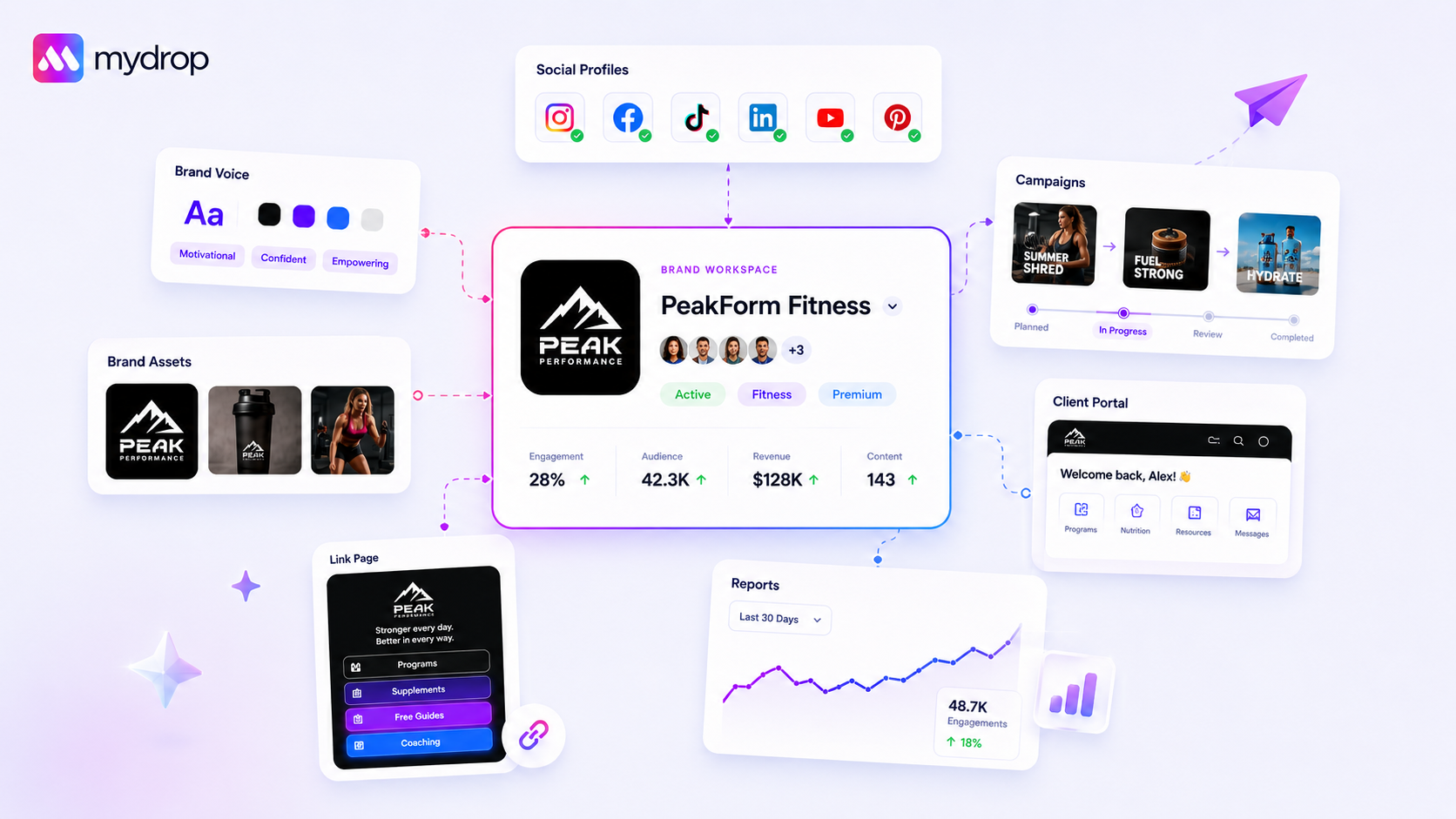
The most efficient way to connect client social profiles is to stop asking for passwords entirely. Instead, use a portal-based OAuth workflow that allows clients to authorize their own accounts, granting you access while keeping their credentials strictly within their own control.
We get it. Managing access for fifty different brand accounts across an agency feels like a constant juggling act of password resets and security spreadsheet updates. It is messy, it is high-risk, and it is likely the biggest bottleneck in your daily workflow. The awkward truth is that every time a client sends you a password, your agency liability increases. The goal should not be better password management; it should be the total elimination of manual credential handling.
When you shift to client-initiated OAuth, you stop acting as a vault and start acting as a partner. You send a secure link, the client logs into their native provider (like Facebook or LinkedIn), and they grant specific permissions directly to your platform. No one sees a password, no one has to reset anything when a token expires, and you maintain a clean audit trail. It is the kind of professional operating habit that turns a chaotic onboarding week into a five-minute task.
The decision teams usually frame too broadly

Most teams treat access management as a one-time "setup" task, but that frame is a trap. If you view authentication as a binary state-connected or disconnected-you will inevitably be blindsided when an API token expires mid-campaign or a platform changes its scope requirements.
In our experience across thousands of brand profile connections, teams get stuck because they focus on the what (the password) rather than the how (the authorization flow). When you try to control the entire authentication path by requesting credentials, you invite coordination debt. You are suddenly responsible for account recovery, security compliance, and explaining why a specific platform suddenly requires a re-authorization.
Instead, frame access as an ongoing security protocol. You want to separate the strategy (which you own) from the authentication (which the client controls).
| Security Risk Factor | Manual Password Sharing | Portal-Based OAuth |
|---|---|---|
| Password Visibility | Agency sees client password | Client credentials remain private |
| Account Ownership | Client loses control of entry | Client maintains native access |
| Token Refreshing | Manual reset required | Automated/Client-re-auth |
| Onboarding Time | Hours of back-and-forth | Minutes of self-serve flow |
| Audit Compliance | High liability risk | Transparent provider logs |
This is where teams usually get tripped up: they underestimate how much friction "simple" requests create. A client might not know which specific admin account has the necessary permissions for an Instagram Business profile, or they might be wary of sharing a main business login. By using a portal connection flow, you provide a clear, professional interface where they can see exactly which pages they are authorizing. The client stays in their own environment, and you stay out of their security perimeter.
This is the part that transforms your agency from a service provider into a professional partner. You aren't just "managing" their social accounts; you are implementing a governance model that respects their security boundaries.
Operator rule: Delegate the permission, own the connection. If you are touching a client password, you are already behind on your security posture.
What should stay manual and what can move faster

The biggest mistake we see teams make is trying to control everything from a central dashboard. You need to distinguish between strategic orchestration-which is your job-and authentication rituals, which are the client's responsibility.
High-level brand strategy, content calendar approvals, and performance reporting are where your team adds the most value. These require your active oversight. But the actual act of logging into a social platform to grant an app permission? That is pure administrative friction.
When you ask a client to send their password, you are asking them to break their own security policy so you can bypass yours. It is a lose-lose.
Move these to the client-initated portal flow:
- Platform authentication: Let the client handle the OAuth handshake.
- Multi-account selection: Let the client confirm which specific pages or channels get imported.
- Token refreshes: Stop chasing expired tokens. If a client connection drops, the portal makes them re-authenticate directly, removing you from the middle.
Keep these under your team's governance:
- Permission scoping: You decide which brands the client can access through your portal.
- Service mapping: You define which imported channels go into which analytics or inbox workflows.
Decision check: If your workflow requires you to touch a client's plaintext password, it is not a workflow. It is a security debt incident waiting to happen.
The tradeoff matrix
Every decision to automate access comes with a cost. You are trading the "comfort" of having full control (which is actually just an illusion of control) for the efficiency and safety of a distributed OAuth model.
The following scorecard helps you evaluate the risk profile of your current onboarding process.
| Factor | Manual Password Sharing | Portal-Based OAuth |
|---|---|---|
| Security Risk | High (Credential theft) | Low (Token-based access) |
| Onboarding Speed | Slow (Email back-and-forth) | Fast (Client self-service) |
| Compliance | Fails (Audit failure) | Passes (Granular scopes) |
| Maintenance | High (Password rotations) | Zero (Automated refresh) |
| Client Friction | High (Trust barrier) | Low (Standard flow) |
Threshold for action: If your team spends more than two hours per month on credential management, troubleshooting expired social profiles, or chasing clients for updated passwords, you have exceeded the "reasonable friction" limit.
At Mydrop, we see teams managing hundreds of brand profiles finally hit their stride when they stop acting as a help desk for account access and start acting as a partner for brand strategy. By using portal-based connection, you stop being the custodian of the client’s identity and start being the architect of their presence.
It is a simple shift, but it effectively closes the gap between "we can start the campaign next week" and "we are live today."
How to pilot the workflow safely
You do not need to flip a giant switch for every brand you manage overnight. In fact, doing so is a great way to trigger an office panic. Start by isolating the variables. Pick one non-critical channel or a single test project and walk through the portal connection process while you have a human on the line.
Here is how to run a controlled pilot without risking your core publishing schedule:
- Select a low-stakes profile. Choose a secondary channel or a seasonal project that does not require daily 24/7 engagement.
- Invite the client. Send them the portal link and ask them to perform the connection themselves while you watch via a screen share. This lets you observe where they might hesitate or get confused.
- Confirm the scopes. Check that the connection successfully brings in the specific pages or profiles you need, rather than just service-level connections like Google Drive or Photos.
- Validate the side effects. Once the connection is live, verify that your analytics dashboard starts pulling data and that your team can see the profile in the publishing dropdown.
If you hit a snag, you have only affected one profile, not your entire portfolio. Most of the time, the "issues" are just minor permission mismatches that take thirty seconds to resolve on the client side. Once you see the process work once, the confidence shift is immediate. You will realize that you have moved from a manual, high-risk bottleneck to a clean, transparent, and scalable routine.
Workflow check: Never be the person typing the password. If you are ever on a screen share and see a client's login screen, gently stop them, send the portal link, and wait for them to finish the OAuth handshake. It is a one-time conversation that saves months of future liability.
The operating rule to keep
The most successful teams we work with at Mydrop do not just change their software; they change their policy. They make a hard line: No credential sharing is permitted under any circumstances.
When a new client joins, don't ask for a login. Instead, trigger the portal connection as the very first step in your onboarding checklist. If they hesitate, send them the security logic: "We don't keep your passwords because we want you to have total control over your security. If you ever leave, you don't have to change 50 passwords; you just revoke our access, and we are gone."
This is not just a polite request. It is a fundamental operational boundary that prevents the "password spreadsheet" from ever becoming a security liability. When you frame it as a benefit to them, the friction usually disappears.
Conclusion
At the end of the day, social media management is already complex enough without the added weight of coordination debt and manual access rituals. You have enough to worry about regarding creative strategy, engagement quality, and platform-specific quirks. You should not be spending your time playing digital bouncer, tracking down expired passwords, or navigating the legal risks of holding your clients' keys.
By shifting to a portal-based OAuth model, you reclaim that time and replace it with a repeatable, automated habit. You get the access you need to do your job, the client keeps the security they require, and your agency removes a massive, unnecessary compliance risk from its plate.
Stop managing passwords and start managing the work that actually grows your brands. The technology is already there to help you do it-all you have to do is set the boundary.