
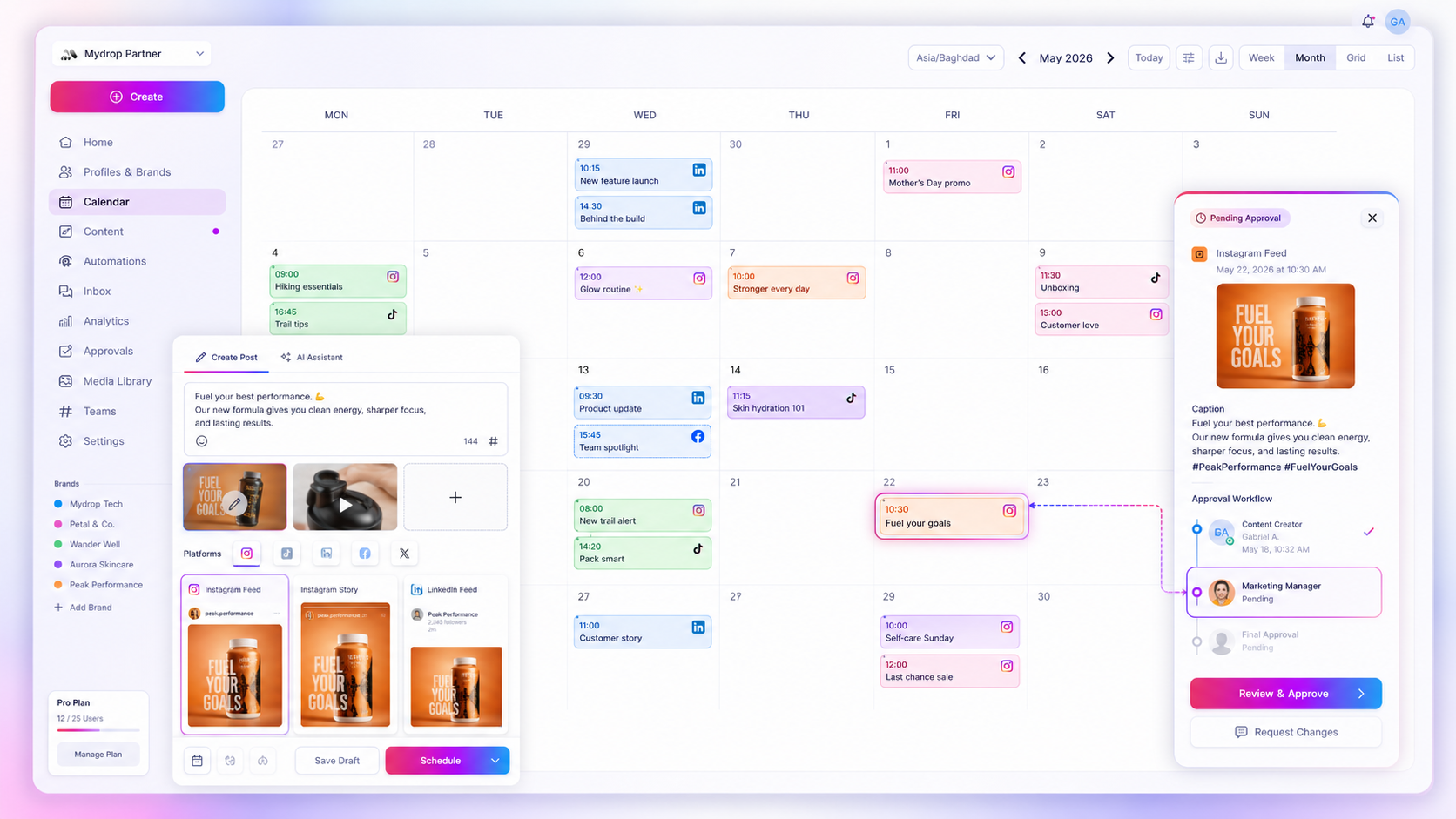
To measure the actual revenue impact of your social campaigns, you must stop relying on post-publication guesswork and instead bake your tracking identifiers into your creative workflow at the moment of creation. If you are waiting until the end of the month to retroactively map "vanity" clicks to revenue in a spreadsheet, you have already lost the trail. The most resilient teams we work with treat campaign metadata as a prerequisite for publishing-not an afterthought for reporting.
We have all felt that specific brand of fatigue: you pour weeks of effort into a high-visibility awareness campaign, only to be met with a "results" meeting where the best you can offer is a spike in reach and a vague promise that it helped the brand. Your stakeholders are not asking for more reach; they are asking for proof that the brand investment actually moved the needle. It is frustrating to feel like your creative work is trapped in an attribution black hole, but this is almost always a result of coordination debt rather than a lack of actual impact.
The decision each metric should trigger

Data is useless unless it points to a specific change in your operational habits. If your reporting dashboard shows you high engagement but zero attributed revenue, you are tracking the wrong signals for an enterprise-grade workflow. You need to shift your focus from volume-based metrics to influence metrics that clarify whether a post is a dead end or a bridge to conversion.
To make this actionable, stop asking "how many people liked this" and start asking "which campaign goal does this post serve." Every piece of content should map to a clear attribution path. In our experience, teams that define their campaign parameters in Mydrop before writing their first caption are the only ones who actually finish the quarter with clean data. When you centralize your campaign identity, you eliminate the inconsistency that creeps in when different regional managers use different UTM tags for the same global launch.
Use this reference to standardize how you evaluate your social output.
| Metric Type | Primary Question | Operational Decision |
|---|---|---|
| Reach/Impressions | Is the content visible? | Adjust platform or timing if low. |
| Click-Through (UTM) | Does the intent exist? | Validate landing page and CTA. |
| Attributed Lead/Sale | Does the content convert? | Scale the specific content archetype. |
| Campaign ROI | Is the spend efficient? | Reallocate budget to top performers. |
Operator rule: If a social post does not have a linked campaign identity, it is effectively invisible to your CRM. Do not approve posts that lack a defined campaign source and tracking configuration.
Most teams struggle here because they treat "Awareness" as a free pass to ignore tracking. That is a mistake. Even for top-of-funnel content, you need to know exactly which utm_source and utm_medium are feeding your funnel. By forcing every post-manual or automated-to carry consistent campaign metadata, you transform your social calendar from a static list of content into a predictable pipeline of data. When you do this, your reporting becomes a conversation about growth, not an apology for missing numbers.
The scorecard that keeps reporting useful

Stop measuring "reach" and start measuring influence paths. If your monthly report is just a wall of impression numbers, you have built a vanity metrics machine, not an attribution engine.
To break this cycle, you need to tie every social touchpoint to a specific goal. We find that the most effective teams treat every campaign-even a simple brand awareness post-like a distinct, trackable product launch. When you force your team to assign a campaign ID to a post before it hits the feed, you stop wondering if that click came from organic discovery or a paid push.
Here is an example of how to structure your scorecard to move from volume to value.
| Metric | Why it matters | Decision Trigger |
|---|---|---|
| Attribution Rate | Percentage of clicks with valid campaign UTMs. | If under 80%, stop publishing and audit your campaign tagging. |
| Conversion Velocity | Time between first social touch and site action. | If it's too slow, rethink your landing page friction, not your content. |
| Influence Ratio | Ratio of awareness clicks to high-intent sign-ups. | If low, your campaign promise doesn't match the reality of your product. |
| Content Decay | Rate at which engagement drops after campaign end. | Use this to decide when to archive old assets and refresh your creative. |
In our experience, teams that define the campaign in Mydrop before writing their first caption are the only ones who actually finish the quarter with clean data. By linking the post to a campaign, you ensure that every link automatically carries the right UTM tags, removing the human error that usually turns tracking spreadsheets into a crime scene.
What to stop measuring by default
You need to ruthlessly cull the metrics that make you feel productive but do nothing for your bottom line. If a metric doesn't help you decide whether to scale a budget, change a creative direction, or pause an automation, it is just noise.
Stop measuring "Follower Growth" as a proxy for revenue. It is a lagging indicator that is often decoupled from your actual sales goals. You can double your followers and still see zero movement in your pipeline if you are attracting the wrong audience.
Stop measuring "Total Clicks" without source segmentation. A click from a "Buy Now" post is not the same as a click from an "Industry Insight" article. Treating them as the same signal destroys your ability to understand which stage of the funnel your content actually serves.
Decision check: If you cannot explain in one sentence how a specific metric impacts your conversion path, delete it from your dashboard.
Finally, stop trying to retroactively assign revenue to "dark social" traffic. You will never perfectly track every conversation in a private DM or a Slack channel. Instead, build your system so that 90% of your public traffic is perfectly tagged, and accept the remaining 10% as the inevitable cost of doing business in a distributed digital environment. Focus on the data you can control, rather than chasing the ghosts of the data you missed.
How to connect metrics to next actions
Most reports are built to justify the past, not to dictate the future. If you are looking at a dashboard and seeing "Impressions: 500k" without knowing which campaign actually drove that traffic to your site, you are just collecting digital receipts. To shift from passive reporting to active steering, your metrics must trigger a specific, pre-agreed workflow.
We often see teams treat "Social" as a fire-and-forget channel. The campaign launches, the posts fly out, and everyone checks the leaderboard a week later. Instead, use these triggers to turn your data into a steering wheel:
- The Velocity Trigger: If click-through rate (CTR) is 20% below your baseline within the first 48 hours, the campaign is stalling. Don't wait for a weekly meeting. This should trigger an immediate review of the creative or the offer.
- The Intent Trigger: If a "Brand Awareness" post starts driving high-intent traffic-meaning users aren't just clicking, they are visiting your pricing or feature pages-your next action should be to pivot upcoming posts in that campaign to focus on specific product benefits.
- The Fatigue Trigger: If engagement drops across multiple channels for the same campaign, stop the automated distribution. You are burning your audience and wasting your brand equity.
Workflow check: If a campaign's conversion path isn't clear within 72 hours, it isn't an "awareness" campaign; it's a silent one. You must adjust your creative or re-link your call-to-action before the second wave of content goes live.
At Mydrop, we see teams use the Campaigns section to manage these triggers in real-time. By assigning posts to an active campaign, you can see exactly which content is tied to which goal. If a campaign is underperforming, you can pause or update the creative across the entire set of posts in one place, ensuring you aren't just "watching" the failure-you're fixing it.
The review cadence that makes the model stick
Attribution isn't a post-mortem; it is a pulse check. If you only review your revenue impact at the end of the quarter, you have already lost the opportunity to iterate. Your team needs a rhythm that separates noise from signal.
| Cadence | Focus | Action |
|---|---|---|
| Daily | Technical Health | Check if campaign UTMs are attaching correctly and links are functional. |
| Weekly | Engagement Quality | Identify which creative variants are outperforming others in the same campaign. |
| Monthly | Revenue Attribution | Cross-reference social clicks with CRM conversion data to calculate ROI. |
Most teams get stuck because they try to do everything at once. They look at monthly revenue and try to guess which social post caused it. This is impossible. Instead, make the Weekly Pulse your primary operational habit. Use this time to move your best-performing content from awareness into a more conversion-focused flow, or kill off the posts that are simply taking up space.
When you manage multiple brands and dozens of stakeholders, this cadence becomes your defense against coordination debt. If every campaign follows this structure, you spend less time explaining why things didn't work and more time scaling what does.
Conclusion
The difference between a team that "does social" and a team that drives revenue isn't found in a better analytics tool or a more expensive ad budget. It is found in the discipline of your operational habits.
By standardizing how you identify campaigns, embedding that metadata into your publishing workflow, and committing to a rigorous review cadence, you turn your social channels from a black box into a predictable engine. You stop guessing which posts worked and start knowing exactly which levers to pull to hit your numbers.
The next time you sit down to plan a launch, don't start with the creative. Start with the campaign identity. Build the tracking into the process, not onto it. Your reporting will finally look less like a post-mortem and more like a map.