Stop managing social engagement platform-by-platform. To scale, you must treat every comment and DM as a row in a unified, prioritized operational queue, decoupled from the native apps and their endless, distracting feedback loops.
We get it. The inbox is where the social part of social media goes to die in a pile of notification fatigue. You are toggling between six apps, worrying about who replied to what, and feeling that constant, low-grade anxiety that a high-value customer inquiry is burying itself under a sea of emojis and spam. It is exhausting, and frankly, it is the fastest way to burn out a talented team.
At Mydrop, we see this across hundreds of brand profiles: the moment engagement becomes a series of frantic, manual check-ins, you have lost control. You are no longer managing a brand; you are firefighting. When your response speed depends entirely on whoever happens to be logged into the app, you do not have a strategy; you have coordination debt.
The operating problem this solves

The biggest mistake enterprise teams make is treating engagement as a creative act rather than an operational one. Creative work requires flow and focus, but engagement requires cadence and consistency. When you treat comments like "part of the post" rather than "part of the ticket," the work becomes unmeasurable, unassignable, and eventually, unmanageable.
Here is where teams usually get stuck:
- The Toggling Tax: Every time a community manager switches from Instagram to LinkedIn, they lose context. The mental effort to refocus-and the physical time spent waiting for pages to load-is a massive, hidden drag on productivity.
- The "Who is doing what?" Mystery: Without a shared queue, you inevitably double-reply to the same customer or, worse, leave the most critical questions unanswered because "I thought Sarah was handling that account today."
- Approval Limbo: For teams managing many brands or markets, high-risk questions often sit in drafts while legal or brand managers hunt for the original context across different platforms.
Operator rule: If your team cannot answer "What is our current backlog of unassigned, high-priority customer inquiries?" in under ten seconds, you do not have a triage system-you have a scattered pile of digital sticky notes.
Most teams do not have a volume problem. They have a decision bottleneck. You need to stop thinking about "checking the feed" and start thinking about "working the queue." When your activity data is normalized into a single view, your team stops guessing and starts operating. That shift from checking to processing is the only way to stop the churn of platform-native notification chaos and build a durable, auditable support standard.
The minimum system that works

The secret to scaling social support isn't more people## The minimum system that works
The secret to a sane social inbox is simple: stop treating replies like social media and start treating them like support tickets.
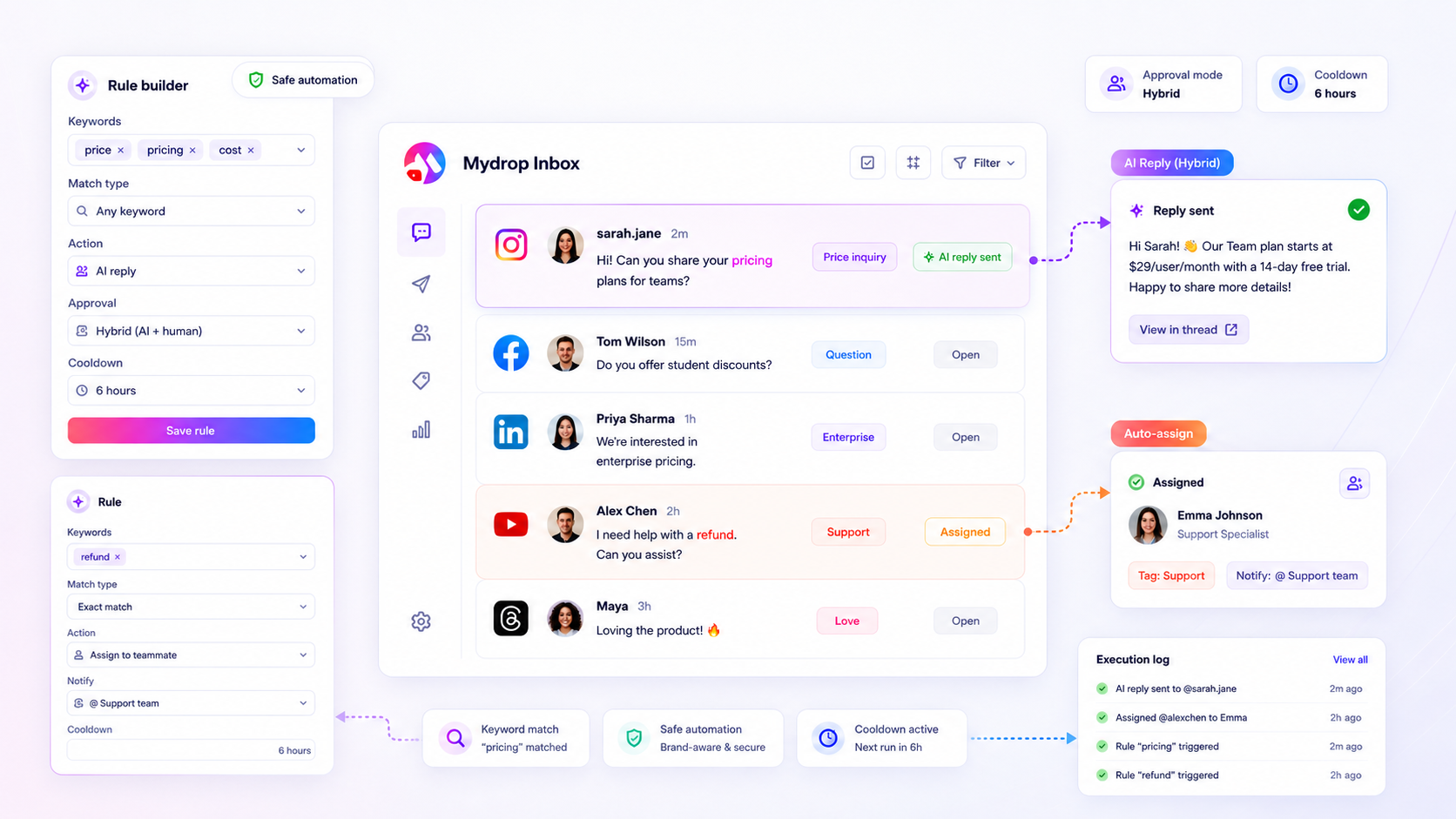
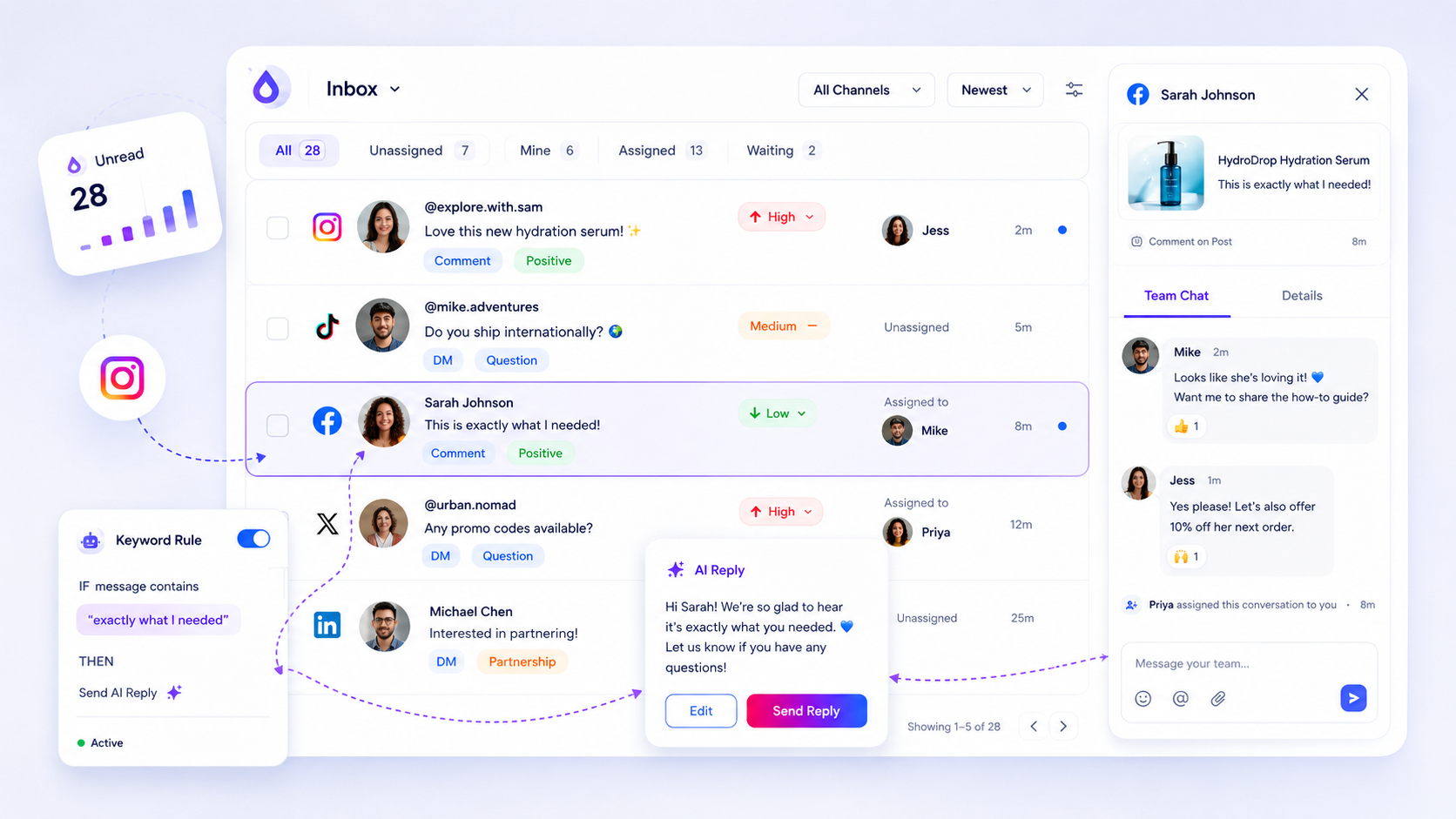
When you shift from "checking the app" to "working the queue," you immediately stop the madness of notification-chasing. You need a centralized place where every comment and DM from every profile becomes a distinct record. This record must carry its own metadata-status, priority, assignee, and internal notes. If a message doesn't live in a system that allows you to mark it "assigned" or "needs reply," it doesn't exist to your team.
At Mydrop, we see teams struggle for months just because they haven't decoupled their engagement from the native platform interfaces. When you rely on Instagram or LinkedIn native notifications, you are at the mercy of their sorting logic, not your own. Your team will inevitably miss the high-value customer inquiry because it was buried under a pile of generic "love this!" comments.
To build a working minimum system, ensure your workflow forces these three inputs:
- Normalization: All threads-whether they are DMs or comments-must land in a single, searchable feed regardless of platform.
- State Management: Every thread needs a clear state (e.g., Unread, In Progress, Resolved). If you can't tell what’s pending, you’re flying blind.
- Owner Assignment: If a thread has no clear owner, it will never get answered, or worse, three people will answer it at once.
| Capability | Platform-Native App | Unified Operational Queue |
|---|---|---|
| Visibility | Fragmented per profile | Global across all brands |
| Ownership | Shared credentials (risky) | Individual user assignment |
| Audit Trail | None (or limited) | Full activity/note history |
| Response | Manual typing | AI-assisted drafts/templates |
Where teams overbuild the process
The most common trap we see in enterprise teams is over-engineering the beginning of the workflow.
Some teams try to map out an elaborate, twelve-step approval ladder for every single comment, including DMs that are just simple product questions. This is where your team’s engagement speed goes to die. They spend more time moving tickets between buckets and waiting for legal sign-off than actually talking to your community.
You do not need a three-person approval chain to answer a question about store hours.
Decision check: If your triage process requires more than one human to "sign off" on a standard reply, your brand guidelines are too vague. Fix the guidelines, don't add more managers.
Most teams also overbuild by trying to automate everything. They wire up complex logic that auto-replies to every comment with a canned response, which usually results in a robotic, soulless feed that pushes your real community away.
The danger zone of over-automation:
- The "Auto-Reply" Abyss: You send the same automated thanks-for-reaching-out message to a loyal brand advocate who just shared a heartfelt story, making them feel like a nuisance.
- Approval Debt: You require a manager to review every single draft, effectively doubling your response time for no measurable increase in quality.
- Tool Complexity: You introduce a middle-man tool that doesn't actually integrate with your social platforms, creating a "data graveyard" where threads are copied and pasted but never truly resolved.
The sweet spot is high-context, low-friction. Use AI to draft the baseline response based on the specific brand voice and thread history, then empower one human to hit send. If the situation is sensitive, escalate. If it's standard, keep moving. The goal is to clear the deck so you have time for the conversations that actually matter.
How to run the cadence
To move from "firefighting" to "operating," you need to stop checking your feeds and start running a structured engagement sync. If you treat inbox triage as a sporadic, ad-hoc activity, it will always be the first thing your team drops when the pressure mounts.
The goal is to move from reactive scrolling to a repeatable, time-blocked operational heartbeat. Here is the weekly engagement rhythm we recommend for teams managing high-volume, multi-brand social presence.
The Weekly Engagement Routine
| Stage | Frequency | Objective |
|---|---|---|
| Morning Triage | Daily, 9:00 AM | Clear urgent DMs and high-sentiment comments. |
| Midday Sync | Daily, 1:00 PM | Handle standard engagement, assign complex threads. |
| End-of-Day Audit | Daily, 4:30 PM | Check inbox health; flag unanswered threads for the next shift. |
| Weekly Review | Friday, 10:00 AM | Analyze volume trends, update AI draft guidance, review team SLA metrics. |
Workflow check: If a message sits in "unassigned" status for more than 4 hours, it automatically moves to "High Priority" for the next available team member. Do not let your coordination debt accumulate overnight.
If your team is toggling between apps, you are losing the battle. Using a tool like Mydrop allows you to normalize these platform-specific threads into a unified view. When every comment from Instagram, LinkedIn, and YouTube is a single row in your Mydrop inbox, your team stops guessing who is doing what and starts operating off a single, shared source of truth.
The proof that the habit is working
How do you know if you are actually improving or just rearranging deck chairs? You need a way to measure the shift from "noise" to "response."
A common trap is measuring only "total volume," which tells you how much work you have, not how well you are performing. Instead, track the Engagement Resolution Ratio. This is simply:
[Total Inbound Threads Resolved / Total Inbound Threads Received] * 100
If your ratio stays below 90% over a rolling 30-day window, your triage cadence is broken. You are not managing a strategy; you are managing a backlog.
The Success Checklist
Use this 4-step checklist to verify your operational health at the end of each month:
- Zero-Inbox Status: Are all threads from the last 24 hours categorized (status: done, assigned, or pending)?
- SLA Consistency: Are we consistently replying to DMs within our established time targets?
- Audit Trail: Can a manager pull a report for any brand and see exactly who assigned, drafted, and approved a high-stakes response?
- AI Utility: Are our AI reply drafts actually accelerating the workflow, or are we just generating text that requires a full rewrite?
If you find yourself failing these checks, you likely have a coordination bottleneck, not a volume problem.
Conclusion
Most social media operations fail not because they lack creativity, but because they lack an engine. When response times are erratic and approval processes are buried in email chains or native app notifications, you aren't building a brand community-you are just creating more work for yourself.
Start by treating your inbox like the support queue it is. Standardize your triage, time-box your efforts, and use tools that normalize your activity into a predictable, auditable flow. When you strip away the chaos of toggling, you finally get to see what your community is actually saying. And that is where the real brand value begins.