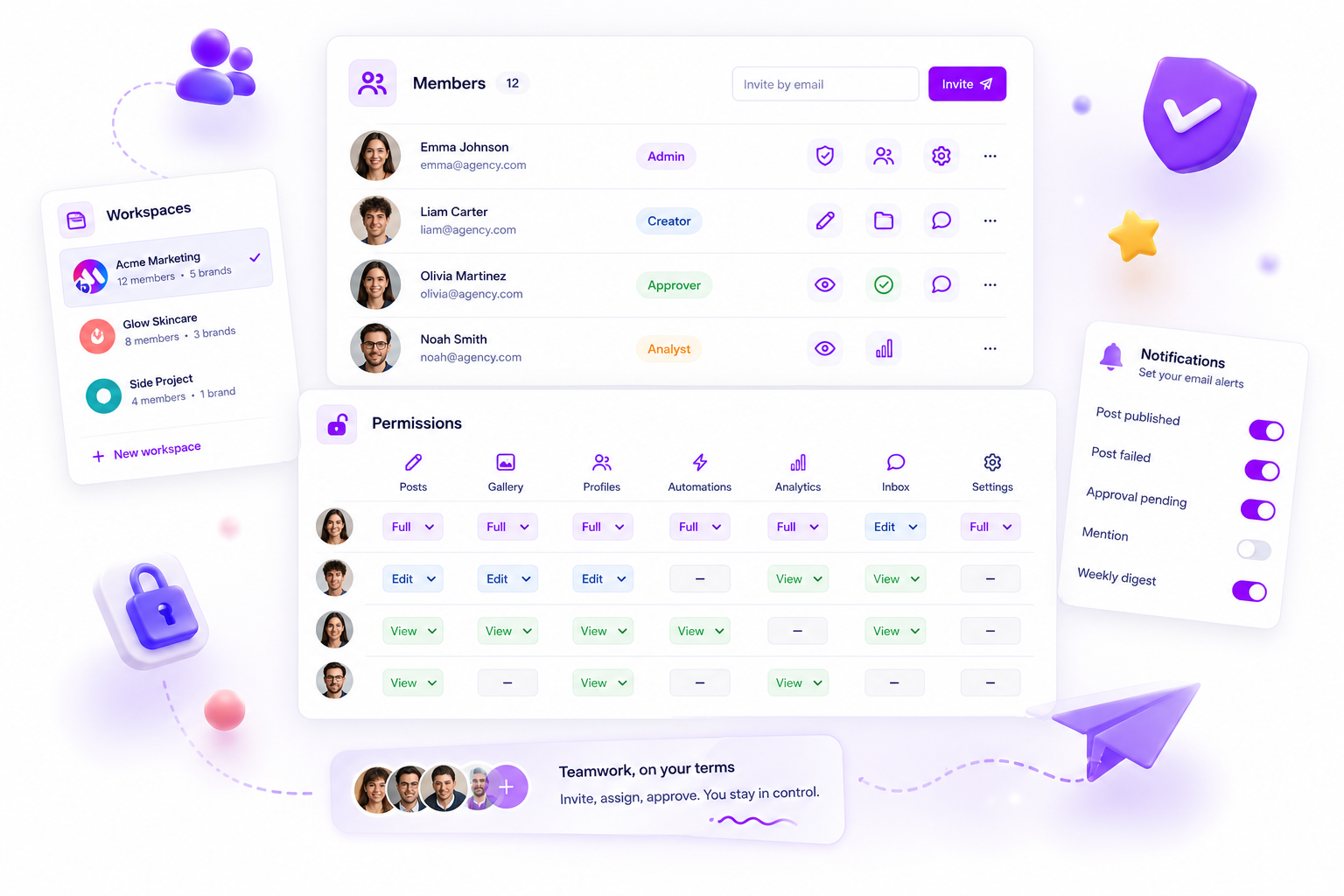
The best workspace tool for managing multiple client brands is one that treats "workspaces" not as folders, but as absolute, permission-gated containers for every asset, billing cycle, and team member assignment within your agency. True operational scalability for agencies is impossible without hard-boundary isolation; you aren't just managing data, you are managing distinct client realities.
We know the panic of a client seeing an internal memo meant for a competitor, or the administrative nightmare of reconciling usage quotas across five different accounts. Managing multiple brands isn't just "more work"-it is a high-stakes balancing act where one wrong click can dismantle professional trust. Most agencies scale by adding more logins; the smartest agencies scale by adding more walls.
What the best tools need to handle

If your current platform forces you to "tag" assets to distinguish between Client A and Client B, you are already one misclick away from a PR nightmare. Managing multiple brands at scale requires a platform that enforces separation at the architectural level.
Here is what you should demand from your workspace management:
- Hard-Boundary Isolation: Assets, scheduled posts, and performance reports must physically live within their own
workspace. If you are navigating a global dashboard, you are at risk. - Granular Permission Scoping: You need the ability to invite a stakeholder to a single client workspace without them seeing your entire agency roster or other clients.
- Independent Billing & Quotas: Every brand should have its own usage limits. You cannot afford to have a viral campaign for one client cannibalize the posting capacity of four others.
- Contextual Timezone & Localization: A decentralized team working across timezones needs the platform to respect the specific
workspace timezonesetting, ensuring posts go live when they are meant to, not based on your server's clock.
Operator rule: If a tool allows global assets to bleed across client environments, it is a liability, not an asset.
To help you audit your current setup, use this risk matrix. If your workflow matches the "Single-Account" side, you are carrying significant coordination debt.
| Capability | Single-Account (Risk) | Multi-Workspace (Secure) |
|---|---|---|
| Data Boundary | Shared pool; prone to leakage | Isolated container per client |
| User Access | All-or-nothing permissions | Per-workspace member assignment |
| Quota Management | Pooled (The "Neighbor" Effect) | Individual per-brand limits |
| Settings/Reporting | Global (One-size-fits-all) | Customizable per-workspace |
Most teams do not have a content problem. They have a decision bottleneck-and that bottleneck almost always starts with a lack of clear operational boundaries. If your team has to manually verify which account they are logged into before they hit "publish," you have already lost.
Where basic tools start to break

Most teams hit a wall the moment they move beyond a single brand. You might start with a general-purpose project management tool or a basic social dashboard, and for a while, it feels fine. You invite a couple of people, you share a login, and you get the work done. But then, the "Single Account" trap springs shut.
This usually happens when you try to apply granular permissions to a platform designed for a single user or a flat team. You end up with a mess of "Guest" roles that can accidentally view sensitive campaign calendars for Brand A while you are trying to onboard a new freelancer for Brand B. The data is all in one pool, and the boundaries are just suggestions rather than hard stops.
Here is the reality of the friction we see when tools fail to isolate client environments:
| Failure Mode | What it actually feels like for your team |
|---|---|
| Asset Contamination | A junior designer accidentally uploads a competitor's creative assets to the wrong client library. |
| Approval Bottlenecks | The client reviewer sees every pending post for your entire agency, not just their brand. |
| Billing Ambiguity | You spend two hours every month manually pro-rating software seats across five different client budgets. |
| Timezone Chaos | You miss a prime-time launch window in London because the tool is locked to your New York server time. |
The spreadsheet often becomes a crime scene here. When the tool can't handle the complexity, your team reverts to manual logs, email chains, and frantic Slack messages to "verify" what is live where. It is exhausting, and eventually, somebody makes the mistake that costs you a client's trust.
The buying criteria that matter
When you are ready to stop fighting your own software, you need to look for containerization over convenience. An agency-grade tool should not just hold your posts; it must act as a vault for each client's specific needs.
If you are currently auditing your tech stack, check if your platform can handle these four non-negotiables:
- Permission-Gated CRUD: Can you define user access at the workspace level, or is it global? If a user needs to see Brand A, they should not even know Brand B exists.
- Isolated Billing Cycles: Does the tool allow you to tie product quotas and subscription billing directly to a specific workspace? You should never have to manually calculate split-costs.
- Local Context Persistence: Does the app remember the timezone and language preferences for that specific client, or does it reset every time you log in?
- Data Scoping: When you run an analytics report, is the data restricted to the current workspace? If your reporting engine pulls from a global database, you are one wrong filter away from a major data leak.
Decision check: If a tool allows global assets to bleed across client environments, it is a liability, not an asset.
At Mydrop, we built the Workspace feature specifically to solve this. Instead of a single, leaky account container, Mydrop treats each workspace as an absolute, isolated environment. Your permissions, billing, members, and product usage are contained within that boundary. When you switch into a workspace, the application shell reloads completely to ensure you are only interacting with that client's reality.
This isn't just about security; it is about cognitive load. When your team stops worrying about which brand they are posting to-because the tool physically blocks them from touching the wrong one-they spend significantly less time on administrative cleanup and more time actually managing the social presence. Most teams do not have a content problem; they have a coordination bottleneck. Remove the bottleneck, and the scale takes care of itself.
How Mydrop supports this workflow
We built Mydrop on the hard-learned truth that coordination debt kills creativity. When you manage dozens of channels across five different time zones, you do not need "more features." You need walls.
At Mydrop, we use Workspaces as the primary containment unit. Think of it as a clean-room environment for each client or internal business unit. When you switch into a workspace, the application effectively forgets everything else exists. Your assets, your approval loops, your billing quotas, and your team permissions are scoped strictly to that container.
- Scoped Access: A team member can be a creative lead in Client A’s workspace but have zero visibility into Client B. Permissions are inherited by the container, not the user, which eliminates the risk of an analyst pulling data from the wrong dashboard.
- Operational Integrity: Each workspace maintains its own set of product counters and billing states. If one brand over-indexes on video output, their usage quotas do not cannibalize your other clients' publishing limits.
- Context Isolation: Because the app forces a re-load of the workspace context, you eliminate the "last-saved" error. You are either working on Client A or Client B; you are never, ever in both at once.
We have seen this across thousands of campaigns: the teams that struggle the most are usually the ones trying to hack permissions within a single, bloated account. The teams that scale are the ones that treat workspaces as distinct, permission-gated reality checks.
A simple shortlist checklist
Before you commit your agency to a platform, run it through this five-minute audit. If the answer is "no" to more than two of these, your operations team is about to have a very long, very painful year.
| Requirement | Why it matters |
|---|---|
| Absolute Data Separation | Can a user see assets from another client? If yes, it is not a workspace. |
| Per-Workspace Billing | Can you isolate costs per unit without manual math? |
| Granular Member Scoping | Are permissions tied to the container, or just layered on top? |
| Contextual Persistence | Does the app remember which workspace you were in after a refresh? |
| Zero-Leakage Reporting | Is it impossible to accidentally select data from Client B while in Client A's reporting view? |
Workflow check: If you have to create a custom internal spreadsheet just to track which team members have access to which brand, your software has already failed you.
Conclusion
The best workspace tool for managing multiple client brands is the one that forces you to be disciplined. It should make it mechanically impossible for a team member to make a cross-brand mistake.
Most teams do not have a content problem. They have a decision bottleneck-a mess of overlapping permissions, shared assets, and misaligned reporting. Stop trying to organize that chaos and start isolating it. Build the walls, keep the environments clean, and stop worrying about who is seeing what. Your clients are paying for security as much as they are paying for strategy.