To stop the constant, exhausting cycle of chasing signatures across timezones, you must move your team off global platform defaults and into localized workspace containers. If your software treats time as a single, universal setting, your agency is essentially paying for a 24-hour shift where the last person to log off takes on the entire world's coordination debt.
We get it. You are juggling high-stakes campaigns across continents, and that "agile" dream often feels more like a frantic game of hot potato. When your London team is signing off just as your Singapore team is starting, the handoff shouldn't feel like a crisis-but in most tools, it does. You are not failing at communication; you are fighting a structural wall.
What the best tools need to handle

The best platforms acknowledge that work is inherently regional, even when the brand identity is global. If you are managing dozens of stakeholders across three markets, the software cannot assume a monolithic "office hours" calendar. It has to handle context-switching with zero friction.
When evaluating your tech stack, look for these three operational pillars:
- Isolated Environment Scoping: Your Singapore workspace must contain its own members, permissions, and regional deadlines. If a change in the London office impacts the local settings or visibility of a Singapore-based campaign, you are still operating in a shared-pool nightmare.
- Autonomous Timezone Authority: Every workspace needs a dedicated timezone setting that drives all automated scheduling, reporting, and deadline alerts. No one should have to do mental math to figure out if a post goes live at 9:00 AM in Tokyo or 9:00 AM in New York.
- Permission Boundary Consistency: Membership access should be scoped at the workspace level. If a contributor is added to your regional retail unit, they should not automatically have access to your corporate global branding unit unless explicitly granted.
Common mistake: Relying on "global" user roles that force you to create workarounds or manual spreadsheets just to keep the wrong people out of the wrong region's calendar.
Here is a quick diagnostic check to see if your current setup is helping or hindering your team:
| Feature | The "Global" Trap | The Scalable Approach |
|---|---|---|
| Deadlines | Manual UTC conversions | Localized by workspace |
| Visibility | Everything is everywhere | Scoped to active environment |
| Permissions | All-or-nothing access | Member-per-workspace |
| Alerts | Batch spam at 3:00 AM | Relevant to your local hours |
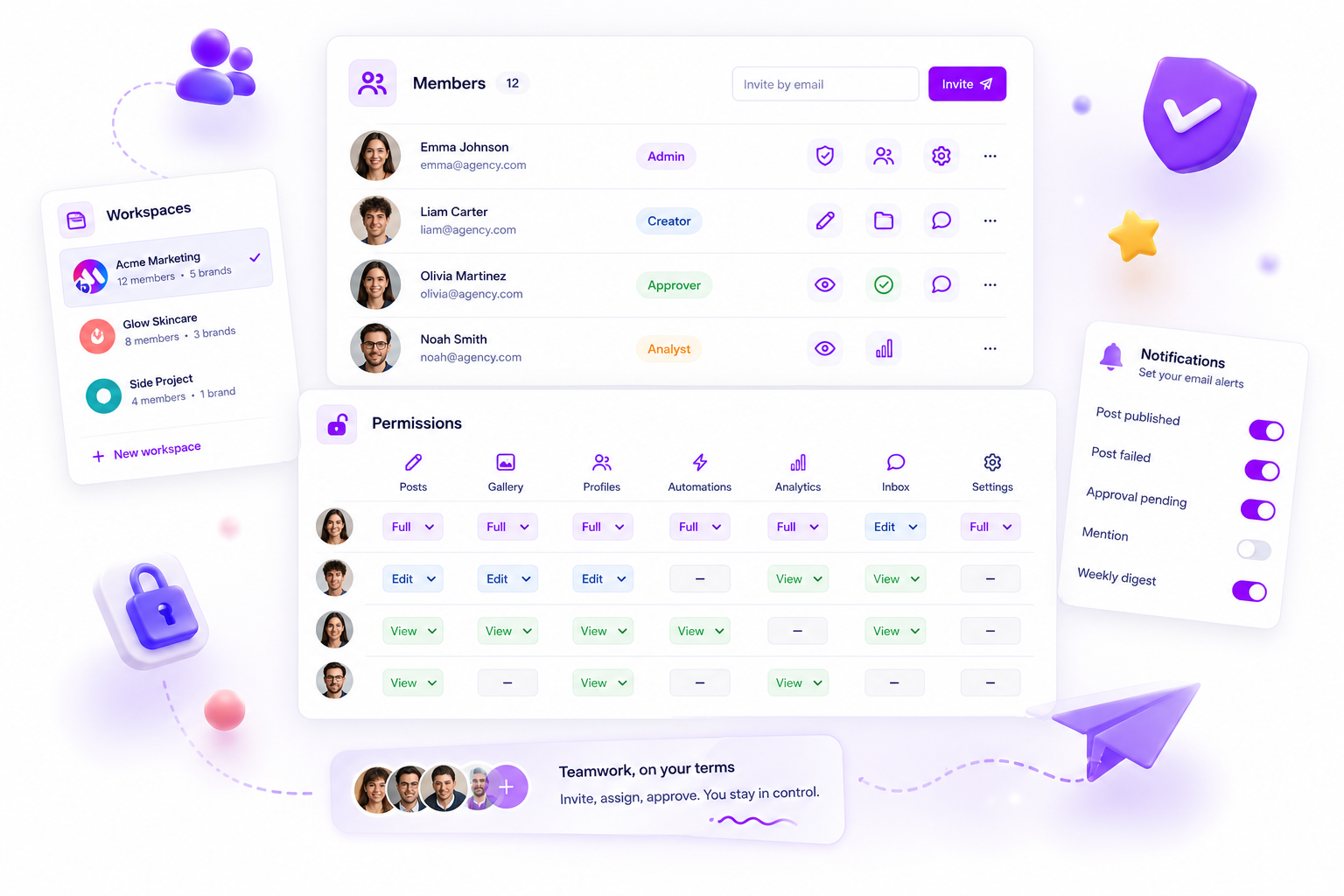
At Mydrop, we designed Workspaces to act as these isolated containers. We found that teams managing hundreds of brand profiles often break under the weight of "global" clutter. By bounding your operational state-permissions, timezone, and member access-within a specific workspace, you stop the cross-region noise and let your teams move as fast as they need to without stepping on each other's toes.
The truth is, most teams do not have a communication problem. They have a decision bottleneck caused by tools that refuse to let them work in their own time.
Where basic tools start to break

Most teams realize their tool is failing when the "time-of-publish" field starts to feel like a trap. You set a deadline for 9:00 AM, but for your team in another time zone, that is the middle of the night. Or worse, the platform defaults to UTC, and your local social team has to keep a physical notepad on their desk just to do the mental math of adding or subtracting hours before every single upload.
This is more than a minor annoyance. It is a coordination tax that compounds as your team grows. When your dashboard does not reflect the local reality of your team or your audience, you end up with two versions of the truth: the official schedule in the tool and the "actual" time the team intends to post. Once that gap exists, you have lost control of your governance.
Watch out: Relying on a single, global account setting that assumes everyone works in the same room.
When the tool ignores regional business hours, you force your team to build workarounds. They start using personal calendars, sticky notes, or spreadsheets to track when content should actually go live. Soon, the software becomes nothing more than a static archive, while the real work happens in the shadows of secondary documents. That is where high-stakes campaigns fall apart.
The buying criteria that matter
If you are evaluating tools, stop looking for "global" features and start looking for workspace autonomy. You need to know if your Singapore team can own their local settings without accidentally nuking the configuration for your London office. If changing a timezone setting affects every user in the company, your platform is not scaling; it is just becoming more rigid.
Here is a simple scorecard to evaluate whether your current setup will support your growth or eventually break under the pressure of too many timezones.
| Criterion | What to look for | Why it matters |
|---|---|---|
| Timezone Scoping | Are settings bounded by the workspace? | Prevents regional updates from causing global scheduling errors. |
| User Access | Can users only see what they need? | Reduces data noise and limits permission-related mistakes. |
| Last-Active Memory | Does it remember your workspace? | Speeds up the daily workflow for power users managing multiple regions. |
| Permission Isolation | Are actions gated per workspace? | Ensures one region cannot inadvertently delete another region's assets. |
Operator rule: If a platform requires you to submit a support ticket or contact an account manager just to change a timezone or update a team member's permissions, it is not built for high-velocity agency work.
You need a platform that treats your regional workspaces as isolated, self-contained units. This means when your New York team logs in, they are in their own environment with their own timezone and their own set of approved members. They should never have to cross-reference a global chart or worry about triggering a notification in a workspace halfway across the world. Autonomy is the only way to scale without adding layers of management overhead.
How Mydrop supports this workflow
At Mydrop, we designed our Workspace feature to move you away from the "global account" trap. Instead of forcing everyone into one massive, unmanageable bucket, we treat each region or client environment as its own dedicated container. This isn't just about organizing files; it’s about giving your Singapore team and your London team their own operational "home" that actually respects their local reality.
Within a Mydrop Workspace, the timezone is a first-class citizen. When your local team sets a publish time, the system respects the workspace-level setting, not some arbitrary global default that someone in headquarters set three years ago. You don't have to do the mental gymnastics of converting PST to SGT before hitting schedule. The environment is scoped to the people working within it, meaning permissions, assets, and reporting data are bounded by that workspace. Your global admins keep the bird's-eye view, but your regional operators get the local autonomy they need to move fast without breaking things in other markets.
Decision check: If your team spends more than ten minutes a day checking timezones, you have a configuration problem, not a communication problem.
When we see teams managing hundreds of brand profiles across five markets, the shift to localized workspaces usually resolves the "coordination debt" overnight. You stop managing global chaos and start managing local performance, which is exactly where your impact actually happens.
A simple shortlist checklist
Before you commit your team to another year of manual deadline adjustments, put your current tool (or your next prospect) through this test. If they fail more than two of these, you are just buying yourself more work.
| Criteria | The "Global" Default Trap | The Mydrop Standard |
|---|---|---|
| Timezone Logic | Fixed to the account owner or HQ | Localized per workspace |
| Data Scoping | Everything is visible to everyone | Isolated to the workspace |
| Deadline UX | Manual math required | Local-first scheduling |
| Permission Model | Broad, all-or-nothing access | Workspace-bounded access |
Before you sign your next contract, ask these three questions:
- Can my regional managers change their local workspace settings without needing a global admin to approve it?
- If I delete a test environment or an old client workspace, will it accidentally wipe data from my active, healthy campaigns?
- Does the platform allow me to see aggregate reports across workspaces, or am I forced to export everything to a spreadsheet to make sense of it?
Conclusion
The reality of running a global agency is that you are always operating at the edge of your capacity. You are balancing high-stakes client expectations against the grueling, 24-hour nature of social media, and that pressure is exactly where the best teams distinguish themselves. You don't solve this by hiring more people to chase approvals or by mandating longer hours. You solve it by removing the friction points that make the work harder than it needs to be.
If your tools force you to act like a human calculator for every single post, you are failing your team. Real scale isn't about doing more work faster; it is about building a system that allows your teams to act locally while you maintain governance globally. Choose a path where the software works as hard as you do, and stop paying the hidden tax of poor architectural design. Your team, and your sanity, will thank you for it.