The secret to scaling a global agency is ruthlessly standardizing your workspace configurations. When your team is spread across London, Tokyo, and New York, "operational drift" is inevitable if your tools ignore local realities. You need a centralized environment that anchors every team member, billing entity, and client account to a single source of truth. Without this, you lose time to timezone calculations and invite approval bottlenecks that derail your biggest campaigns.
We have all been there. It is 6 p.m. in London, the Tokyo team is already off-shift, and you are chasing a sign-off on a report a New York stakeholder has not seen because their workspace clock is set to Pacific time. You are not alone; this is the hidden cost of growth.
What the best tools need to handle

At this scale, your workspace tool must function as a foundation, not just a folder. The best tools handle the complexity of global teams by enforcing governance at the container level. If you cannot define roles, manage timezones, and enforce data isolation for every client environment independently, your operations will break under the pressure of your own success.
In our experience, most tools fail because they are designed for individual creators, not for enterprise governance. They treat workspaces as cosmetic labels rather than functional boundaries.
Your platform must handle these four core capabilities:
| Capability | Why it matters |
|---|---|
| Timezone Locking | Ensures every automated report and deadline aligns with the specific market operating hours. |
| Permission Granularity | Prevents "permission creep" by ensuring members only access the specific workspaces required for their client role. |
| Account-Level Data Scope | Keeps client performance metrics and asset libraries strictly contained, eliminating accidental data exposure across agency units. |
| Permission-Gated Deletion | Safeguards against accidental destruction of client environments by requiring explicit, elevated authorization. |
Operator rule: A workspace is not just a place to store files; it is a secure, isolated boundary for execution. If your tool does not treat it as such, you are managing coordination debt, not content.
Most teams do not have a content problem. They have a decision bottleneck. When your tools force you to manually calculate timezone offsets for every campaign launch, you are forcing your talent to do the work of a calendar. That is not just inefficient; it is a waste of high-value strategy time.
Your goal is to build a setup where you can "set and forget" the governance rules at the top level, allowing the team to focus entirely on execution. The moment you are spending your day adjusting account permissions or reconciling mismatched timestamped reports is the moment you have lost control of your operational velocity.
Where basic tools start to break

When your team grows past a dozen people, the "all-access" approach stops being an advantage and starts being a liability. Most tools are designed for a single brand, a single market, or a small, co-located squad. When you scale that to five global markets, three different agencies, and a rotation of freelancers, the foundation cracks.
The biggest issue is operational drift. You see this when London is finishing their workday, New York is just waking up, and Tokyo is already deep into tomorrow. If your tool treats time as a global constant rather than a local setting, you aren't managing a schedule. You're guessing. Automated reports meant for a Monday morning review arrive on Sunday night, or worse, during a client’s busiest, most unmonitored window.
Then there is permission creep. We have all worked in an environment where everyone can see everything. It feels efficient at first. But when a junior designer accidentally pushes a draft for a high-stakes campaign or a client sees an internal budget note in a shared dashboard, the "transparency" becomes a compliance nightmare. You need walls, and most standard tools treat security like a global toggle rather than a granular control.
Finally, consider the context-switching tax. If your team has to constantly navigate through a sea of irrelevant clients or inactive workspaces to find their current project, you are losing minutes that add up to hours. Every unnecessary click is a potential distraction. When the tool forces users to hunt for their context, it is not serving the team. It is standing in their way.
The buying criteria that matter
If you are evaluating platforms to scale your agency, stop looking for "more features." Start looking for boundary enforcement. You need tools that understand the difference between a global account and a local operating unit.
To help you audit your current setup, we built this simple scorecard. It highlights the non-negotiables for any enterprise-grade workspace strategy.
Workspace Consistency Scorecard
| Capability | Why it matters | Risk of failure |
|---|---|---|
| Local Timezone Locking | Ensures scheduling aligns with the brand's actual market, not your home office. | Automated content fires at the wrong time, ruining engagement. |
| Granular Access Control | Separates client data and prevents accidental exposure or cross-contamination. | Security breaches or client-sensitive data leaking to the wrong agency unit. |
| Isolated Quotas | Lets you manage usage, billing, and limits on a per-workspace basis. | One brand’s high volume eats the entire agency’s quota without notice. |
| Default Context | The app remembers exactly where the user last worked. | Teams spend time navigating menus instead of doing work. |
| Destructive Action Safety | Workspace deletion is permission-gated and high-friction. | Critical brand data is wiped by a user who thought they were just closing a tab. |
Decision check: If your tool does not allow you to set a timezone per workspace, you are already operating with a broken clock.
When you look for a platform, demand that it handles these constraints as first-class citizens. You are not just buying a tool to post content; you are buying a governance framework.
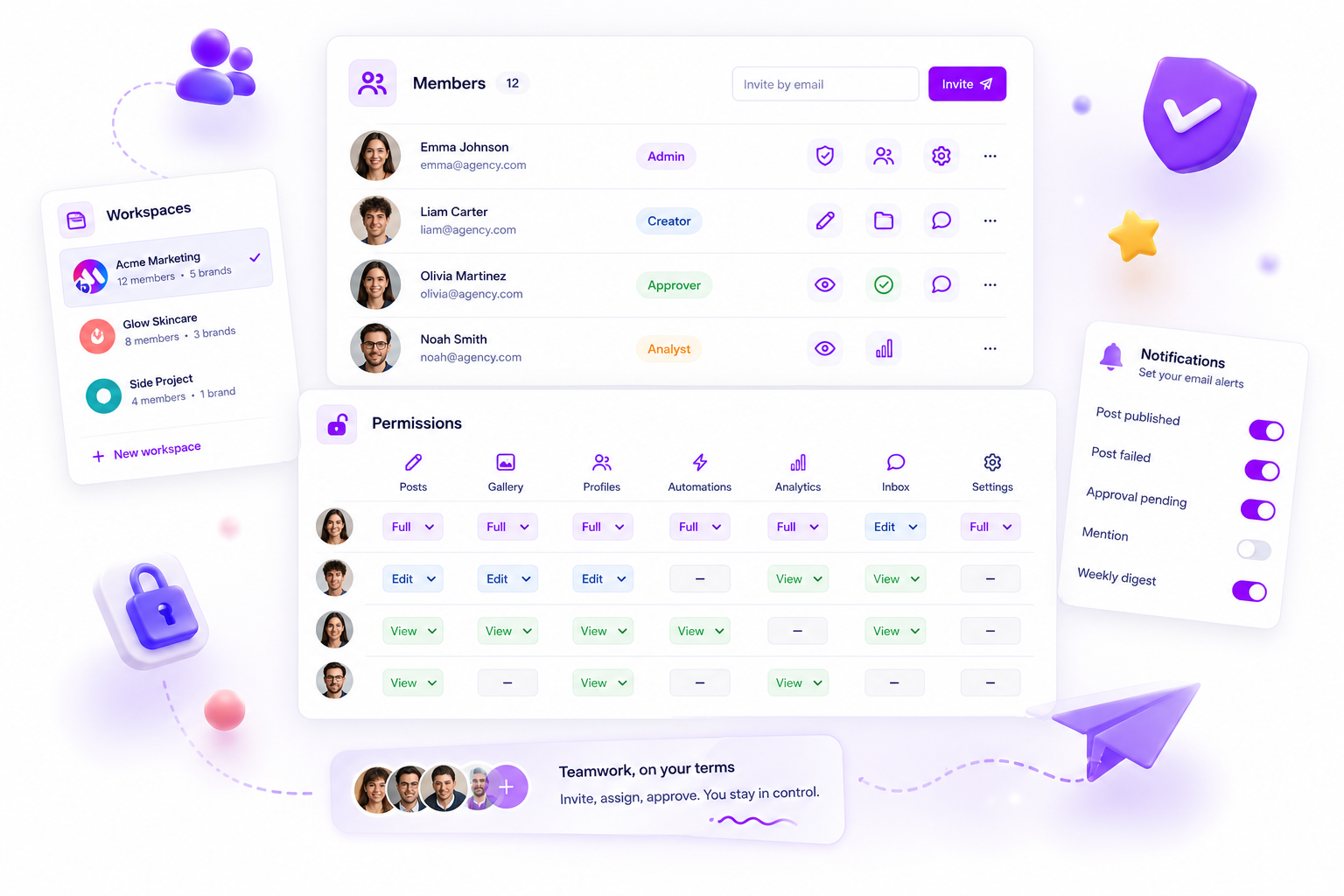
At Mydrop, we see this every day. Our "Workspaces" feature was built specifically to solve this. It serves as a container for every aspect of a team’s operation-billing, timezones, and membership-so that your global agency can maintain centralized governance without sacrificing distributed execution.
The goal is to eliminate the guesswork. When every unit in your agency works within a controlled, isolated, and locally-tuned workspace, you can scale to hundreds of profiles without the "operational drift" that kills smaller teams. If the platform cannot enforce these boundaries, you are just buying yourself a more expensive version of the mess you already have.
How Mydrop supports this workflow
We built our Workspaces container specifically to stop operational drift before it starts. Instead of treating your entire agency as one giant, unmanageable bucket, Mydrop lets you carve out distinct boundaries for every client or operating unit.
When you open Settings > Workspace in Mydrop, you are not just naming a project. You are setting a local reality. Each workspace is a sealed container that holds its own timezone, member roster, and quota. By locking the timezone at the workspace level, you ensure that when an automated report lands in the inbox of your London office, it arrives at the correct local hour, not six hours late.
We also enforce strict boundary checks. Because your team members are scoped directly to the workspace where they work, you eliminate the risk of permission creep. Someone working on a confidential launch for one client simply does not exist in the workspace for another. They cannot see the calendar, the draft assets, or the analytics dashboards for a workspace they aren't invited to. It is granular, secure, and it prevents those embarrassing "whoops, I didn't mean to share that" moments.
Finally, we handle context switching without the headache. The app remembers where you were last, so your team can jump between five different client workspaces without having to hunt for the right account or re-verify which timezone they are currently operating in.
A simple shortlist checklist
Before you commit to a new platform or double down on your current stack, run this 5-point audit. If a tool fails more than two of these, it is not a workspace management platform; it is just a shared login page with a fancy UI.
The Workspace Consistency Audit
- Scoped Timezones: Can you define a timezone for a workspace that overrides the individual user's locale for all reporting and scheduling?
- Hard Permission Boundaries: Are members isolated to only the workspaces they need, or does "member" status imply access to every brand account in the platform?
- Administrative Isolation: Can one workspace admin delete or reset data without accidentally destroying settings for the entire agency account?
- Automated Context Loading: Does the platform automatically resolve and load the correct workspace context based on the user's last session or team membership?
- Granular Usage Tracking: Can you view and manage product quotas, billing, and usage counters at the individual workspace level?
If you cannot check these boxes, your tool is actively fighting your growth.
Conclusion
The biggest hurdle for scaling an agency isn't finding better ideas or producing more content. It is managing the hidden tax of coordination. Every time a team member has to calculate a time difference, double-check a permission setting, or hunt for the right reporting dashboard, they are burning energy that should be going into client strategy.
Governance is often mistaken for slowing things down. In reality, the right structure is the only thing that lets you move fast. When your workspace settings, roles, and timezones are standardized, you stop managing people and start managing outcomes. You move from checking if everyone is on the same page to actually shipping work at scale. Don't build a bigger machine if the one you have is leaking energy through every connection. Standardize the foundation, secure the boundaries, and give your team the breathing room to actually create.