
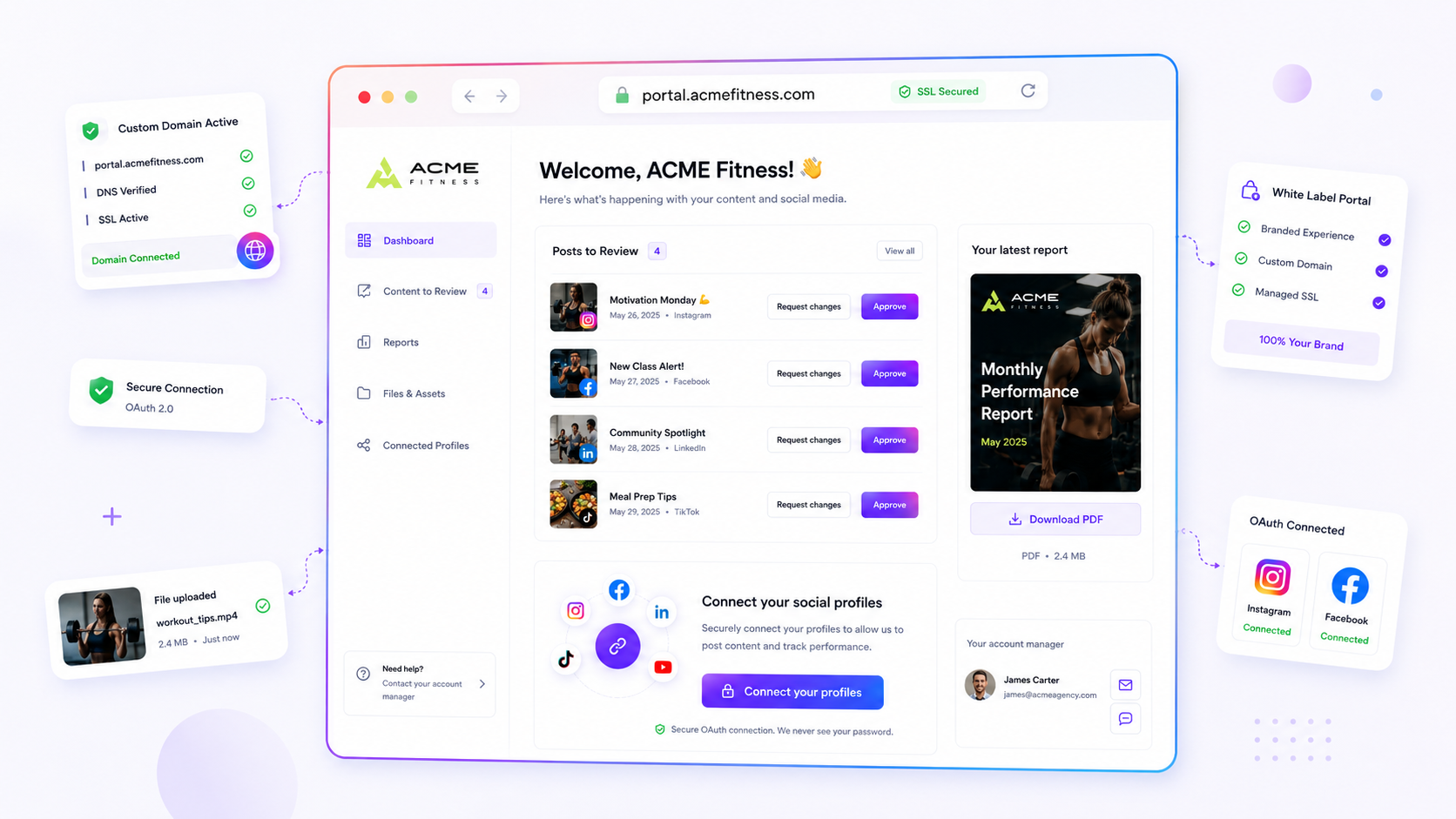
The secret to painless agency-to-client domain handoffs isn't better email templates; it is moving away from manual setup entirely in favor of a centralized tool that automates the entire lifecycle of DNS verification, SSL provisioning, and surface routing. Most handoff friction is just "coordination debt" masquerading as a technical issue. When you force a client to act as an intermediary for a single DNS update, you create a bottleneck that stalls your entire launch. You need a system that gives you, and your client, a single, transparent source of truth that shows real-time status without a single Slack message.
We have all spent those final, tense hours before a campaign launch, refreshing a DNS lookup tool and wondering if the client actually hit "save" on the right record. It is the kind of invisible work that burns out account managers and creates unnecessary anxiety for stakeholders. The best tools eliminate this by turning a series of disconnected, error-prone tasks into a fluid, self-service experience where everyone sees the same progress.
What the best tools need to handle
When you're managing dozens of brands, you shouldn't be manually checking certificate status or emailing instructions for A-records. A robust domain management tool must treat the entire domain lifecycle as a singular, automated loop. If your system requires you to manually trigger SSL or jump between different dashboards to verify DNS, you are just inviting more administrative overhead.
We use the "Three-Step Validation Principle" to evaluate these systems: Verify (DNS), Provision (SSL), and Route (Surface Assignment).
- DNS Verification: The tool must instantly validate that the client’s domain points to your infrastructure. This shouldn’t require a help desk ticket; the interface should confirm status in seconds.
- Managed SSL Lifecycle: SSL provisioning should happen autonomously. The moment DNS is verified, the platform should request, issue, and renew the certificate without human intervention.
- Surface Routing: Finally, the tool needs to dynamically map the domain to the correct asset-whether it is a link-in-bio page or a brand portal-without requiring new DNS changes.
Here is how we compare a traditional manual process against a modern, automated approach.
| Metric | Manual Handoff | Automated Lifecycle |
|---|---|---|
| Status Visibility | Email/Slack updates | Real-time Dashboard |
| DNS/SSL Setup | Manual/Multi-step | One-click Automation |
| Routing Changes | Requires DNS update | In-app reassignment |
| Launch Delay Risk | High (days) | Minimal (minutes) |
At Mydrop, we see teams struggle most when they treat custom domains as temporary technical hurdles rather than persistent brand assets. By centralizing the host dispatch, Mydrop allows you to handle the entire chain-DNS check, SSL provisioning, and final target assignment-within the same environment where your teams already manage their content. This removes the coordination debt that slows down enterprise teams, effectively turning a week of back-and-forth into a five-minute configuration.
The key is moving from "I hope the client updated the record" to "The system confirms the record is active."
Where basic tools start to break

The real trouble begins the moment you try to scale. If you are managing one or two domains, you can survive the manual overhead of updating DNS, waiting for propagation, and then manually checking SSL status in a separate browser tab or command-line tool. But once you move from a handful of domains to supporting dozens-or when your agency is balancing client-owned infrastructure across multiple regions-that manual process isn’t just slow; it’s a constant drain on your team’s focus.
Basic tools usually fail because they treat domain management as a static configuration step rather than a dynamic, ongoing lifecycle.
- The "Wait and See" bottleneck: Most systems require you to manually check if the DNS propagation has finished before you can even trigger SSL provisioning. This creates a hard stop in your workflow, where you are forced to check back in an hour, only to realize the client missed a trailing period in the CNAME record.
- SSL as a separate chore: If your tool doesn’t treat managed SSL as a native, automated part of the domain connection process, you are essentially doubling your effort. You end up troubleshooting certificate errors in a secondary dashboard, disconnected from the actual link-in-bio surface you are trying to launch.
- Lack of visibility: Without a centralized dashboard that clearly shows the status-DNS verified, SSL pending, or routing active-you are left guessing. If a client reports a site-down error, your team has to manually hunt through logs or verify configurations, costing precious hours during a campaign launch.
The buying criteria that matter
When evaluating tools to remove this friction, look for platforms that collapse these disparate steps into a single operational interface. You are not just buying a "domain connector"-you are buying an automated agent that manages the health of your brand’s entry points.
Use this scorecard to evaluate whether your current setup (or a prospective one) actually solves for scale.
| Evaluation Metric | Manual/Fragmented Approach | Automated Integrated Workflow |
|---|---|---|
| DNS Verification | Manual check (email or nslookup) |
Instant, platform-native validation |
| SSL Provisioning | Manual triggers, external cert management | Automatic, background provisioning |
| Surface Routing | Requires IT/Dev involvement for each change | Instant assignment in UI |
| Status Transparency | None (reactive troubleshooting) | Real-time state indicators (e.g., sslState) |
| Failure Recovery | High-touch, slow manual intervention | Automated retry/refresh mechanisms |
Operator rule: If your team spends more than five minutes total on any single domain launch, your tools are doing too much of the "doing" and not enough of the "managing."
A robust system must handle the "Three-Step Validation Principle": Verify (DNS check), Provision (managed SSL lifecycle), and Route (assigning the domain to a link-in-bio page or portal). Anything less, and you are simply moving the coordination debt from one spreadsheet to another.
At Mydrop, we see the most successful teams moving away from the "setup-and-forget" model entirely. They rely on centralized host dispatch systems, where custom domains are treated as managed assets that automatically route to the right client-facing surface, regardless of whether that surface is a simple link-in-bio page or a complex, gated brand portal.
Stop managing domains as isolated tickets and start managing them as part of your core brand infrastructure. Your launch velocity depends on it.
How Mydrop supports this workflow
Most agencies think they have a domain problem when they actually have a communication problem. The goal is to move the conversation from "is the DNS record propagated?" to "is the campaign ready for launch?"
At Mydrop, we built our domain infrastructure to turn the manual, multi-step process into one continuous motion. We treat domains not as temporary settings, but as first-class brand assets that need stability and oversight.
The system follows the Three-Step Validation Principle automatically:
- Verify (DNS): When you add a client-owned domain, our system instantly checks if the DNS records point to the correct public target. If they do not, the error is caught immediately, giving you a clear instruction to pass to your client's IT team without guessing.
- Provision (SSL): As soon as the DNS check passes, the system triggers managed SSL provisioning. There is no manual certificate uploading or waiting for a third-party security team to respond to an email thread. The certificate lifecycle is handled internally, and we monitor state changes to ensure the connection is secure before it ever hits the public.
- Route (Surface Assignment): Once the domain is active, Mydrop's centralized host dispatch takes over. You assign the domain to a specific link-in-bio page or a brand portal through a simple interface. The system updates the routing in real-time, removing the need for you to reconfigure load balancers or edit host files every time a client campaign changes direction.
This approach means you only interact with the tool when a decision needs to be made, not when a technical status update is required. Because the system tracks domain documents and sslState across your entire workspace, you get a bird's-eye view of all client-facing surfaces.
Decision check: If your team is spending more time troubleshooting DNS records than planning campaign strategy, your current tool is just an expensive configuration interface, not a management system.
A simple shortlist checklist
When your team is evaluating a new tool, use this scorecard to ensure you are not buying another manual process hidden behind a clean interface. If the tool fails on more than two of these, it will become a source of technical debt before your third client launch.
| Requirement | Why it matters |
|---|---|
| Integrated SSL Lifecycle | Manual certificate management is the #1 cause of sudden, unexpected site downtime. |
| Immediate DNS Feedback | You need to know if a client made a mistake within seconds, not hours after the launch call. |
| Centralized Surface Routing | Managing domains and targets separately creates massive potential for configuration drift. |
| Asynchronous Provisioning | Your workflow should not pause while the platform waits for global DNS propagation. |
| Self-Service Client Access | If you have to intervene to assign a domain every time, you haven't actually reduced handoff friction. |
If you are currently managing dozens of domains, ask this simple question: "If every client updated their DNS records at the exact same time, could our current tool handle it without a single manual intervention?" If the answer is no, you are still doing the work of a machine.
Conclusion
At the end of the week, the difference between a high-performing agency and one that is constantly putting out fires is the quality of their infrastructure. When you remove the noise of manual domain verification and SSL tracking, you free up your team to focus on the only work that actually moves the needle: high-impact content strategy and client growth.
The best agency-to-client handoffs are the ones where nobody notices the technical setup. The campaign goes live, the branded domain works perfectly, and the team moves to the next project without a single Slack thread about certificate errors.
Stop treating client domains as a technical hurdle to be cleared, and start treating them as an integrated part of your brand experience. When you move to a system that automates the boring stuff, you'll find that your team's capacity to take on new clients grows naturally, without needing to hire more operations staff just to manage your existing ones.
It is time to stop being the middleman for DNS changes. Pick a tool that acts like an operator, and watch your handoff friction disappear.