
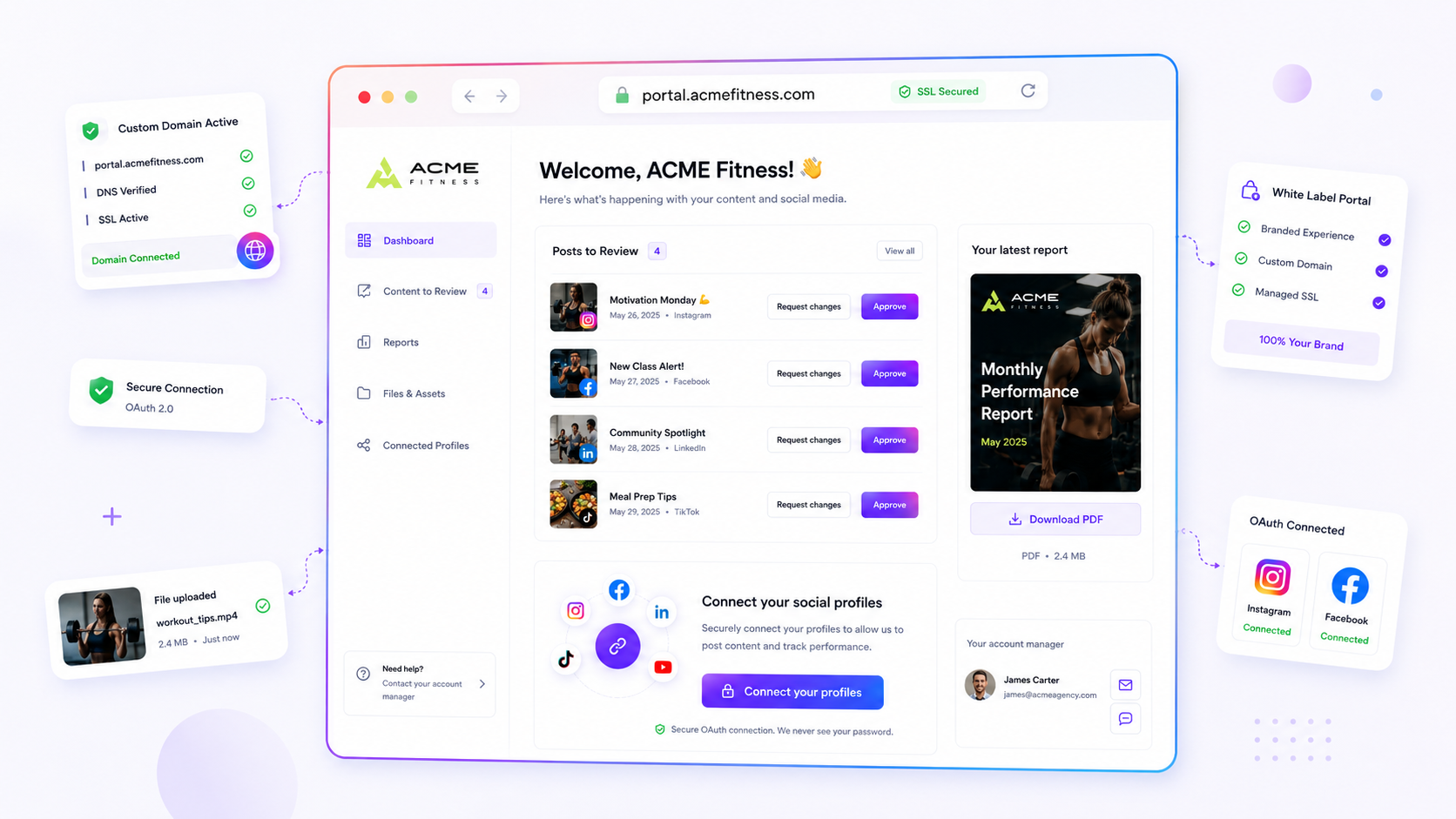
Move your client-facing portals to a custom brand domain only when the cost of manual explanation-constantly telling stakeholders that your agency-branded URL is "safe" and "official"-starts to slow down your actual campaign results.
We get it. You are juggling dozens of client portals across a dozen time zones, and the "good enough" generic URL feels like one less thing to break. It is messy, it is manual, and it feels infinitely safer to keep clients on your own infrastructure than to go hunting for a client IT contact who can actually grant DNS access without sending a support ticket into a black hole.
But here is the awkward truth: using generic platform URLs for high-value client portals acts as a quiet trust leak. It subtly signals that the client is just another tenant in your ecosystem, rather than the owner of their own digital presence. When you are managing brand identity for enterprise teams, that distinction is not just aesthetic; it is structural.
The goal is to stop treating link-in-bio pages and brand portals as temporary utility links and start treating them as permanent digital real estate.
The decision each metric should trigger

Use this rubric to weigh whether your current operations are ready to absorb the minor friction of DNS and SSL provisioning in exchange for the long-term authority of a branded URL.
| Maturity Stage | Generic URL ("mydrop.me/client") | Custom Brand Domain ("link.client.com") |
|---|---|---|
| Primary Goal | Velocity & Speed: Launch in seconds. | Brand Integrity: Own the user experience. |
| Trust Signal | "Managed by Agency" (Internal view) | "Official Client Property" (Customer view) |
| Ops Cost | Near Zero: No DNS, no certificate tracking. | DNS/SSL Lifecycle: Requires IT coordination. |
| Best For | Internal testing, temporary campaigns. | Enterprise partnerships, long-term stability. |
Common mistake: Trying to push a custom domain for a project that will only exist for three weeks. The administrative overhead of coordinating domain records with client IT teams usually costs more than the three weeks of brand authority is worth.
If your client's brand identity is the primary driver of their market positioning, the "trust leak" of a generic URL is a liability. At Mydrop, we handle the automated SSL provisioning and host dispatch so you do not have to keep a manual spreadsheet of certificate expirations, but the decision to start that process is all about your client relationship. If you are still in the "testing and rapid deployment" phase, stay generic. If you have moved to "permanent brand partnership," it is time to map that domain.
The scorecard that keeps reporting useful

Most teams sabotage their own analytics by muddying the waters with generic, platform-hosted URLs that blend into the noise of every other link-in-bio page. You lose the ability to cleanly partition your traffic data, forcing your analysts to waste hours filtering out the "platform noise" before they can even look at campaign performance.
When your client portals live on their own custom domains, you get clean, segmentable data from day one. You aren't just tracking a link; you are tracking a dedicated brand asset.
Use this scorecard to figure out if your current reporting setup is actually working for you or if it is just creating more manual work for your team.
| Assessment Question | Low Maturity (Stay Generic) | High Maturity (Move to Custom) |
|---|---|---|
| Data Partitioning | Need manual filters to find client data. | Data flows natively into client-owned property. |
| Stakeholder Visibility | Stakeholders doubt the "official" status. | Branding matches the domain perfectly. |
| Link Governance | Links get lost in platform-wide lists. | Domain points strictly to one active campaign. |
| Approval Cycles | IT is never involved in link setup. | IT approves domain CNAME records once. |
| Audit Requirement | "Trust us, it's our link." | Clear audit trail on the client's DNS host. |
If you answered "High Maturity" to three or more of these, you are likely suffering from coordination debt. You are paying for that "easy" generic link with a massive, recurring tax on your reporting accuracy and stakeholder trust.
What to stop measuring by default
It is easy to get addicted to vanity metrics like total clicks across your entire agency's portfolio. But when you use generic platform URLs, that total number is essentially a lie. It mixes your high-performing enterprise clients with your testing accounts, your abandoned projects, and your internal templates.
Stop measuring these three things until you have migrated to custom domains:
- Total Platform Click Volume: This number is useless because it conflates your top-tier brand presence with the "test link" you made last Tuesday.
- Generic Domain Referral Traffic: If your analytics tool is flagging your own platform domain as a top referrer, you have a visibility gap. You are seeing the tool, not the brand.
- Platform-Hosted Conversion Rates: When a user hops from a generic link to a client-owned site, you lose the clean referral path.
The pivot is simple: If you cannot tie the link directly to the brand owner's domain, stop counting it as a "managed brand surface." At Mydrop, we see teams that move to custom domains instantly slash their "unclassified traffic" reports because the DNS record acts as a hard filter. You aren't just cleaning up a URL; you are reclaiming your data integrity.
Operator rule: If a campaign or portal is important enough to demand an executive report, it is important enough to live on a custom brand domain. If it is just for a quick test, keep it generic, but stop calling it a core brand asset in your monthly roll-up.
When you switch, you stop being a conduit and start being a partner. You are no longer asking the client to "trust the platform link"; you are handing them the keys to a digital property that lives on their own turf. It is a subtle shift, but it effectively kills the most common excuse for reporting delays at the end of the quarter.
How to connect metrics to next actions
The data in your dashboard is useless if it does not trigger a conversation about who actually owns the audience. When you notice a dip in click-through rates or engagement depth, stop asking if the content is "too creative" and start asking if the domain is building trust or breaking it.
If your analytics show high traffic but abysmal conversion, you might be suffering from a URL friction penalty. Users click a link expecting a secure, professional portal, but instead, they land on a generic platform domain. That subtle, subconscious disconnect-where the URL doesn't match the brand-is enough to make a user bounce before the page even loads.
Connect your metrics to this simple decision trigger:
| Metric Trend | Diagnosis | Action |
|---|---|---|
| High CTR, Low Conversion | Trust gap; brand mismatch | Pivot to a custom domain |
| Stable Engagement, High Bounce | Confusion; platform overhead | Audit portal path UX |
| Low Organic Discovery | Identity fragmentation | Consolidate under primary domain |
If you are currently running dozens of campaigns and the data is fragmented across generic hostnames, you aren't just losing traffic-you are losing the ability to iterate. When every link-in-bio page lives on a custom domain, your analytics become clean, segregated, and actually actionable.
The review cadence that makes the model stick
Don't let domain migration become a one-off "IT project" that sits in the backlog for six months. Treat the transition to white-label infrastructure as a quarterly housekeeping item.
At Mydrop, we suggest a simple 3-step audit every quarter to clear out the coordination debt that accumulates when you have multiple teams managing multiple brands.
- The Identity Audit: Flag any active client surface that still relies on a generic
mydrop.meor similar public URL. If it has been live for more than 30 days, move it to the backlog for a domain migration. - The Security Sync: Verify that the SSL provisioning-which we automate on the backend-is healthy. If a domain is flagged, verify DNS records with the client’s IT lead immediately; don't let a "Certificate Error" be the reason your campaign goes dark.
- The Ownership Check: Confirm which team member is the point of contact for the client’s DNS admin. If you don't have a direct line to someone who can update a TXT record, you don't have a brand partner-you have a service bottleneck.
Decision check: Never assign a client-owned domain to a portal until the SSL is confirmed as active. It saves you the 6 p.m. panic when a link breaks because the handshake failed.
Conclusion
The shift from generic URLs to branded domains is rarely about the tech. It is about whether you are willing to step out of the way and let the client own their digital front door.
We know the prospect of managing DNS and SSL feels like a thankless, manual chore. But the alternative is worse: a graveyard of generic, disconnected links that signal to your audience that your client’s brand is just another tenant in your ecosystem.
Make the move when your operational maturity-your ability to coordinate with client IT teams and maintain secure, custom infrastructure-finally catches up to the scale of your creative output. When you do, the friction vanishes, the trust remains, and you stop being a conduit for your tools. You become the partner who actually built the destination.