When your agency sends a client a link that starts with a third-party platform’s name, you are not just sending a file-you are telling them that your professional service is an add-on to someone else’s software. The most successful agencies stop this leakage at the source by wrapping every portal and link-in-bio in their own branded domains.
We get it. You are juggling twenty client requests, and the last thing you want to do is fight with DNS records or chase down expired SSL certificates. It feels like a technical hurdle that distracts from the creative work, but ignoring it is costing you perceived value every time a client clicks a link. The goal isn't just aesthetics; it's establishing your agency as the primary owner of the digital experience.
Operator rule: Every client-facing link must pass three gates: DNS Validation (ownership), Managed SSL (security), and Host Dispatch (proper routing). If a tool lacks one, it is not an agency-grade solution.
What the best tools need to handle

Agencies that struggle with domain infrastructure usually treat it as a manual "one-off" chore for every new client. This is a trap. You want a tool that treats domain setup as a templated, repeatable step in your onboarding flow. If your current software requires you to manually copy and paste SSL keys or alerts you via email that a certificate is expiring, you have already lost.
The best tools move that burden from your team to the infrastructure layer. They should handle the entire lifecycle-from initial DNS checks to asynchronous SSL provisioning-without you ever needing to log into a registrar or manage a server.
When you evaluate a tool for this, look for these three core capabilities:
| Capability | Why it matters for agencies |
|---|---|
| Automated DNS Verification | Prevents "domain not found" errors by confirming configuration before a portal goes live. |
| Asynchronous Managed SSL | Removes the "Connection Not Private" warning by handling certificate renewal automatically in the background. |
| Host Dispatch Routing | Allows you to map a single client-owned domain to different surfaces-like a landing portal or a bio page-based on your current delivery needs. |
This is where the distinction between "creator-grade" and "agency-grade" software becomes obvious. A creator-grade tool might let you plug in a domain, but if that domain fails to route or triggers a browser security warning because the platform-managed certificate timed out, the agency is the one that looks incompetent during a client check-in. At Mydrop, we see teams managing hundreds of brand profiles, and we know that the moment a client sees a generic platform.me URL in their browser bar, the perceived value of your agency-delivered strategy takes a hit. You are essentially training the client to look past your brand and toward your vendor.
Where basic tools start to break

Most teams realize their domain infrastructure is failing exactly when they least want it to-in the middle of a high-stakes campaign launch or during a live client meeting. You add a new portal, assume the platform’s "auto-setup" works, and then hit a wall.
The cracks usually appear in three predictable stages:
- The SSL Dead Zone: Many "easy" tools treat SSL certificates as a one-time setup. They don't monitor for expiry or auto-renew effectively. Suddenly, your client’s site displays a "Connection Not Private" browser warning. You’re now scrambling to refresh certificates while your client asks why their professional brand looks like a security risk.
- The DNS Black Hole: If a tool requires manual DNS configuration without a built-in verification check, your team is guessing whether the record propagated. You lose hours-or days-playing tag with IT departments because you have no visibility into the domain’s status.
- Routing Rigidity: You might want
portal.client.comfor their asset hub andbio.client.comfor their link-in-bio. Basic platforms force you into a one-size-fits-all host path, breaking your branding strategy and forcing you to use disjointed URLs for different client touchpoints.
At Mydrop, we see agencies get stuck when they treat domain assignment as a "set it and forget it" task. When your infrastructure doesn't handle the async heavy lifting-like DNS validation, certificate provisioning, and host dispatch-it becomes a permanent part of your overhead. You stop being a creative partner and start being an unpaid server administrator.
The buying criteria that matter
When you are ready to stop leaking authority, you need to move beyond "does it support custom domains?" and look at the operational reliability of the tool. Use this scorecard to evaluate whether your current platform is ready for enterprise-level agency work.
| Capability | What to demand | Why it matters |
|---|---|---|
| DNS Verification | Real-time status checks with clear error feedback. | Stops the "waiting game" while IT confirms if records are live. |
| Managed SSL Lifecycle | Zero-touch, asynchronous provisioning and auto-renewal. | Prevents the "Connection Not Private" embarrassment in front of clients. |
| Target Assignment | Granular routing (portals vs. links) on the same domain. | Keeps your agency's branding ecosystem unified under one umbrella. |
| Service Integration | Internal health checks and service account authorization. | Ensures the platform itself is talking to your DNS records securely. |
| Removal Hygiene | Automated cleanup of resources upon domain deletion. | Prevents orphaned SSL certificates and security gaps when a project ends. |
Decision check: If your domain tool requires you to manually monitor or refresh your SSL certificates, it is not an agency-grade platform. It is a liability.
The best tools are essentially invisible. Once you configure the initial CNAME or A record, the platform should take over the full lifecycle. It should handle the handshakes with the certificate authority, confirm the domain is ready, and route the host appropriately without anyone on your team having to "refresh" a status page manually.
If you are currently spending your Monday mornings checking SSL statuses instead of reviewing content strategies, you aren't just losing time. You are failing a basic security gate that your clients expect you to have under control.
This is the hidden cost of "simple" tools: they are cheap upfront but expensive to maintain as your brand list grows. You aren't paying for the domain; you are paying for the peace of mind that every link, portal, and bio page looks exactly as professional as the work you actually delivered.
How Mydrop supports this workflow
At Mydrop, we have seen enough broken brand experiences to know that domain management is rarely a technical issue; it is a coordination problem. When you need to spin up a new client portal or link-in-bio page, the last thing you want is a multi-day delay while your IT team navigates a ticket queue or, worse, a panicked email from a client because their site is showing an SSL warning.
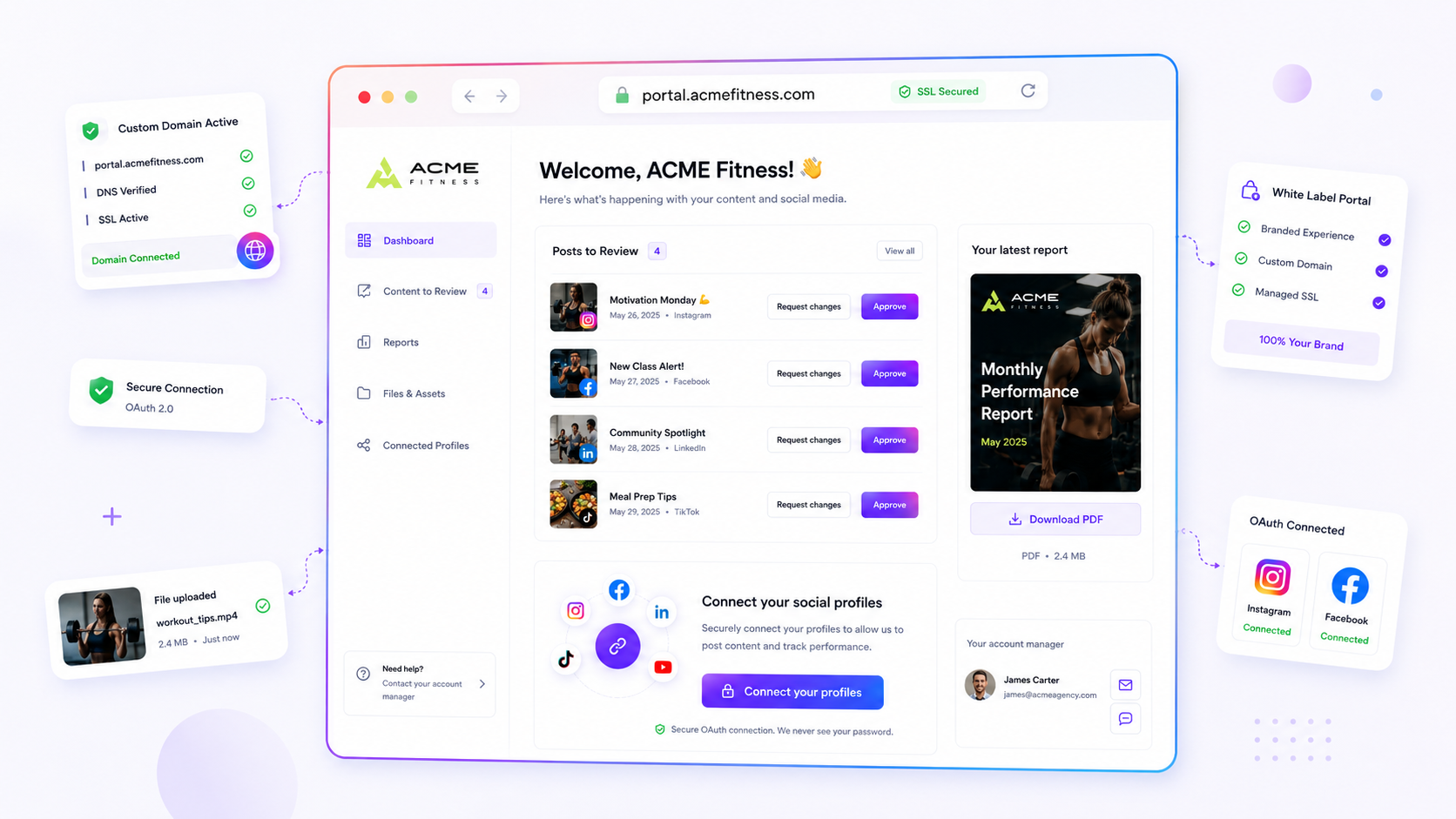
We built our custom brand domain infrastructure to get the technical heavy lifting out of your way. Instead of manual DNS hand-offs or custom scripts, Mydrop automates the entire lifecycle. You enter the desired domain in your workspace settings, perform the initial DNS verification, and the platform takes over. We handle the provisioning of managed SSL certificates, perform the automated checks, and even manage the host dispatch to route visitors to the right portal or bio page.
The real benefit is that your team stops being a bottleneck. Once the domain is verified, you can assign it to any target-a client-specific bio page or a full brand portal-without needing to touch DNS records again. We essentially treat your domains as a reusable, secure asset that you can instantly point at whatever surface the client needs right now.
Workflow check: If your domain tool requires you to manually copy and paste certificate files or perform recurring status checks, you are not using a tool; you are performing unpaid IT maintenance.
A simple shortlist checklist
Before you commit to a platform for client-facing surfaces, run your current setup-or your next candidate-through this audit. If it fails on any of these four points, you will feel the friction within the first three months.
| Requirement | Why it matters | Decision Check |
|---|---|---|
| Automated SSL | Eliminates the "Connection Not Private" panic during meetings. | Does the tool auto-renew and monitor health? |
| DNS Verification | Proves ownership and prevents unauthorized spoofing. | Is the validation step clear and non-destructive? |
| Granular Routing | Allows one domain to serve multiple surface types. | Can I toggle a domain between a portal and a bio page? |
| Async Provisioning | Keeps your team moving while the web catches up. | Does the tool handle the "wait time" without blocking UI? |
Conclusion
The difference between an agency that feels like a partner and one that feels like a commodity often comes down to the quality of the small, persistent details-and nothing is as persistent as the URL in the address bar.
When you consistently deliver branded, secure, and professional client surfaces, you reinforce your authority without ever needing to say a word about it. Conversely, every time you default to a generic, platform-owned URL, you are quietly telling your client that they could have just gone to the software vendor themselves.
Stop the leakage. Move your client-facing surfaces to your own domains, automate the security layer, and treat your web infrastructure as a piece of brand equity that you own. You will save hours of manual maintenance, and more importantly, you will look exactly as professional as the work you actually deliver.