If your Monday mornings are hijacked by a frantic scramble to pull platform metrics, format PDFs, and draft summary emails, you are not managing social media-you are running a manual spreadsheet factory. Reporting efficiency is not about faster data collection; it is about eliminating coordination debt, the silent tax your team pays for every hour spent stitching data together instead of analyzing it.
We get it. You were hired to drive growth and craft strategy, but instead, you spend your most creative hours acting as human middleware between dashboards and client inboxes. It is repetitive, error-prone, and leaves zero room for the actual consultation clients pay you for. When you stop chasing the data, you can finally start selling the insight.
At Mydrop, we have seen this across thousands of campaigns. Teams that stop treating reports as a manual "Friday fire drill" and start treating them as an orchestrated service are the ones that actually scale. The goal is to move from a "human-in-the-loop" bottleneck to a set-and-forget delivery system that preserves data integrity while freeing your account managers to actually talk to clients.
What the best tools need to handle

The problem with most "reporting" tools is that they focus on the look of the dashboard while ignoring the lifecycle of the delivery. If your software does not handle the operational reality of client reporting, you are just trading manual Excel work for a slightly flashier manual export process.
Here is where the reporting cycle usually breaks, and why you need a tool that handles the full job, not just the data visualization.
The Recurrence Integrity Scorecard
Use this rubric to audit your current workflow. If your software fails more than two of these, you are carrying unnecessary coordination debt.
| Feature | The Manual Trap | The Operational Standard |
|---|---|---|
| Data Snapshotting | Live links that change if you update tags later. | Fixed point-in-time snapshots of metrics. |
| Delivery Trigger | Remembering to "run" or "export" manually. | Automated cron-based execution. |
| Failure Visibility | Discovering a crash when the client complains. | Proactive alerts on failed delivery attempts. |
| Workflow State | Deleting the file to stop a report. | Pause/Resume controls for active schedules. |
| Single Source | Attaching a static PDF to an email. | Secure public links with living report access. |
Where standard tools fail the agency test
Most tools assume you are a solo creator, not a manager overseeing dozens of accounts. They fail when the scale hits, specifically in three areas:
- The Snapshot Gap: If you rely on a tool that does not snapshot data, a client asking about "last month's performance" might see updated (and thus inaccurate) numbers because someone reorganized the brand profile. You need a record of exactly what the client saw at the moment of delivery.
- The "Forgot to Run" Risk: If your reporting depends on a team member remembering to hit "send," you have a systemic risk. The best software treats report delivery as a scheduled job-managed by a persistent runner that handles the queue, attempts the delivery, and logs the outcome.
- Disconnected Delivery: Sending a PDF as an attachment is a dead end. It disconnects the client from your expertise. Teams that succeed provide a
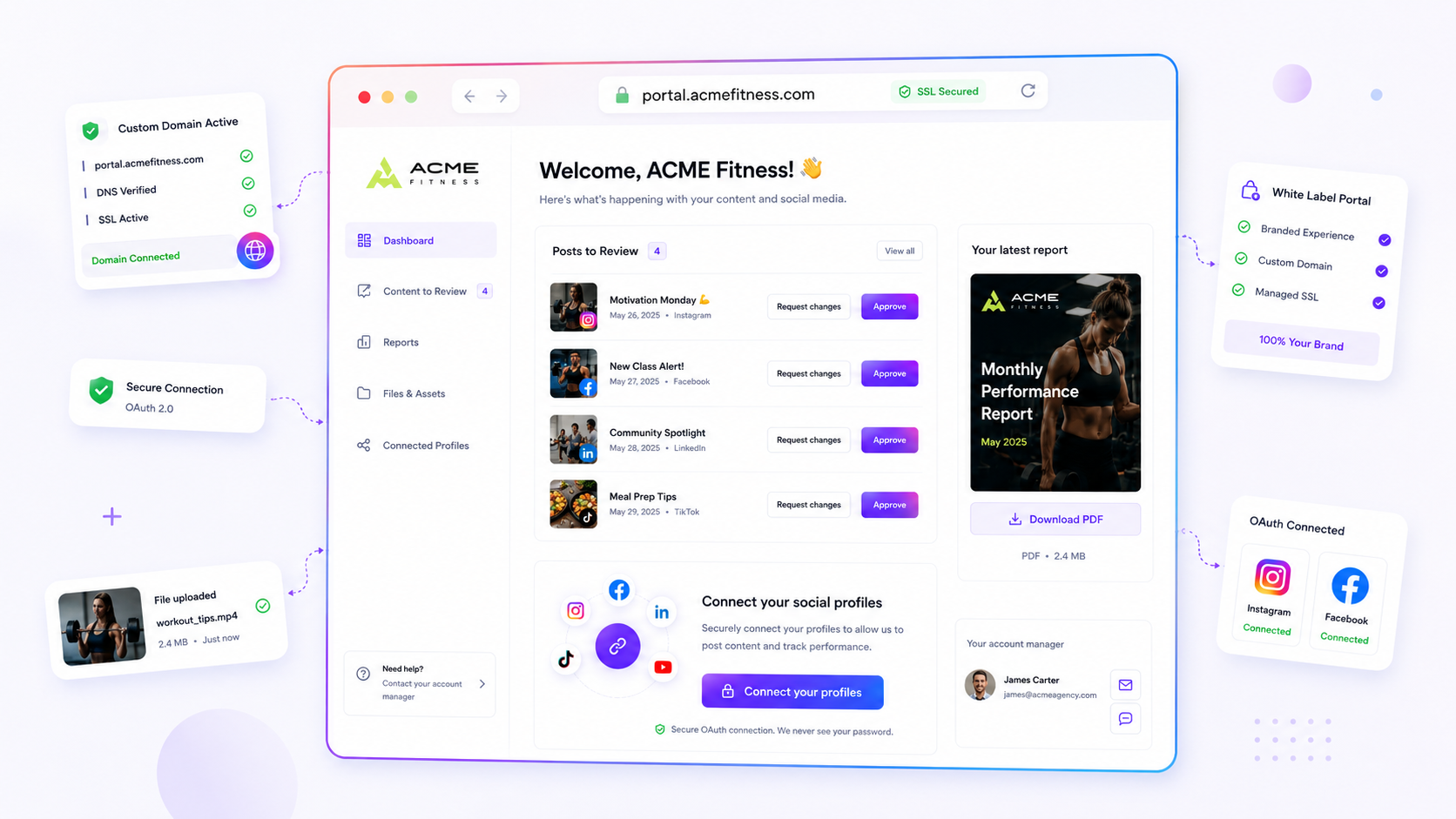
public linkthat keeps the client inside a branded environment, where you can present the data with context.
Operator rule: A 90% perfect, on-time automated report is exponentially more valuable to a client than a 100% perfect report that arrives two days late because your account manager was out sick. Consistency wins.
Where basic tools start to break

Most entry-level reporting tools are built for a single creator tracking one account. They assume you have the time to manually trigger every report, double-check the data export, and personally attach the PDF. When you scale to a team managing dozens of brand profiles across multiple markets, these manual dependencies become a liability.
The failure usually starts with snapshot fragility. Basic tools often fail to save the state of a report configuration. If you delete a social profile or update a brand name, your historical report links break or the data drifts. You end up with "ghost reports" that don't match what the client saw last month.
Another common breaking point is notification opacity. In many tools, if a scheduled job fails, you only find out when an angry client emails you asking why their report didn't arrive. A professional tool doesn't just send a report; it guards the process. It must proactively flag failures before they reach the client, giving your team the window to fix a data gap or refresh a connection without the client ever knowing there was a hiccup.
Common mistake: Relying on tools that treat reporting as a "print command" rather than a persistent service. If you have to log in to click "Run," it isn't an automated report-it is just a saved template.
The buying criteria that matter
When you are ready to stop acting like a spreadsheet factory, stop looking for "pretty charts" and start evaluating software based on its operational resilience. Use this scorecard to audit your current stack against the realities of enterprise reporting.
| Capability | What to look for | Why it matters |
|---|---|---|
| Config Snapshot | Saves the report structure, audience, and filters at the moment of creation. | Ensures a report run today looks identical to one run six months ago, regardless of current profile changes. |
| Job Lifecycle | Offers "Run Now," "Pause," and "Resume" controls on any schedule. | Allows you to halt reporting during a brand crisis or re-run a report instantly if a data sync fails. |
| Failure Visibility | Automated alerts for the operator, not just the client. | Keeps you ahead of the client so you can solve delivery issues privately. |
| Delivery Flexibility | Options for PDF attachments, public links, or secure app-portal access. | Different stakeholders have different security and accessibility requirements. |
| Recipient Logic | Support for CC chains and member-based distribution lists. | Automatically gets data to the right stakeholders without manual email drafting. |
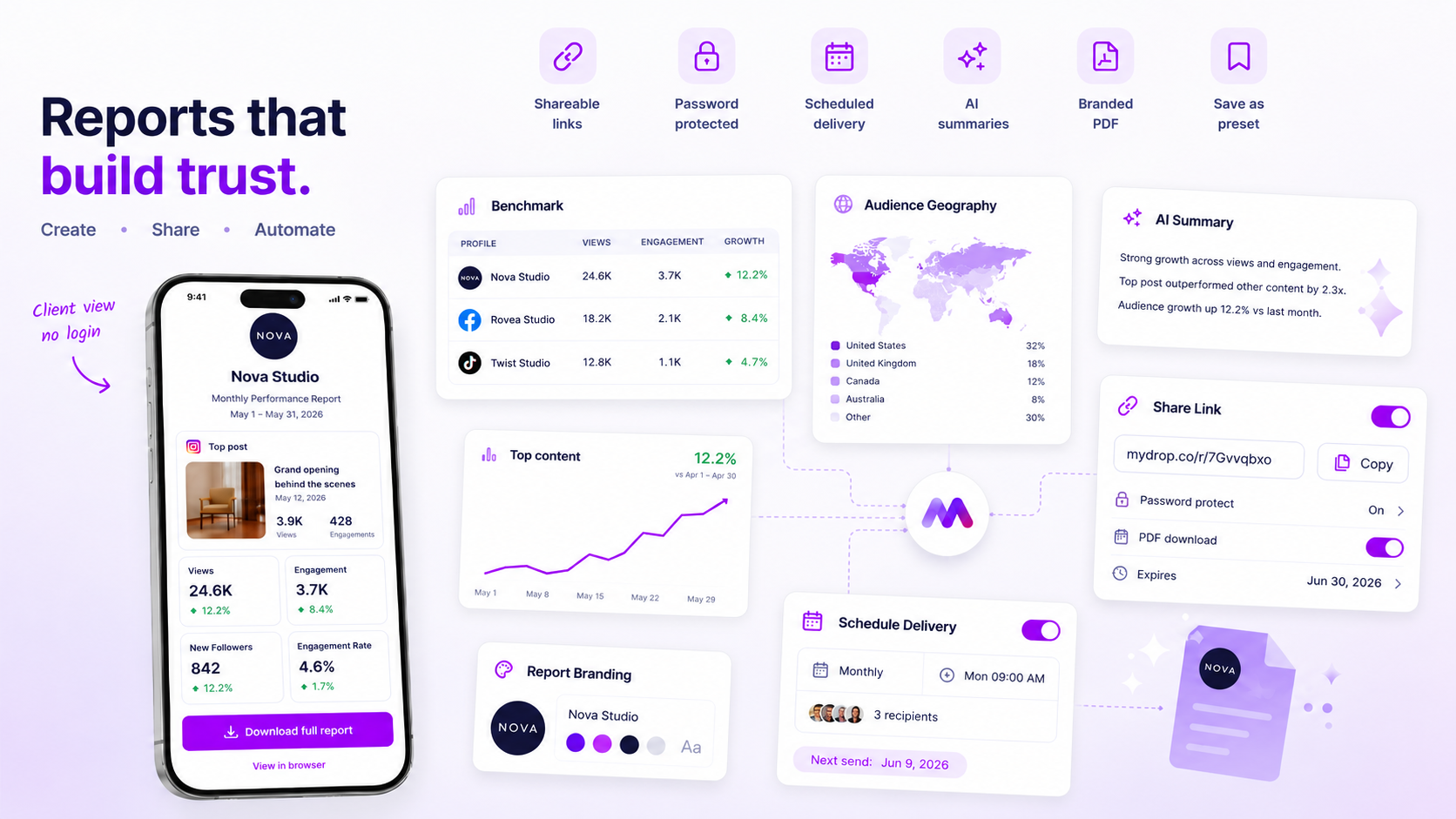
At Mydrop, we built our Analytics Scheduling around the reality that reporting is a service, not a task. We focus on data-derived recurrence-where schedules are treated as first-class, authenticated jobs that run in the background, keeping your clients informed without you having to touch a single file.
The goal isn't to make the report look 1% nicer; it is to make the report disappear as a line item on your team's to-do list. When you move to an automated, resilient delivery system, you stop paying the "coordination tax" and finally get back to the actual consulting work your clients are paying for.
How Mydrop supports this workflow
At Mydrop, we have seen this play out for years across teams managing hundreds of brand profiles. You do not need another dashboard; you need a system that removes the middleman between your data and your stakeholder's inbox. We designed our Analytics Schedule feature specifically to stop the Monday morning scramble.
Instead of manual exports, Mydrop treats your reporting as a set-and-forget service. You configure your report template once, define your audience, and select a cadence. The internal scheduler then handles the heavy lifting-authenticating your data, generating the snapshots, and ensuring the delivery goes out on time, every time. If a data source has a hiccup, you get a proactive failure notification rather than a client pinging you because their report never arrived.
This moves your account managers from "spreadsheet operators" back into the role they were actually hired for: client advisors. They spend their time interpreting the results rather than formatting the delivery.
A simple shortlist checklist
Before you commit to a new reporting tool, run this five-point integrity check. If the software cannot guarantee these, you are just buying yourself a slightly faster way to do the same manual work.
| Feature | Why it matters | Decision Check |
|---|---|---|
| Config Snapshotting | Ensures reports stay identical even if you delete profiles later. | Does the tool save a "view" of the data? |
| Failure Logic | Alerts you if a report fails before the client notices. | Do you get a proactive email on delivery errors? |
| Delivery Variety | Provides options for PDF, public links, or in-app access. | Can clients access data how they want? |
| Job Lifecycle | Allows pause, resume, and immediate 'run now' overrides. | Can you stop the flow without deleting the schedule? |
| Unified Audit | Keeps a log of what was sent and when. | Is there a history of every report delivered? |
Watch out: Teams often ignore the "Pause" capability. You will eventually have a situation where a campaign is paused or a client is transitioning, and you do not want to be forced to delete and rebuild a complex report schedule just to stop it for a week.
Conclusion
The difference between a frantic agency and a scaling one is rarely the quality of their creative-it is the reliability of their operations. When your reporting is manual, it is a liability that grows with every new client you sign. When it is automated and managed through a robust job lifecycle, it becomes a scalable product you can sell with confidence.
Do not let your best talent get buried in the "Deadline Trap" of manual report generation. Choose tools that prioritize consistency over craft in your operational pipeline, and you will find that your clients value the reliability of on-time, actionable data far more than they care about how you formatted the PDF. Audit your current reporting overhead this week. If it takes more than a few clicks to get a report into a client's hands, it is time to build a better machine.