For social media teams scaling content output, the best AI image tool is the one that manages the operational lifecycle of your assets-not the one that generates the slickest concept art. If your current tool forces your team to manually track job statuses, move files between tabs, or guess if an image will break your brand guidelines, you are not scaling; you are just moving your manual labor into a more expensive window.
We know the feeling. You are likely juggling a dozen campaigns, constant creative requests, and the looming fear of a brand color mismatch or a late post. Your creative team is burning cycles wrestling with disconnected AI windows, copy-pasting assets, and playing email tag just to see if a prompt finished rendering. It is messy, draining, and honestly, no one should be chasing image generation status at 6 p.m.
What the best tools need to handle

When you move from individual creation to enterprise operations, the requirements shift from artistic flair to structural integrity. An AI image tool for a large brand must act as a reliable member of your team, not just a creative spark. You need to look for platforms that handle the entire media lifecycle without requiring human intervention for every minor update.
At a minimum, your chosen system must manage these four operational pillars:
| Capability | Enterprise Value | Why it matters |
|---|---|---|
| Async Polling | Automated state tracking | You should never have to manually refresh a browser tab to see if a prompt finished. |
| Quota Governance | Budget & limit control | Enterprise scale requires tracking workspaces.ai_images_used so you do not hit surprise overages. |
| Media Verification | Brand compliance | An agent or review flow must check generated assets against your campaign plan before they hit the library. |
| Resilient Storage | Asset continuity | Completed media should land directly in your mediaMetadata or cloud storage, not stay trapped in a chat window. |
The most common failure we see occurs when teams treat AI generation as a "magic button." They trigger a request and assume it will just appear in their post. But the real world of external providers is messy-jobs get stuck, providers lag, and duplicate updates happen. A production-ready tool like Mydrop accounts for this by treating media generation as a tracked task (mediaJobs). It polls for completion in the background, handles the inevitable provider delays, and ensures that when the image arrives, it is already mapped to the right campaign or post, rather than sitting as a loose, unmanaged file on a desktop.
Operator rule: If your AI tool does not have an audit trail for usage and a way to verify the media against your plan before application, you are creating a downstream cleanup job for someone else.
Where basic tools start to break

The real trouble begins the moment you move past the "wow" factor of a single generated image. Basic tools treat generation as a one-off event, but your operation is a constant, messy, and high-velocity machine. When you lack a bridge between the generator and your final post, you start bleeding time.
Teams often find themselves caught in the Manual Trap. You fire off a prompt in a third-party app, then wait. And wait. When the image finally arrives, someone has to download it, rename it, and manually upload it to the platform you are actually using. If you are managing dozens of campaigns, that loop isn't just inefficient-it is an error waiting to happen.
We see this across agencies and large brand teams: files end up in the wrong folders, brand guidelines get ignored, and the legal team is left guessing if the asset is even approved. If your tool doesn't handle asynchronous job tracking, it isn't an enterprise solution. It is just a distraction that adds another chore to your day.
Common mistake: Treating image generation as a static request rather than a stateful job that requires reliable status callbacks.
When your workflow lacks native quota governance, things get even hairier. Without a centralized view of your team's spend, you end up with rogue accounts burning through your budget on experimental art that never sees the light of day. At Mydrop, we have seen how important it is to keep usage visible, because when you can see the cost per asset, you naturally start making better decisions about where to spend your creative energy.
The buying criteria that matter
When you are auditing potential vendors, stop looking at the "creativity" slider and start looking at the infrastructure. You need a platform that treats media generation as a first-class citizen of your post composition process.
Use this scorecard to distinguish between a shiny toy and a platform that can actually handle your team's workload.
| Criteria | Why it matters | Enterprise threshold |
|---|---|---|
| State Management | Prevents lost work when providers lag. | Needs automated job polling and status callbacks. |
| Quota Governance | Stops budget leaks at scale. | Must track usage per workspace/account. |
| Workflow Integration | Kills the download-and-reupload loop. | Direct attachment to the post composition screen. |
| Brand Guardrails | Maintains identity without manual review. | Pre-configured style/color enforcement. |
| Verification Loop | Ensures assets are ready for publication. | Native support for media plan review and approval. |
If you are currently chasing down files across three different apps, you have already lost. The goal is to move from Request to Review without ever leaving the flow of your campaign management.
Decision check: If you cannot trigger the generation and verify the output within your primary work interface, you are doing double the work for half the visibility.
An enterprise-grade tool handles the mess behind the scenes. It should be polling for status updates, managing those pesky provider delays, and ensuring that by the time you look at the media, it is already mapped to the correct campaign. Your team should be deciding on strategy and creative direction, not babysitting a loading bar. When the system handles the heavy lifting, you gain the space to actually govern the output.
How Mydrop supports this workflow
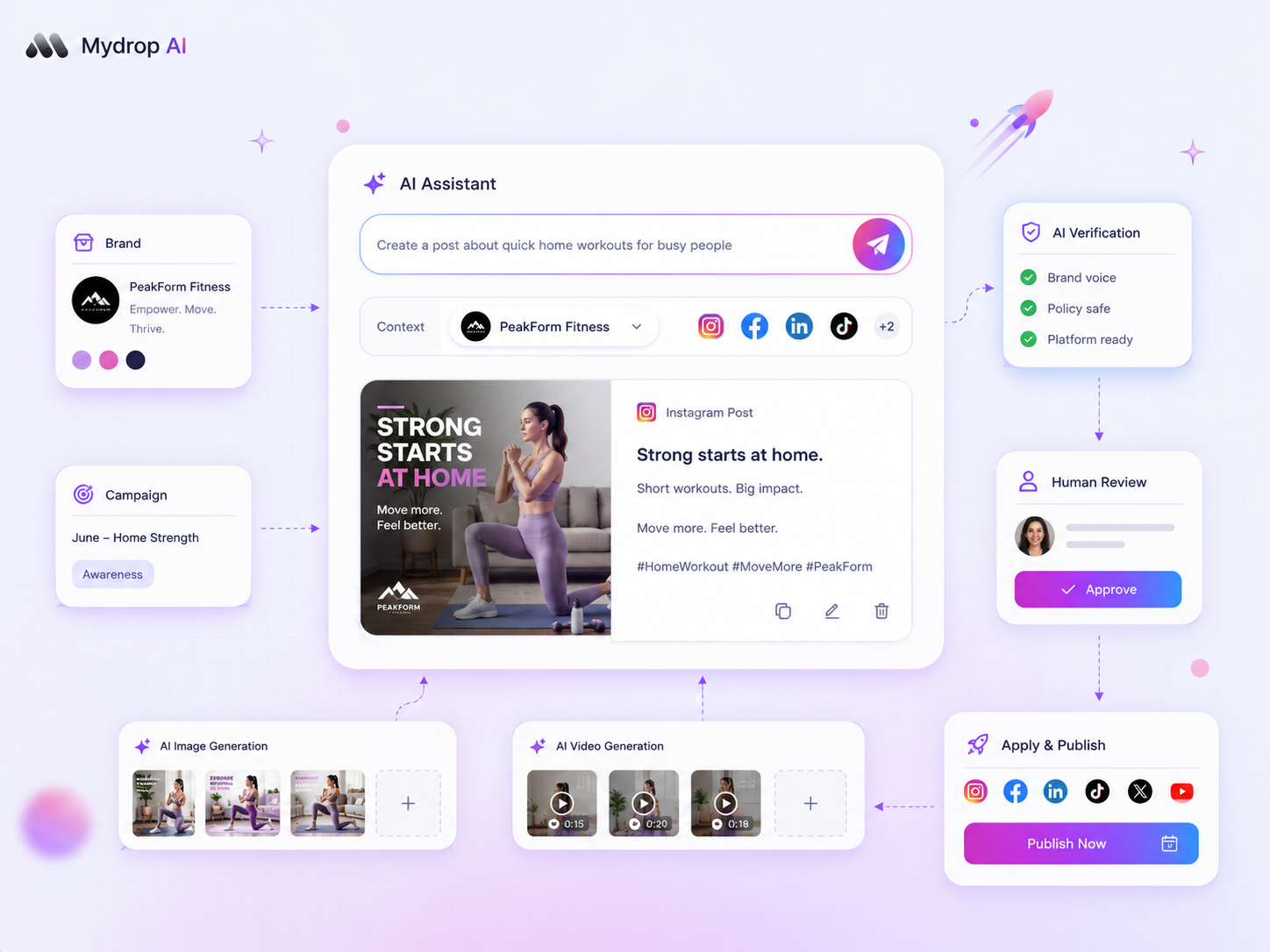
At Mydrop, we see the same pattern repeat across teams managing hundreds of social profiles: the bottleneck isn't the AI generation itself, but the "coordination debt" created when generated assets aren't immediately linked to the right campaign or approval loop. We built our AI Media Panel to solve exactly this, shifting the focus from simply generating images to managing their lifecycle.
When your team requests media, Mydrop doesn't just fire off a prompt. It manages an asynchronous job status, polling the provider and handling the inevitable provider delays or duplicate updates without needing a human to refresh a browser tab. Once the job succeeds, the media is automatically routed into your workspace storage, ready for the next step in your post composer.
We also treat AI usage as a governed resource. If your team is running large-scale content experiments, you need visibility into your spend. Mydrop tracks every image and video request, updating your workspace quota counters in real time. You aren't left guessing if a campaign is about to hit a budget cap; the system handles the accounting for you.
Finally, we added a Media Plan Review step. Before you attach an AI-generated image to a public-facing post, an agent verifies it against your intended media plan. It’s a simple guardrail, but it prevents the "oops, wrong file" errors that plague teams moving at speed.
Workflow check: Never treat an AI-generated asset as production-ready until it has passed through a structured verification step within your central management system.
A simple shortlist checklist
If you are currently evaluating vendors, use this scorecard to separate the workflow-ready platforms from the consumer-grade toys.
| Criteria | Must-Have for Enterprise | Why this matters |
|---|---|---|
| Asynchronous Job Management | API-driven polling | Eliminates manual checking of job status. |
| Quota Governance | Per-workspace usage logs | Prevents unmanaged budget spikes. |
| Media Plan Verification | Pre-attach verification | Stops wrong assets from reaching production. |
| Resilient Callbacks | Handles duplicates/delays | Ensures the system doesn't break during provider outages. |
| Centralized Storage | Integrated media library | Stops the "download-reupload" mess. |
Quick Audit: If you cannot answer "Yes" to all five, your team will eventually spend more time managing the tool than using it.
Conclusion
Scaling social media output is less about finding a faster engine and more about building a reliable chassis. The novelty of AI-generated imagery fades quickly when your team is spending six hours a week chasing down missing assets or reconciling mismatched billing logs.
Stop looking for the tool that draws the prettiest pictures and start looking for the platform that respects your operational constraints. Your goal should be to remove the friction of creation, not just add a new layer of manual management. When you move to a system that tracks status, enforces quotas, and automates asset storage, you finally get to focus on what actually drives your metrics: the creative strategy itself.
Pick a platform that functions like a member of your operations team, not just a standalone creative studio. Your future self, dealing with a major campaign launch, will thank you.