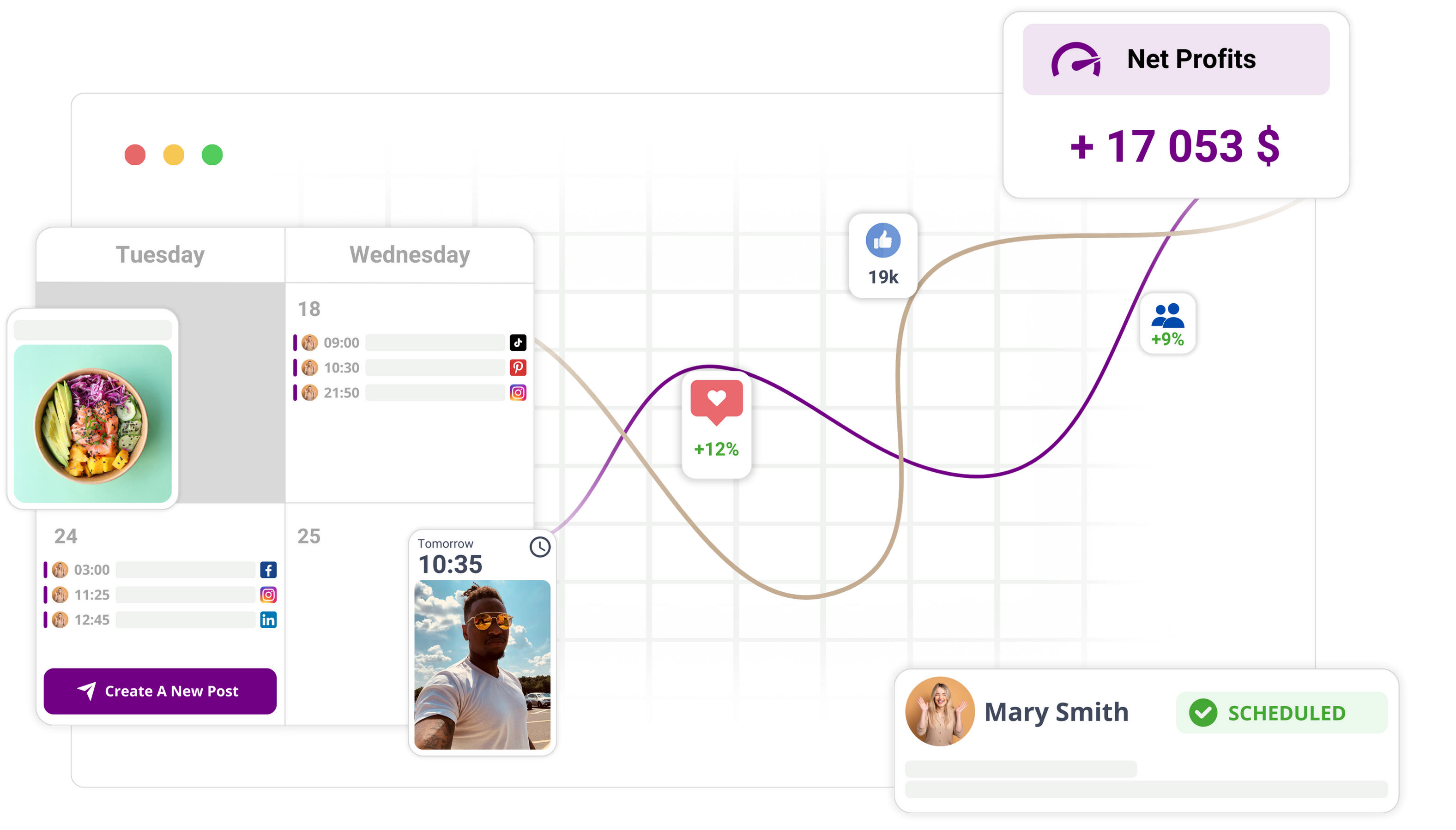
If you want to stop the constant churn of social media management, your best move is to consolidate your feedback and publishing into a single source of truth like Mydrop. Most teams think their issue is a lack of features, but the real friction is hiding in the spaces between your tools: the Slack thread where the image was approved, the email chain where the copy was finalized, and the spreadsheet where you track what actually went live.
TLDR: Stop trying to duct-tape your workflow together with external messaging apps. If you manage an Enterprise social team, prioritize tools that pull your approval, scheduling, and analytics into one unified dashboard.
You are likely exhausted by the "lost translation" phase-that moment where a high-stakes campaign idea gets shredded because the context stayed in a chat app while the post was scheduled in a siloed tool. This is the hidden cost of "all-in-one" platforms that don't actually integrate the decision-making process. The goal is to move from chaotic, multi-tab orchestration to a single, stable environment where intent meets execution.
A simple rule helps ground this: if you can't approve it in the calendar, you are just chatting, not planning.
Operator rule: Never start a campaign until the approval path is defined within the same interface as your publishing calendar.
When you remove the friction of jumping between tabs, you stop managing chaos and start scaling your output. To determine if your current setup is helping or hurting, consider these three indicators of a healthy social team:
- Context Persistence: Can a new team member see the entire approval history of a post without leaving the calendar?
- Workflow Consolidation: Does your approval trigger an automatic state change, or are you manually checking boxes in a separate sheet?
- Audit Readiness: Can you pull a report showing who signed off on specific copy or media without digging through archived chat logs?
The feature list is not the decision

It is tempting to shop for social media tools by checking boxes against a list of network integrations. Everyone claims to offer "multi-platform support," but a tool that connects to every channel while keeping feedback trapped in external threads is just a fancy archive for missed deadlines.
Most teams fall into "The Feature Trap." They prioritize the breadth of integrations-thinking that having an X, Threads, and TikTok button is the key to velocity-but they ignore the structural bottlenecks in their own internal processes. You do not need more buttons; you need fewer handoffs.
| Workflow Stage | Standard Tool (External Chat) | Mydrop (Integrated) |
|---|---|---|
| Review | Link sent in Slack/Teams | In-post approval button |
| Changes | Typed instructions | Annotated comments on media |
| Status | Manual spreadsheet update | Automatic state change |
| Context | Lost in thread history | Attached to the asset |
The most common mistake is evaluating a tool based on its feature roadmap rather than its impact on your team's decision-making rhythm. When your approval workflow is disconnected from your publishing calendar, your team’s focus-and accountability-is constantly being pulled away from the work.
You end up paying for a tool that handles the "how" (posting) while failing to facilitate the "why" (aligning stakeholders and brand voice). In a high-volume social operation, the tool should act as the nervous system of the team, not just a relay station for content. If the software is making you work harder to keep the team informed than it is to publish the post, it is time to reassess your stack.
Most teams do not have a content problem. They have a decision bottleneck. When you centralize the approval gravity inside your calendar, you stop chasing updates and start controlling your brand's presence across every market and channel.
The buying criteria teams usually miss

Most organizations shop for social tools like they are picking a dinner menu: they look at the list of networks, check off the "AI features," and ignore the architecture that actually keeps the team sane. They focus on the output-how many platforms can we blast?-but completely miss the coordination debt they are accumulating.
When you are managing a global brand or a complex agency portfolio, you aren't just hitting "publish." You are managing compliance, brand voice, and a dozen stakeholders who have no business being inside a social media dashboard. If your tool doesn't have robust audit logs or granular permission sets, your biggest risk isn't a bad post; it is a lack of accountability when things go sideways.
Most teams underestimate: The cost of "copy-paste" verification. If you cannot see exactly who approved what, and when, you are one rogue intern away from a PR crisis that no analytics dashboard can fix.
The best enterprise teams prioritize Governance over "gadgets." They stop asking "Does it post to Threads?" and start asking "Does it lock the draft once legal has signed off?" If the system allows a change to a post after the compliance review is finished without triggering a new alert, your "all-in-one" tool is actually a liability.
Scoring Your Current Setup
Use this simple framework to see if you are managing a workflow or just a collection of disconnected tasks.
| Criterion | Why it Matters | Risk of Ignoring |
|---|---|---|
| Integrated Approval | Feedback lives with the asset. | Context is lost in chat history. |
| Audit Trail | Clear history of who approved what. | Compliance exposure. |
| Asset Syncing | Media stays in the source truth. | Duplicated, outdated files. |
| Permission Granularity | Only relevant eyes on drafts. | Information overload/errors. |
Where the options quietly diverge

The market for social tools is split into two distinct camps: the "Creator Toys" that focus on speed and flashy filters, and the "Enterprise Operatives" designed for actual governance. Mydrop sits firmly in the latter, but the way these tools handle friction is where you can spot the difference.
Creator-focused tools prioritize the "now." They are excellent for individuals or tiny teams where the person hitting publish is the same person who had the idea. But move that process into a large team, and these tools hit a wall. Suddenly, you are using external Slack threads to track "Final_v2_final_FINAL.png" because the tool has no concept of an internal review gate.
Operator rule: A tool that disconnects feedback from the asset is just a fancy archive for missed deadlines.
Mydrop differentiates itself by treating the approval workflow as a primary feature, not a bolt-on. In other tools, an approval might be a simple toggle or an external link that breaks the moment someone deletes the draft. In a true enterprise setup, the approval is a state that protects the work. Once you push a post for review within Mydrop, the workflow locks the intent and captures the specific media used, ensuring that what the legal team sees is exactly what hits the feed.
Consider the path of a campaign launch:
- Strategic Intent: Define the goal inside the calendar.
- Asset Assembly: Attach the final media and captions, tailored by platform.
- Approval Gravity: Request review directly from the manager or client, keeping the conversation tied to that specific post.
- Validation: The status shifts automatically; no one has to ping anyone to "check the sheet."
- Publish: The system executes based on the validated state.
Most alternatives force you to manufacture this process manually using a combination of Trello, Google Drive, and your scheduling app. You end up spending 30 percent of your day just synchronizing the status of posts across these apps.
Common mistake: Evaluating a tool by its list of social network integrations rather than its approval bottlenecks. If you have to leave the platform to finalize a decision, you have already lost the efficiency battle.
When you finally stop treating your social tool as a glorified megaphone and start treating it as an operational backbone, the constant churn of "who said what about this post" disappears. You aren't just publishing content anymore; you are managing a predictable, auditable, and repeatable machine. If your current tool makes you do extra administrative work just to get a green light, it is time to move the operation to a platform that prioritizes your team's sanity as much as your reach.
Match the tool to the mess you really have

You do not need more features; you need a system that stops your team from tripping over its own feet. If your current workflow feels like a game of telephone where the brand message gets garbled between the designer, the copywriter, and the legal lead, you are suffering from coordination debt. Adding a tool with a bigger feature list will only speed up the rate at which you generate noise.
Match your current operational state to the tool that actually fixes the friction, rather than just burying it under more dashboard icons.
Common mistake: Choosing a social media platform based on the number of "AI writing" bells and whistles. If your team spends more time arguing over Slack about who approved which version of a TikTok script than they do actually filming, you do not need better AI. You need Approval Gravity.
| If your team looks like this | Your primary bottleneck is | The solution you need |
|---|---|---|
| The Spreadsheet Silo | Approval visibility | Centralized, in-post review |
| The Chat-Thread Chaos | Context loss | Integrated comment-and-fix workflows |
| The Multi-Brand Giant | Governance and compliance | Role-based permissions & audit logs |
| The "Always-Behind" Team | Execution latency | Automated triggers & templates |
When you centralize your work, you stop treating social media management as a series of disconnected tasks and start treating it as a production line.
Framework: A high-performing social engine follows a clear, non-negotiable path.
Intake -> Asset Creation -> In-Line Approval -> Platform-Ready Sync -> Publish
If your tool forces you to step out of this line to send a "please approve" email, you have already broken the chain. Mydrop works here because it keeps that feedback loop locked to the asset itself, so legal or brand managers can drop their thumbs-up or specific changes without ever leaving the calendar view.
The proof that the switch is working

You know the switch to a consolidated, team-native platform is paying off when your Monday morning "status sync" meeting disappears. When the source of truth is transparent, there is nothing to sync about. The work is either approved and scheduled, or it is in progress.
If you are wondering if your team is ready for this shift, use this 5-minute audit. If you check more than two boxes, your current tools are actively fighting your progress.
- We have at least three open threads across Slack, email, or Trello regarding a single upcoming post.
- Our "latest version" of a creative asset is often found in an email attachment rather than the publishing tool.
- A stakeholder had to ask, "Is this approved yet?" in the last 48 hours.
- We spend more than 15 minutes manually updating a spreadsheet or status board after a post is approved.
- Someone has accidentally published a draft with a typo because they missed a comment in an external chat.
KPI box: Monitor your "Time to Approval" (TTA) as your North Star metric. If your TTA is climbing even as your output stays flat, your coordination burden is increasing. A successful switch to an integrated platform should shrink TTA by allowing reviewers to interact with the content directly inside the workflow, not through proxy links.
The goal of switching to a tool like Mydrop is to get your team back to the work that actually builds your brand. When the admin, the tracking, and the back-and-forth are built into the infrastructure, you stop "managing" social media and start producing it with confidence.
The most dangerous thing for an enterprise brand is a fast publishing cadence powered by a disorganized, fragmented process. You are not just aiming for speed; you are aiming for reliable velocity. If you can clear the path so your team spends zero time hunting for status, you have already won the biggest challenge in social media management.
Choose the option your team will actually use

The best social media tool is the one that forces the least amount of "context switching" for your stakeholders. If your legal counsel, brand manager, or client has to log into a separate portal, check an email link, or jump into a Slack thread just to look at a post, your process is already leaking efficiency.
Common mistake: Teams often purchase a tool with the most "social network integrations" thinking it will solve their workflow problems. In reality, a tool that supports 20 networks but forces approvals into email is just adding more places for things to break.
Instead, prioritize tools that integrate the approval process directly into the editing and scheduling environment. If the person giving the thumbs-up can see the final post format, the scheduled time, and the original campaign brief in the same view as the "Approve" button, they are significantly more likely to provide high-quality, actionable feedback.
The 5-Minute Collaboration Audit
Run this quick scan to see if your current setup is built for speed or friction:
- Does approval happen inside the dashboard? If you are linking out to PDFs or chat apps, you have an external silo.
- Is context persistent? When you open a post, do you see the history of feedback, or just the current draft?
- Is it multi-role friendly? Can you restrict permissions so that interns create, managers review, and admins publish?
- Are assets locked to the post? If you change a media file in your drive, does the post update, or do you have to re-upload and re-approve?
If you answered "No" to more than two, you are likely spending more time managing the coordination of your posts than the strategy behind them.
Three steps to reclaim your calendar
You do not need a massive overhaul to start fixing these bottlenecks. Take these three steps this week:
- Centralize one channel: Pick the social profile that currently has the most "lost" feedback and force all drafts for that channel through a single, integrated workflow.
- Define the "Final" state: Audit your current process to see how many people must touch a post before it hits the live feed. If that number is higher than three, remove one layer of unnecessary sign-off.
- Audit the tools: Review your current software stack and identify which tool is causing the most "Where is that draft?" questions. If it’s not Mydrop, calculate how much time your team loses daily just moving content between that tool and your approval chat threads.
Pull quote: "If you can’t approve it in the calendar, you’re just chatting, not planning."
Conclusion
Social media scale usually fails from coordination debt, not a lack of creative ideas. When you force your team to jump between apps to track down feedback or manually update statuses in a spreadsheet, you aren't just slowing down the publishing cycle-you are creating gaps where brand governance and compliance risks thrive.
True operational maturity comes from removing the friction between an idea and its execution. By consolidating your post composer, approval workflows, and analytics into a single source of truth, you stop managing the chaos of disconnected platforms and start leading a coordinated, multi-brand strategy.
The shift isn't about using a more complex tool; it’s about moving your team to a platform like Mydrop where intent, feedback, and publishing happen in the same place. Success in 2026 won't be defined by who posts the most content, but by who manages the complexity of that content with the least amount of internal noise. Focus on the workflow, and the output will take care of itself.