The best social media scheduling software for an agency is not the one with the most integrations, but the one that ensures a single post reaches ten distinct platform audiences without a manual re-login or an unmanaged API error. If you are managing social presence for more than one brand, you know the feeling: waking up to a frantic slack message because your scheduled content failed silently across half your client accounts.
Managing social for a single brand is a sprint, but managing it for ten is a high-wire act. We get it. There is nothing more exhausting than playing "firefighter" when you should be focused on strategy. You are not alone in this; we see it across agencies handling thousands of posts every week. Most teams buy tools based on the interface, but they fail because they ignore the underlying dispatch reliability. The real cost of a budget tool is not the subscription price; it is the cumulative hours your team spends manually troubleshooting why a post didn't go out.
Operator rule: Never prioritize scheduling volume over state-management visibility. If your dashboard cannot explicitly distinguish between a "waiting" job and a "platform-rejected" error, you are flying blind.
What the best tools need to handle

When you move from managing a single account to a multi-brand agency operation, the requirements for your scheduling stack shift entirely. You are no longer just looking for a calendar view; you need a robust dispatch engine. A basic tool might handle a simple Facebook post perfectly, but it often struggles when you have to coordinate a complex campaign across TikTok, LinkedIn, and Instagram simultaneously.
The best tools act as a reliable bridge between your creative team and the final social endpoints. They must provide clear, actionable feedback the moment a platform rejects a request. If the tool simply marks a post as "failed" without explaining why-or worse, keeps it in a "waiting" state while the actual window for engagement closes-you have a visibility problem.
For an agency, a tool is only as good as its error handling. Here is a quick diagnostic check for your current setup:
| Dispatch Checkpoint | What it reveals | Why it matters |
|---|---|---|
| API Error Transparency | Does it show why it failed (e.g., token, media, quota)? | Stops you from wasting time re-sending doomed posts. |
| Silent Failure Alerting | Do you get a proactive notification for platform errors? | Lets you fix issues before the client notices. |
| Queue Resilience | Does the tool automatically retry after transient hiccups? | Reduces your daily "baby-sitting" of scheduled jobs. |
| Platform-Specific Validation | Does it warn you of media constraints before scheduling? | Prevents last-minute reformatting scrambles. |
At Mydrop, we see teams struggle most when their tools treat every platform as identical. The reality is that Instagram, TikTok, and X all impose unique constraints on media and text. A strong scheduling platform doesn't just "hold" your post; it validates your creative assets against the specific technical requirements of every destination before the scheduled time arrives. If the tool doesn't catch a format mismatch until the moment of publication, the damage to your client's engagement is already done.
Where basic tools start to break

Most entry-level scheduling platforms are built for individuals, not teams. They treat the act of posting as a single, isolated event: you hit "Schedule," and if the API doesn't throw a tantrum, the post goes live. But when you are managing fifty brand profiles across ten different networks, this simplistic model becomes a source of endless operational anxiety.
The cracks usually appear in three specific areas. First, silent failures. A basic tool might show a green checkmark in your dashboard because the server successfully sent the request, even if the destination platform silently rejected the media format or hit a rate limit five seconds later. You only find out the post is missing when a client pings you in a panic.
Second, auth drift. Platforms like Instagram and LinkedIn frequently cycle their security tokens. If your scheduling tool doesn't proactively alert your team to a specific credential expiration, your entire social calendar effectively dies without warning.
Finally, contextual mismatch. A tool designed for a single Facebook page rarely handles the nuance of multi-format publishing. If you are trying to post a video to TikTok, a carousel to Instagram, and an image to LinkedIn simultaneously, you are likely wrestling with different aspect ratios, file size caps, and character limits. When a tool treats these as "the same post" without allowing you to customize the technical delivery for each destination, you end up with broken thumbnails or truncated captions that look unprofessional to your audience.
Common mistake: Treating "sent to server" as synonymous with "published to feed." If your dashboard dashboard does not explicitly surface platform-specific API responses, you are operating on blind faith.
The buying criteria that matter
Stop evaluating software by the number of pretty icons on the features page. Instead, look for a tool that treats your social output as a managed sequence of tasks. At Mydrop, we see teams fail not because they lack creativity, but because their tooling lacks the rigor to handle high-volume dispatching.
Use this scorecard to audit whether a tool can handle the load of a professional agency environment.
Publisher Reliability Scorecard
| Capability | Basic Tool | Professional Infrastructure |
|---|---|---|
| Error Transparency | Generic "Failed" alert | Specific API code + corrective action |
| Retry Logic | Manual trigger | Automated background retry for transient errors |
| Auth Monitoring | User notices when it breaks | Real-time alerts for token expiry |
| State Tracking | Single "Posted" flag | Granular states: Waiting, Pending, Warning, Failed |
| Media Handling | Generic upload | Platform-specific transcoding/validation |
Decision check: Does the tool clearly distinguish between a "Pending" job and a "Provider Error"? If it merges these into a single "Scheduled" category, your team will spend hours manually checking live feeds to verify successful delivery.
You need to know exactly why a post didn't land. If a tool doesn't give you a clear trail-like identifying that a YouTube post failed because the video duration exceeded a specific limit, or that an X post didn't go out because the account's Premium status changed-you are just paying to do the same manual investigation work you were doing in your old spreadsheet.
Real scalability is about exception management. If a post fails, the system should tell you why it happened and, whenever possible, handle the recovery automatically. If you have to check your live feeds every morning to see what actually published, your scheduling software is not a solution; it is just a more expensive way to create manual labor.
How Mydrop supports this workflow
At Mydrop, we see teams struggle not because they lack creativity, but because they suffer from coordination drag. You spend half your week chasing sign-offs and the other half re-uploading media because a file size didn't match a specific platform's quirks.
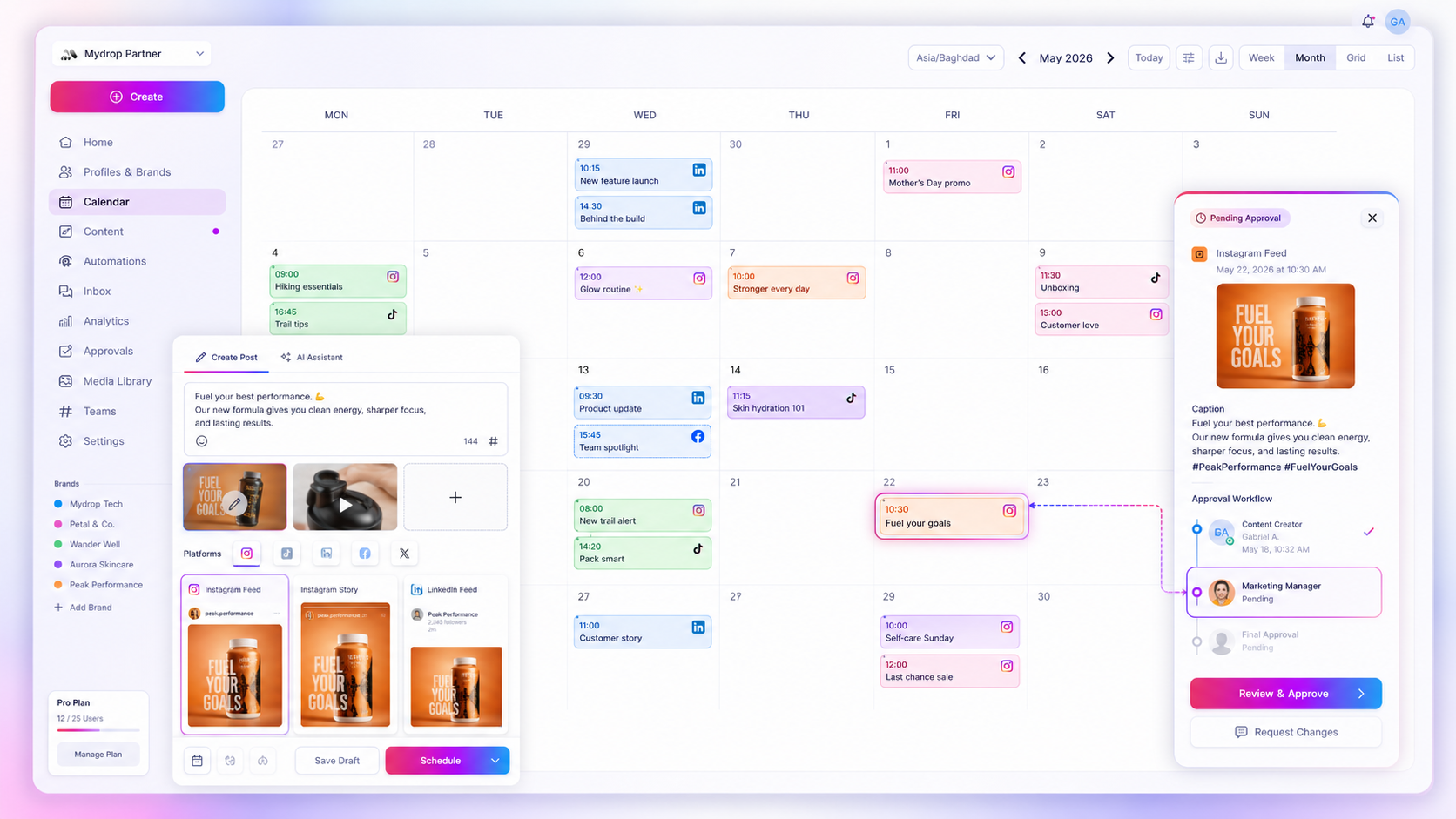
We built our scheduling engine to act as a single source of truth that actually does the heavy lifting for you. When you push a post to our system, you aren't just putting it on a calendar. You are dispatching a job that tracks its own health. If a token drifts or an API throws a wobble, the dashboard surfaces exactly where the disconnect happened-and why. You don't have to guess if a post is "stuck" or "denied."
Because we support everything from Instagram Reels and TikTok carousels to Google Business Profile offers, our system handles those platform-specific constraints before you hit publish. It checks your assets against platform rules, so you avoid those annoying "wait, this format isn't supported" errors at the moment of truth. And for those moments when things do go sideways, our system manages the retries automatically, keeping your team focused on strategy rather than manually hitting "re-post" on five different accounts.
A simple shortlist checklist
Before you commit to a new scheduling platform, run this quick diagnostic against your current process. If you answer "no" to more than two, it is time to look for a more robust solution.
| Requirement | Why it matters |
|---|---|
| Granular failure alerts | Does the system tell you why an X post failed, or just show a red icon? |
| Auth-drift monitoring | Are you notified before a token expires, rather than after a post fails? |
| Multi-format validation | Does the editor block incompatible media types before you schedule? |
| State transparency | Can you distinguish between "waiting," "queued," and "rejected"? |
| Automated job cleanup | If you delete a post, does it also scrub the associated reminders? |
Decision check: Never accept a tool that hides the error details behind a generic "failed" status. If the software won't show you the platform's rejection reason, it isn't saving you time-it's hiding the work you will eventually have to do yourself.
Closing thoughts
Reliability in social operations is earned through visibility. When you stop treating social posting as a simple "set and forget" task, you start building a resilient rhythm that actually serves your agency's bottom line. The best tools don't just clear your queue; they give your team the confidence that when the clock strikes, your brand shows up exactly where it needs to be.
If you find yourself managing more than a dozen profiles, the cost of a "simple" tool isn't just the subscription fee. It is the silent, cumulative tax on your team's energy as they chase down manual errors and missing posts. Switch to a system that treats your content with the same precision you put into creating it.