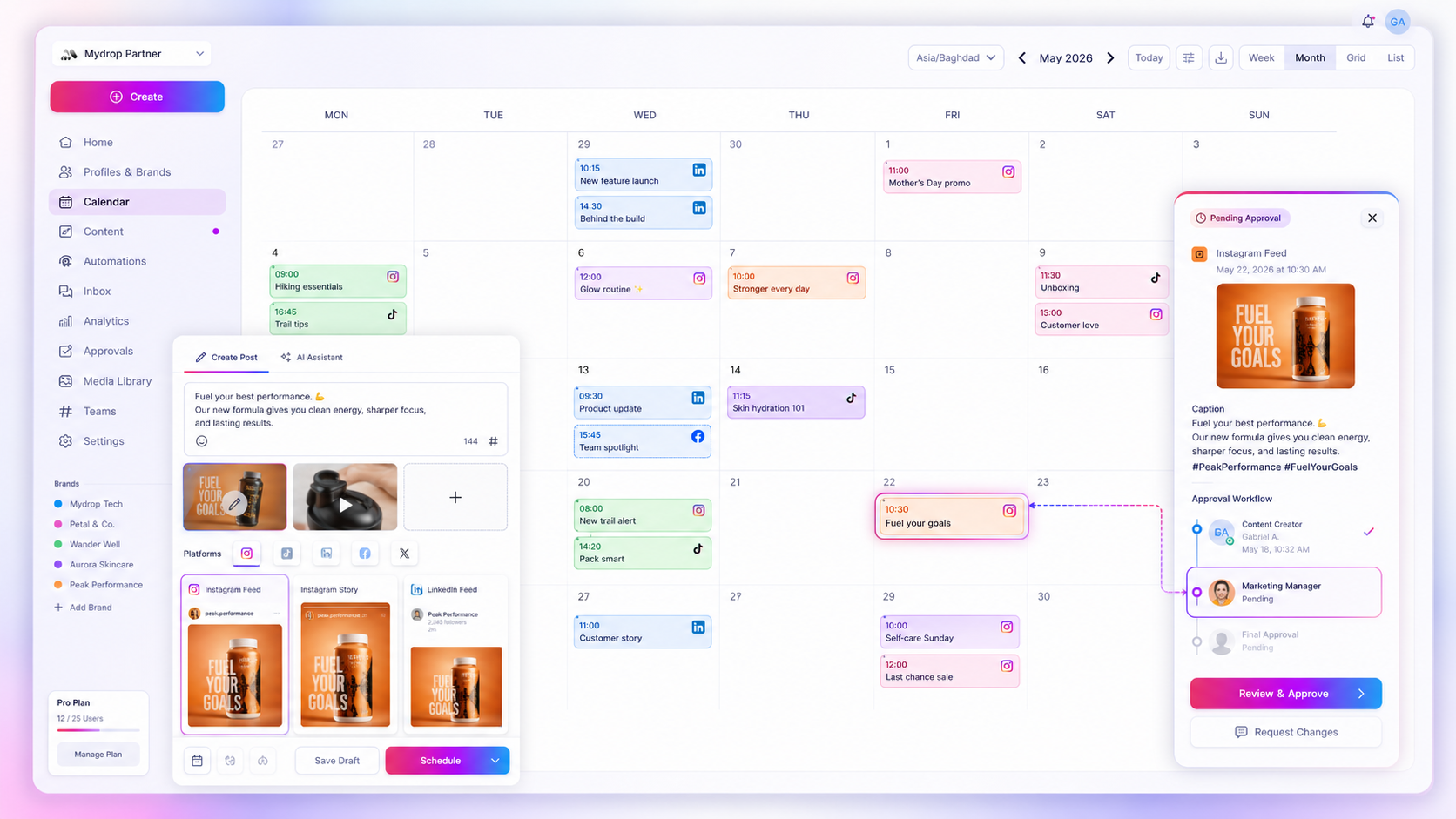
The most effective way to scale social media operations is to stop treating your calendar like a public bulletin board and start treating it like a dynamic filtering engine. If you are still relying on a linear feed of "everything we are posting," you aren't managing a strategy; you are just watching the noise pile up. Your calendar tool needs to act as a precision instrument that lets you isolate brand voices, campaign milestones, or approval states in seconds.
We get it. You are likely managing multiple brands, juggling dozens of stakeholders, and dealing with a content volume that feels like it’s growing faster than your headcount. When the pressure to publish more meets the need for strict compliance, the "scroll of death" becomes a real, operational risk. You’re not alone if you’ve spent half your day hunting for a specific post’s status while an approver is waiting on you. The good news is that this isn't a lack of organization on your part; it is a structural failure of your tools to keep pace with your team's complexity.
What the best tools need to handle

To stop the chaos, your calendar can no longer be a simple list of dates. It must function as a unified source of truth that brings together disparate content types-posts, reminders, and notes-into a single, queryable surface. If your team has to switch between a spreadsheet for notes, a Slack thread for reminders, and a dashboard for scheduling, you are paying a "coordination tax" on every single piece of content.
Operator rule: A calendar is only as valuable as its search filters. If you cannot segment your view by profile group, campaign ID, and post status simultaneously, you aren't managing your workflow-you are just managing the fallout.
The best enterprise-grade tools handle scale by prioritizing contextual density. You need to move beyond simple "calendar view" and "list view" toggles and into deep, criteria-based visibility.
| Criteria | Basic Tool Performance | Enterprise-Grade Requirement |
|---|---|---|
| Multi-Brand Filtering | Global view only or manual grouping | Instant toggle by Brand, Market, or Profile Group |
| Object Aggregation | Posts only | Posts + Reminders + Notes (Unified) |
| Action Latency | View only, then navigate to edit | Direct "Open Preview" and "Approve" from view |
| Volume Handling | Slows down after ~50 items | Instant load/filter for thousands of items |
This is where many teams find their bottleneck. They assume the issue is a lack of content planning, when in reality, the issue is visibility fragmentation. You need a tool that renders your entire social operation-from drafts and reminders to published assets-as a coherent, filterable map rather than a fragmented timeline of tasks. If the tool can’t show you exactly what needs approval across three different regions in under three seconds, it is effectively invisible to the people who need it most.
Where basic tools start to break
Basic tools are usually built for one brand and one social media manager. As soon as you add a second brand, a partner agency, or a cross-functional approval chain, the interface becomes a "scroll-of-death" where your strategy goes to die.
When you cross that threshold of fifty or a hundred posts per month across multiple channels, you stop being a planner and start being a professional scavenger. You spend more time hunting for the right asset in a sea of disconnected cards than you do actually improving your brand narrative.
This isn't just an annoyance. It is a fundamental failure of visibility and governance. When your calendar cannot segment by campaign, automation, or status, you end up doing "manual sync meetings" just to figure out who is posting what, where, and when.
Common mistake: Scaling your team size without scaling your visibility layer. Hiring more people to manage more posts in a tool that doesn't support grouping just adds more voices to a conversation that is already drowning in noise.
The buying criteria that matter
Stop shopping for "calendar features" and start shopping for data filtering capabilities. An enterprise-grade calendar must allow you to transform a chaotic, month-long view into a focused, actionable list of exactly what you need to see in under two seconds.
Look for tools that treat your social content as structured data rather than just pretty blocks on a wall.
| Criterion | What to look for | Why it matters for scale |
|---|---|---|
| Multi-Brand Filtering | Can you isolate one brand or a group of profiles instantly? | Prevents accidental cross-posting and keeps brand voices distinct. |
| State-Based Visibility | Can you toggle between Draft, Pending Approval, and Scheduled? |
Allows approvers to ignore the noise and focus only on what requires action. |
| Cross-Object Aggregation | Does it render posts, reminders, and notes on one timeline? | Connects high-level strategy (notes) with tactical execution (posts). |
| Action Density | Can you approve, edit, or duplicate without leaving the view? | Minimizes click-depth when managing dozens of pending items daily. |
If you are currently evaluating options, run this quick check during your demo. Ask the vendor, "Show me how to filter this view to only show pending posts for our EMEA regional campaigns that need legal approval."
If they have to click through three different menus, open separate tabs, or jump to a report page to find that answer, cross it off your list. If you have to hunt for information, you are not managing a process; you are fighting the software.
Ultimately, the best tools feel less like a passive calendar and more like a command center. You need a view that lets you filter for a specific campaign or stakeholder status because that is where the work actually happens. We often see teams struggle not because they lack creativity, but because they lack the ability to isolate their focus across a high-volume pipeline.
How Mydrop supports this workflow
At Mydrop, we built our calendar around the idea that visibility is not the same thing as clarity. Most platforms dump everything onto one grid, forcing you to play detective to find out what’s actually happening across your ten brands. We take a different approach. We treat your calendar as a high-performance filtering engine so you can move from a bird's-eye view of your entire enterprise to the granular details of a single campaign in two clicks.
Whether you prefer a high-level Calendar View for mapping out monthly beats or a List Mode for surgically cleaning up pending approvals, the data stays consistent. You can filter by campaign, profile group, or status, meaning you never have to scan through a colleague’s local market posts when you are trying to finalize a global product launch.
Decision check: A calendar that shows everything is a calendar that tells you nothing. Use your tool to hide the noise by default.
When you spot a gap in your strategy, Mydrop allows you to create posts, reminders, or notes directly from the slot or the list surface. If you see that a specific brand’s campaign is light on content, you aren't forced to jump into a separate editor; you click, you draft, and you keep the flow moving. We designed this to support the reality of enterprise teams: you are managing multiple approval loops and time zones simultaneously, so the tool needs to surface the right pending items to the right person without burying them in unrelated noise.
A simple shortlist checklist
Before you commit to a platform, run this quick check against your current or prospective tool. If you can't check these off, you are likely buying more coordination debt.
| Must-Have Capability | Why it matters |
|---|---|
| Multi-Brand Filter | Can you isolate one brand’s activity without seeing the other nine? |
| Unified Object Types | Does it render posts, internal reminders, and team notes in one view? |
| Status-Driven Sorting | Can you filter for "Pending Approval" in under two seconds? |
| Action Density | Can you edit, approve, or duplicate a post directly from the list view? |
| Granular Visibility | Do permissions ensure team members only see the calendars relevant to them? |
If you are currently struggling with a "scroll-of-death" scenario, ask your team these three questions: "What is the longest it takes to verify a campaign timeline?", "How often are we missing reminders because they aren't visible in our scheduling tool?", and "Are we duplicating work because we can't see what other teams are doing?"
Conclusion
The goal of your content calendar is not to keep a record of what you have done, but to ensure that everyone knows exactly what is coming next without having to call a meeting. If your current tool is making your team feel like they are constantly navigating a minefield of scheduling conflicts and missed approvals, it is time to move past the basics.
Great social media operations rely on a clear line of sight. By focusing on filter-first planning and unified visibility, you stop fighting your tool and start managing your strategy. Take the time to audit your current workflow today; if you can't see the path forward in a single glance, you know exactly what is broken.