
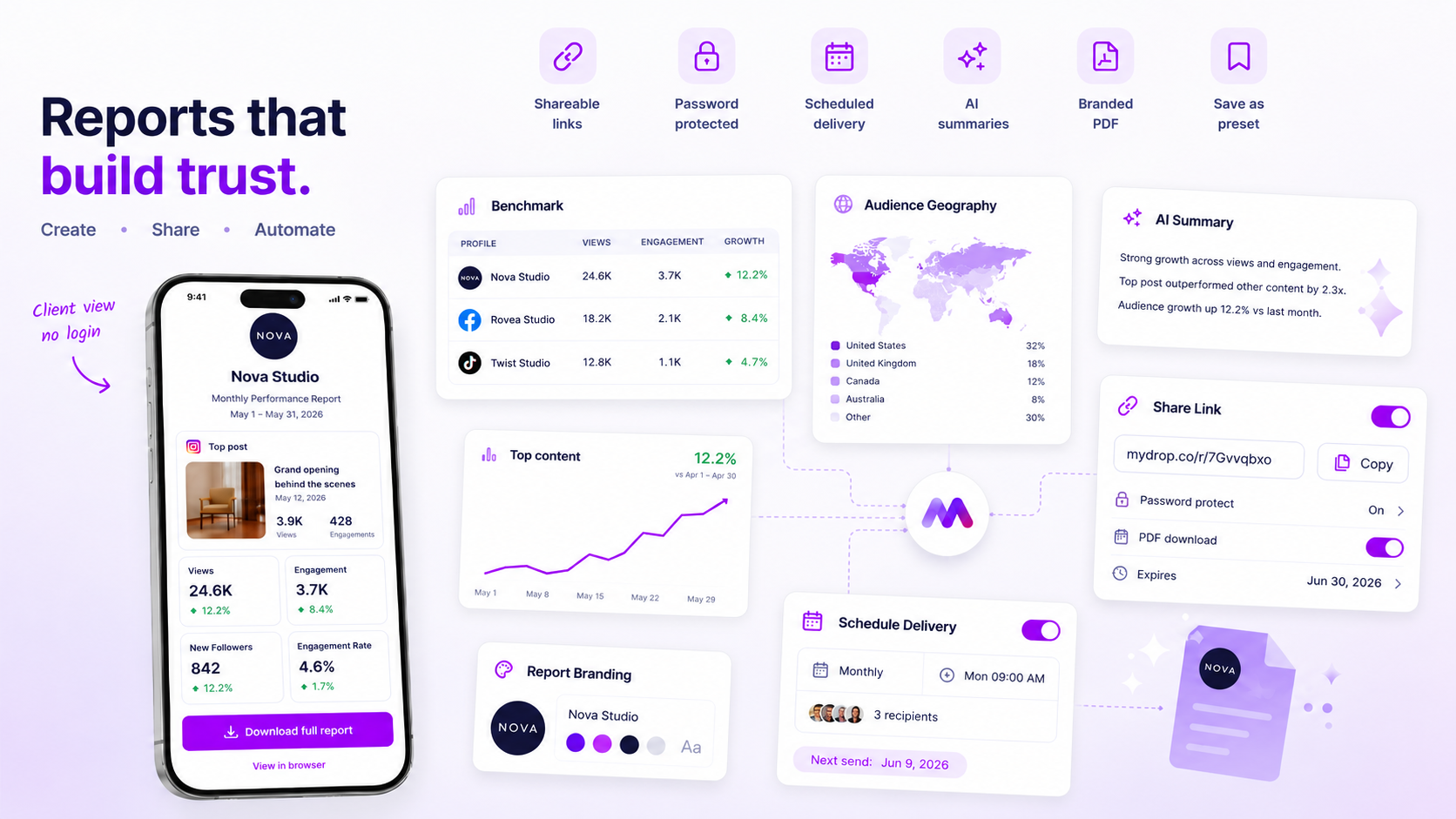
Scaling agency reporting is not about aggregating more data; it is about shifting from manual, fragmented Excel production to a centralized, template-driven workflow that turns metrics into repeatable, brand-compliant deliverables. If your team is still spending the last Friday of every month fighting with screenshots and cell formatting, you are paying the Excel tax. It is a high-stakes, recurring sprint that drains your best strategists of their time and turns high-level insights into administrative survival. We have seen this across hundreds of agencies: when reporting becomes a production bottleneck, the strategy suffers. You do not need more data aggregation; you need a tool that treats the composition of the report as its most important feature.
When reporting becomes a production bottleneck, your best strategists are sidelined from creative work to act as glorified data entry clerks. The goal here is simple: stop manually building reports and start orchestrating them.
What the best tools need to handle

The difference between a functional reporting tool and one that scales with an agency is composition velocity. Most platforms are excellent at showing you the data; very few are equipped to package that data for a client who expects a branded, cohesive narrative.
If you are vetting software for a growing team, do not settle for glorified export buttons. You need a platform that treats your branding and narrative structure as first-class citizens.
Decision check: If a tool requires you to export raw CSVs to finish the formatting in a third-party application, it is not a report builder. It is a data aggregator.
To scale your operations, look for these three capabilities in any reporting stack:
| Feature | Why it matters for scale |
|---|---|
| Reusable Templates | Allows you to save metrics, sections, and branding for recurring client types, turning a four-hour build into a ten-minute run. |
| Branded PDF Delivery | Ensures logos, fonts, and colors are automatically applied, removing the risk of human error during final production. |
| AI Narrative Synthesis | Automates the drafting of context for metrics, giving your strategists a base layer of insight to refine instead of starting from a blank page. |
Most teams assume they need more data points to impress clients. The reality is that clients value consistency and context over volume. A report that clearly ties platform performance to business goals: delivered on time, every time, without manual heroics: will do more for retention than a fifty-page metrics dump.
When you move to a template-driven model, you stop viewing reporting as an end-of-month scramble and start viewing it as a predictable product. Your team should be spending their time identifying the why behind the numbers, not color-coding cells. If your tool forces you to spend more time on the what: the layout, the branding, the manual aggregation: then it is actively working against your ability to scale.
Where basic tools start to break

Most teams start with generic dashboards, but a dashboard is not a report. The moment you need to present data to a client, the gap between "tracking" and "communicating" becomes a chasm. Basic tools usually break when the work moves from individual monitoring to recurring client deliverables.
If your team is still spending the final Friday of the month manually formatting screenshots and triple-checking brand colors in Excel, you have hit the production ceiling. At this stage, your best strategists are sidelined from creative work to act as glorified data entry clerks.
The failure mode is rarely a lack of data. It is the lack of a production pipeline. Standard dashboards are data buckets; they are not communication engines. When your reporting tool lacks the capacity to save reusable layouts or lock in specific branding, your team is forced to rebuild the same structure for every client, every month. That is not just wasted time. It is a massive increase in the risk of human error-and a guaranteed way to kill your team’s morale before the weekend.
Common mistake: Treating a reporting tool as a data storage solution rather than a narrative production tool. If your team cannot generate a client-ready PDF in under ten minutes, the tool is a liability.
The buying criteria that matter
When evaluating reporting software, ignore the vanity metrics and focus on the production workflow. Your goal is to move your team from "data gathering" to "strategic insight." The best platforms prioritize template management, brand consistency, and narrative context over mere chart variety.
Use this decision matrix to evaluate whether a platform can actually scale with your agency.
| Feature | Standard Dashboard Tool | Scalable Reporting Solution |
|---|---|---|
| Brand Identity | Static/Limited controls | Full branding snapshot (logo, fonts, colors) |
| Templates | None (manual rebuild) | Reusable presets (profiles, metrics, sections) |
| Narrative | None (external doc required) | Integrated AI summaries and context panels |
| Production | One-off manual download | Durable, scheduled report packages |
| Delivery | Manual link sharing | PDF generation + automated delivery |
The most important criteria for scaling is the "template-driven workflow." Can you save a report configuration, including the specific profiles, metrics, sections, and brand assets, and apply that same preset to a different client profile next month? If the answer is no, you are still doing manual labor.
At Mydrop, we see teams fail not because they lack data, but because they lack a conduit between raw metrics and client communication. The best tools function as a studio, not just a window. They allow you to define the branding once and let the automation handle the heavy lifting of assembly.
When vetting potential tools, look for these three non-negotiables:
- Template CRUD: Can you create, update, and duplicate reporting presets? If you have to re-select metrics every single time, the tool is not built for agency scale.
- Contextual Narrative: Does the tool allow you to include summaries that explain why the data looks that way? Raw numbers without a story do not persuade stakeholders.
- Branding Snapshot: Does the tool store the branding settings with the report run? You need to ensure that a report generated today looks identical to a report generated six months ago, regardless of current platform defaults.
Ultimately, your reporting workflow is a reflection of your agency’s operational maturity. If your process is brittle and relies on manual effort, your clients will eventually notice the inconsistency. Most teams do not have a content problem; they have a decision bottleneck. Once you solve the production side, you finally have the bandwidth to do the actual work of being a partner to your clients.
How Mydrop supports this workflow
We often see teams that have mastered the art of social media strategy, only to find their momentum stalled by the sheer weight of reporting. The shift from "creating content" to "reporting results" is where the most efficient teams separate themselves from the ones struggling to keep pace. At Mydrop, we approach this by decoupling the data retrieval from the document composition.
Instead of re-building layouts, we treat reports as durable, templated assets. When you configure a report builder, you are actually creating a reusable branding snapshot that holds your logo placement, color palettes, and preferred typography. Once that template is saved, it becomes a blueprint. You can apply the same structural logic-the same sections, metric groupings, and AI summary prompts-across a dozen different client portfolios, knowing the output will be consistent every single time.
This removes the guesswork from your workflow. You aren't just dragging numbers into a grid; you are selecting a preset that automatically pulls in the latest data, applies your client's brand identity, and generates an AI narrative that highlights key performance trends based on the metrics you care about. When the report is generated, you aren't fighting with formatting errors or missing screenshots. You get a clean, client-ready PDF that reflects the strategy you discussed, rather than the data you retrieved. By automating the composition phase, your strategists can spend their energy interpreting the results rather than trying to get the logo to align in a spreadsheet cell.
A simple shortlist checklist
When you are ready to evaluate reporting tools, use this checklist to ensure you are looking for scalability, not just raw functionality. If a tool cannot check off these five boxes, you will likely find yourself back in the same bottleneck within six months of scaling.
Workflow check: Before you demo, ensure your team defines what "scaling" means for your specific brand volume. If you manage fifty profiles, a tool that forces manual setup for each one will fail.
- Dynamic Branding Controls: Does the tool allow you to lock brand elements (logos, hex codes, footer info) into a template? If you have to re-upload assets for every new report, you haven't solved the problem.
- Cross-Profile Templating: Can you clone a report structure from one client to another instantly? A scalable tool treats reports as reusable code, not unique, one-off documents.
- AI-Powered Synthesis: Does the tool provide an editable narrative summary? Raw numbers are just noise to busy stakeholders. You need a tool that translates data into plain-language insight.
- Reliable PDF Output: Is the report generation native? Avoid tools that rely on screen-capture or external browser-print methods, which are notorious for breaking layouts and hiding data.
- Historical Data Hydration: Does the report tool maintain a record of past runs? You need the ability to retrieve the exact report package generated for a client last quarter, without recalculating data.
Conclusion
The transition from a manual reporting process to a scalable, template-driven workflow is not just about adopting better software. It is about acknowledging that your team’s time is your most expensive asset. When you stop acting as a conduit for data and start acting as a strategic partner, your value to your clients increases exponentially.
You don't need another dashboard; you need a system that translates your efforts into clear, consistent communication. The goal is to move from a state of administrative survival to one of consistent production. If you can automate the mundane-the layout, the branding, the standard metric aggregation-you free up your team to do the work that actually justifies your retainer.
Find a tool that respects your team's time and scales with your ambition. Stop managing the spreadsheet, and start managing the narrative. That is the point where the agency cycle turns from a chore into a competitive advantage.