If your team is still manually downloading spreadsheets and drafting individual emails every Friday to update clients, you are not scaling your reporting; you are trapped in a high-cost administrative loop. The most effective way to protect your margins and maintain client trust is to treat reporting as a recurring, automated product asset rather than an ad-hoc service task.
We have all felt the sting of a chaotic Friday afternoon, where the pressure to prove ROI turns into a race against the clock to format PDFs. It is draining, error-prone, and-most importantly-completely unnecessary. By shifting from manual creation to managing a delivery cadence, you stop being a data-entry clerk and start being a strategic partner.
Operator rule: If a report requires manual intervention to reach the client, it is a cost center. If it runs on a scheduled, failure-alerted cadence, it is an automated retention engine.
What the best tools need to handle

When you move past the "do it all by hand" phase, your requirements shift from basic data collection to operational reliability. You are no longer just looking for a tool that can make a chart; you need a system that ensures that chart actually reaches the stakeholder on time, every time, without a team member checking the "Sent" folder.
To scale successfully, your reporting infrastructure must master these four pillars:
- Reliable Recurrence: The tool should handle daily, weekly, and monthly jobs natively. You set the logic once, and the system owns the execution.
- Multi-Channel Delivery: Clients have different preferences. Look for tools that can output a professional PDF, provide a secure public link, or grant direct app access depending on the stakeholder’s needs.
- Fail-Safe Operations: If a data provider has an outage or an API connection drops, the tool should alert you immediately. You need to know before your client does.
- Snapshot Integrity: This is often overlooked. Your configuration needs to be saved as a snapshot so that if you update a dashboard or delete a profile later, your historical client reports remain intact and consistent.
| Feature | Manual Workflow (Risk) | Automated Workflow (Asset) |
|---|---|---|
| Cadence | Ad-hoc; prone to "forgot to send" | Set-and-forget; reliable recurrence |
| Delivery | Individual emails; manual attachments | Automated PDF/Link/App delivery |
| Failures | Silent; client notices first | Proactive alerts; internal visibility |
| Scalability | Linear; more clients = more work | Fixed; same effort for 1 or 50 clients |
If your current tool cannot handle a "run now" manual override or lacks a clear audit trail of who received what and when, you will hit a ceiling the moment you take on your next major account. Managing reporting at scale is about building a pipeline that functions even when your team is off-duty.
Where basic tools start to break

Most entry-level social media tools are built for the creator or the solo marketer, not the agency running twenty accounts. These tools handle the "publish" part just fine, but they fall apart the moment you need to scale the "report" part.
The most common point of failure is silence. A basic tool might fail to pull data from a specific API connection due to a token expiry or a rate limit-but it doesn't tell you. You find out when your client emails you on Monday morning asking why the report link is broken or why the PDF is empty. At that point, the damage to your agency's reputation is already done.
Common mistake: Relying on tools that don't have explicit failure notification workflows. If a report doesn't generate, you need to know before your client does.
Another breaking point is the "manual re-run." If you can't hit a "run now" button for a specific client report on demand, you are hostage to the tool's original schedule. When a client calls for an ad-hoc meeting to discuss a campaign spike, you should be able to trigger a fresh report instantly, not wait until next Tuesday for the next automated cycle to kick in.
The buying criteria that matter
Stop looking for the tool with the most charts and start looking for the tool with the most robust delivery engine. If you are managing multiple brands, your reporting strategy should be governed by consistency, not customization.
Use this scorecard to evaluate whether a tool is actually saving you time or just adding new administrative tasks to your Friday afternoon.
Agency Reporting Maturity Scorecard
| Criteria | Feature Requirement | Why it matters |
|---|---|---|
| Recurrence Reliability | Daily, weekly, monthly options | Keeps clients informed without manual setup. |
| Failure Visibility | Automated error emails/logs | Stops "did you forget to send the report" emails. |
| Delivery Flexibility | PDF, Public Link, App Access | Clients have different security/access needs. |
| Snapshot Stability | Config snapshots preserve state | Report data shouldn't shift if profiles are renamed. |
| Instant Action | Run-now / Pause / Resume | Allows ad-hoc client support without heavy lifting. |
The Scaling Reality Check
Ask your team these three questions. If the answer to any of them is "No," you are currently paying your employees to be glorified data entry clerks.
- Can we pause an entire client's reporting cadence with one click? (Crucial when a client pauses their retainers or changes scope.)
- Does our tool alert us before a client is supposed to receive a report if the data isn't ready? (This is the difference between being proactive and being embarrassed.)
- If a team member leaves, does the reporting configuration stay in the account, or is it tied to their personal login? (This is a major governance risk that often gets ignored until it is too late.)
In our experience at Mydrop, agencies usually break when they try to treat reporting as a creative task. It is not. It is an operational service. The best report is the one that arrives exactly when the client expects it, perfectly formatted, without anyone on your team having to touch a spreadsheet.
How Mydrop supports this workflow
At Mydrop, we see the reporting wall every day. Teams reach a threshold-usually around a dozen clients-where "personal touch" turns into "operational debt." You stop being a strategist and start being a human mail-merge. We built the Analytics Schedule engine to break that cycle.
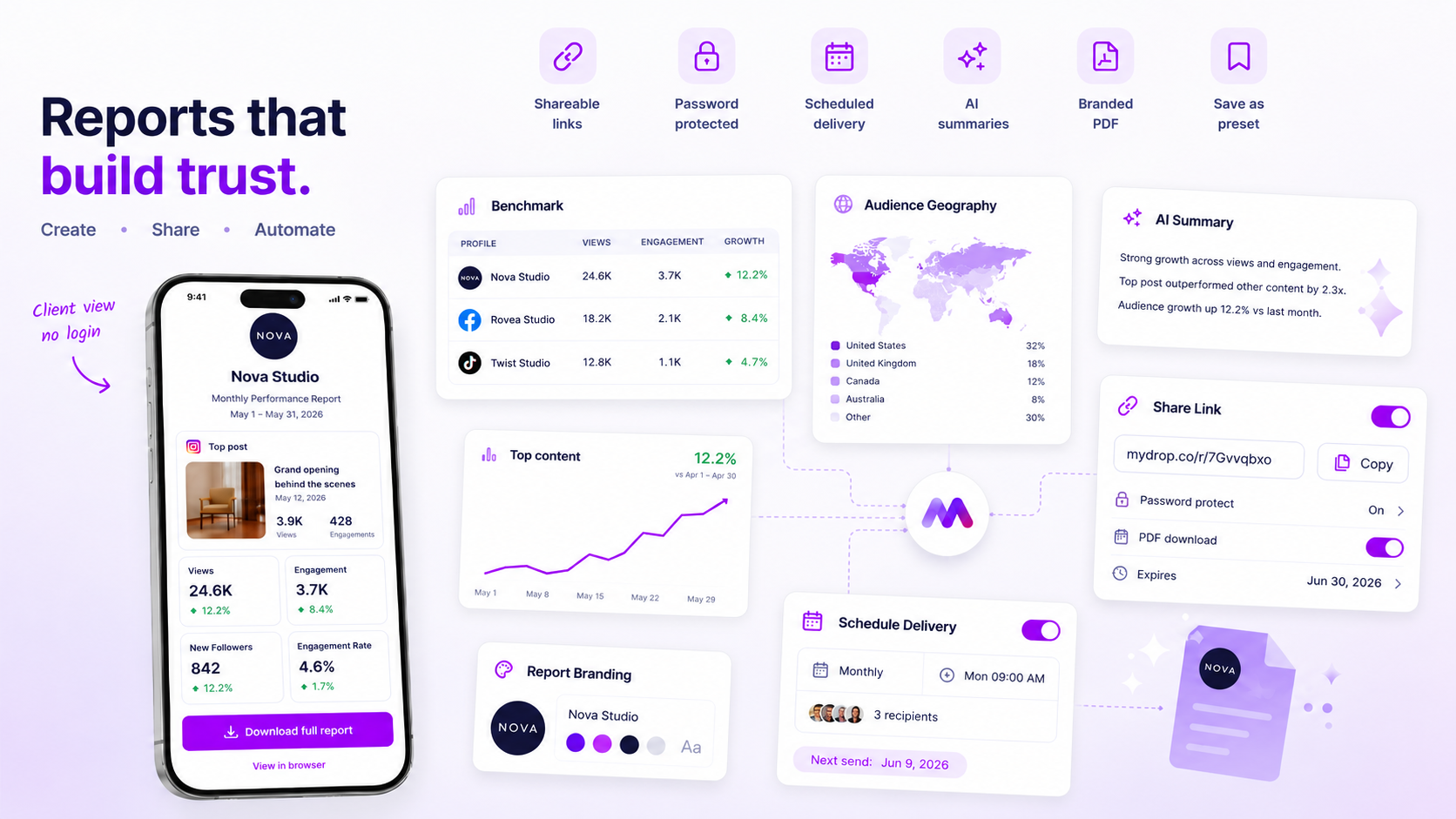
Instead of hunting for spreadsheets, you configure a report once and let our Schedule Runner handle the rest. When you set a schedule, Mydrop captures a configSnapshot. This is vital because it locks in the metrics, brand profiles, and layout you agreed upon with the client. Even if your internal team updates a dashboard or changes a tracking metric for a live campaign next month, the client’s recurring report remains consistent to the original requirements.
We also treat reporting like a production environment. If a data stream hits a snag or an external provider has a temporary gap, you aren't left in the dark. Our system logs the failure and alerts you, so you can address the issue before your client wonders why their inbox is empty. You get:
- Set-and-Forget Cadence: Daily, weekly, or monthly delivery via email, secure public links, or direct app access.
- Safety Valves: Pause or resume schedules without deleting your configuration-perfect for seasonal campaigns.
- On-Demand Reliability: Need to send a report early for a board meeting? Use Run-Now to trigger the snapshot immediately, bypassing the cron schedule without breaking the routine.
This isn't just about sending PDFs. It is about removing the "did they get it?" anxiety from your Friday afternoons.
A simple shortlist checklist
Before you commit to a tool-whether it is Mydrop or another enterprise-grade platform-run your current candidate through this scorecard. If they cannot hit these four operational marks, you are just buying yourself a new set of manual tasks.
| Criteria | The "Manual Trap" Warning | The Enterprise Standard |
|---|---|---|
| Fail-Safe Alerts | No notification if a report fails to send. | Automated failure emails + log visibility. |
| Versioning | Report changes every time you open it. | Config snapshots preserve historical report state. |
| Delivery Mix | Only sends static PDF attachments. | Offers choice: PDF, secure link, or app login. |
| Operational Control | Requires delete/re-create to modify. | Pause/resume and run-now controls included. |
Decision check: If your team spends more than 30 minutes a week manually "gathering" data for clients, you are paying a reporting tax that is eating your agency's profit margins.
Conclusion
The transition from "generating reports" to "managing reporting cadences" is the quietest, most profitable pivot an agency can make. You stop competing on how many hours your team can bill for data entry and start competing on the actual strategy your reports represent.
Stop treating your reporting as a chore you have to survive. Treat it as a passive product you deliver. When your reporting is automated, reliable, and invisible to the client, you finally clear the bandwidth to do the work they actually hired you for. The best reporting tool is the one that lets you forget it exists until the client replies with, "Great insights-let's discuss the plan for next month."