The best social media planning tool for managing recurring tasks isn't just a calendar; it is an operational hub that links every recurring report, approval, or asset-gathering task directly to the campaign assets they support. If your tool only shows you when to post, it is ignoring the heavy lifting required to get there.
We get it: your calendar is perfectly color-coded, yet your team is drowning in a separate, frantic sprawl of Slack pings, email chains, and disconnected alerts. You are working harder because your planning tools exist in a vacuum, forcing your team to switch context just to remember why a reminder exists. This coordination debt is the silent killer of enterprise social teams.
What the best tools need to handle

Managing a complex social presence across dozens of markets and brand profiles requires more than just reminders. It requires a system that treats operational tasks as first-class citizens alongside the content itself. At scale, the difference between a high-performing team and one that is constantly reacting is whether their tools support context-first execution.
For an enterprise-grade platform to actually solve this, it must handle three critical operational realities. At Mydrop, we have seen that when teams bridge this gap, they shift from manual coordination to automated execution.
- Direct Object Linking: Every task needs to know which post, profile, or asset it is attached to. An alert that says "Gather assets" without immediately showing the campaign or the specific post-draft is useless friction. The tool must allow you to pin operational tasks-like weekly review loops or reporting-to the specific content objects that trigger them.
- Granular Recurrence with Overrides: Simple repeating alerts are insufficient. You need the ability to set recurring tasks for things like monthly analytics reports or weekly community management check-ins, while also allowing for exceptions. When a holiday falls on a reporting day, you need the flexibility to override that specific occurrence without deleting the entire rule or causing the team to miss the task entirely.
- Bidirectional Calendar Synchronization: Teams live in their email and main calendars. An operational task that stays trapped inside a proprietary social media dashboard will be ignored. Your tool must sync tasks back to Google Calendar or Outlook automatically, ensuring that the team sees their work where they already spend their time.
Common mistake: Many teams try to force a simple project management app to work as their social calendar, or conversely, try to turn a social scheduling tool into a task management system. Neither approach works because the context gap: where the content lives versus where the task lives; it remains unbridged.
When these elements are missing, teams fall into a trap: they spend 20% of their time planning and 80% chasing people, manually syncing status updates, and hunting for the latest asset versions. The goal is to move from chasing work to completing work by making the task actionable the moment it appears.
Where basic tools start to break

Let's talk about the alert-only trap. We have all lived through it: the calendar reminder pops up, it says "Weekly Report," but it gives you zero clue which report, what data is missing, or who needs to approve it. You stop what you are doing, open Slack to find the thread, jump to the DAM to check the asset, and then finally realize you are missing the approval from the regional lead.
This is not just annoying; it is coordination debt. When your planning tool exists only to alert you that something needs to happen, but it does not know what that thing is, you are essentially paying a tax on every task. Across a team managing dozens of brand profiles and hundreds of posts, that five-minute context-switch adds up to hours of wasted capacity.
Basic calendar apps or standalone task managers are great for meetings, but they fall apart for social media operations. They treat a task as a title, a disconnected string of text, rather than an operational object. When the task is uncoupled from the campaign, it inevitably drifts. The instructions get stale, the attachments vanish into a file-storage abyss, and the intent behind the original plan becomes a mystery by the time the reminder triggers again next week.
Operator rule: If you have to switch tabs to find the context for a task, your tool isn't managing your work; it's just notifying you of your own stress.
The buying criteria that matter
When evaluating a tool to bridge this gap, stop looking for calendar features and start looking for operational integrity. You need a tool that treats your operational tasks with the same priority as your published content.
If your team is struggling to stay consistent, use this scorecard to audit your current stack.
Operational Capability Scorecard
| Criterion | Why it matters | What to look for |
|---|---|---|
| Object Linking | Eliminates searching | Does the task allow attaching posts, profiles, or specific media assets directly? |
| Recurrence Logic | Scales operations | Can you set recurrence with "done state" overrides, or do you have to manually recreate tasks? |
| Bidirectional Sync | Keeps stakeholders aligned | Does it sync to enterprise calendars, like Google, without losing the metadata? |
| Task Ownership | Reduces follow-up | Can you assign tasks to specific roles within the content workflow for accountability? |
| Contextual Visibility | Prevents drift | Is the task visible on the same calendar surface as your actual publishing schedule? |
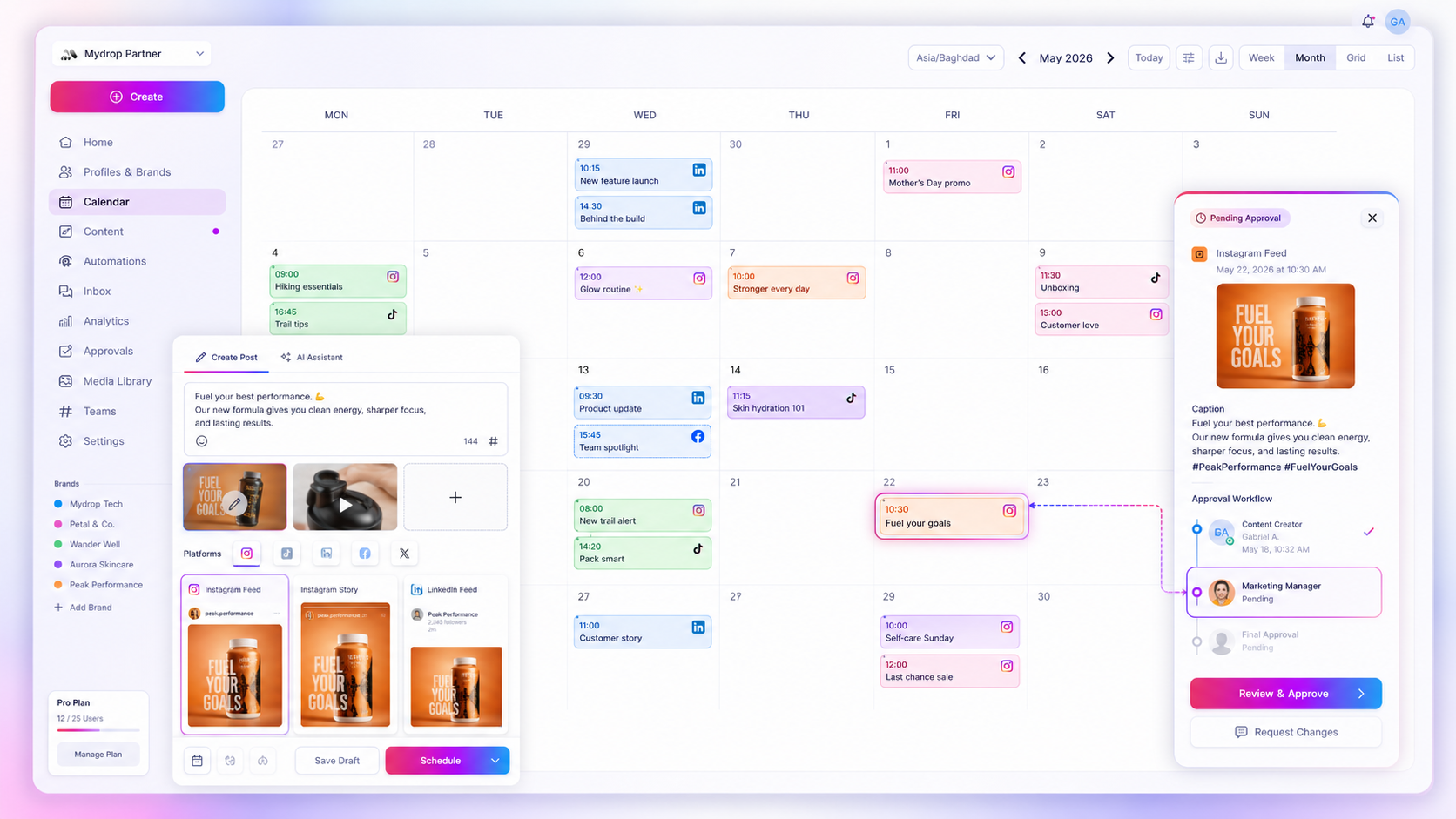
The real differentiator is content-native task management. This is where Mydrop changes the game. Instead of just setting a generic calendar event, you are creating a structured operational task that lives inside your social calendar. You attach the specific post draft or the campaign creative, you set the recurrence for your weekly approval cycle, and when you mark that specific occurrence as done, the system remembers.
It creates a closed-loop system. You aren't just notified that a task is due; you are dropped right into the specific piece of work you need to finish. It keeps the "what" and the "when" in the same place.
When you stop treating planning tasks as noise and start treating them as first-class campaign objects, the frantic Slack pings start to quiet down. You stop managing the calendar and start executing against it.
How Mydrop supports this workflow
The reason teams struggle with recurring tasks is the context gap. You get the alert, you jump into another tool to check the asset, and the original intent is lost. We designed Mydrop Reminders to stay attached to the actual campaign work. When you set a recurring reminder, like a monthly compliance audit or a weekly asset request, it stays linked to the post, profile, or media object itself. You aren't just notified; you are already in the right place to take action.
This means the task is no longer an abstract "thing to do" trapped in a different calendar app. It is a live operational task that knows exactly which posts it needs to review or which assets it needs to gather. Because these reminders handle recurrence natively, you can set them to repeat forever, mark them as done as you finish each occurrence, and trust that the system will handle the state for you. It turns your planning calendar into a functional command center, not just a list of deadlines.
A simple shortlist checklist
Before you sign a contract for a new planning tool, put the vendor on the spot. If they cannot answer yes to these four questions, you are probably buying a glorified spreadsheet, not an operational hub.
The Operational Readiness Checklist
- Can you link a reminder directly to a specific post, profile, or asset? If the tool only allows text titles, it will fail when your team grows to hundreds of posts per month.
- Does the reminder state persist independently for each recurrence? You need to be able to mark the January report as done without the tool mistakenly marking the February, March, and April reports as finished too.
- Is there bidirectional synchronization with your external team calendar? If your team lives in Google Calendar, a task in your planning tool that doesn't sync is a task that will be ignored.
- Does the task layer allow for attachments? You should not have to hunt for a file or a link. The supporting documentation, brief, or draft asset must live inside the task.
If a tool forces you to keep the task in one window and the content in another, walk away. You are paying for software to reduce friction, not to add another layer of manual coordination.
Conclusion
Content operations are not about faster planning; they are about fewer things falling through the cracks. The best social media planning tool is the one that disappears into your workflow, connecting the high-level strategy you built to the daily execution required to keep it alive.
Stop treating your calendar like a digital bulletin board. Start demanding that your tools treat recurring tasks as a first-class citizen of the campaign itself. When you link operations to content, you stop chasing your team for updates and start focusing on the actual output. The best team isn't the one that works the hardest; it's the one that spends the least amount of time coordinating work and the most amount of time doing it.