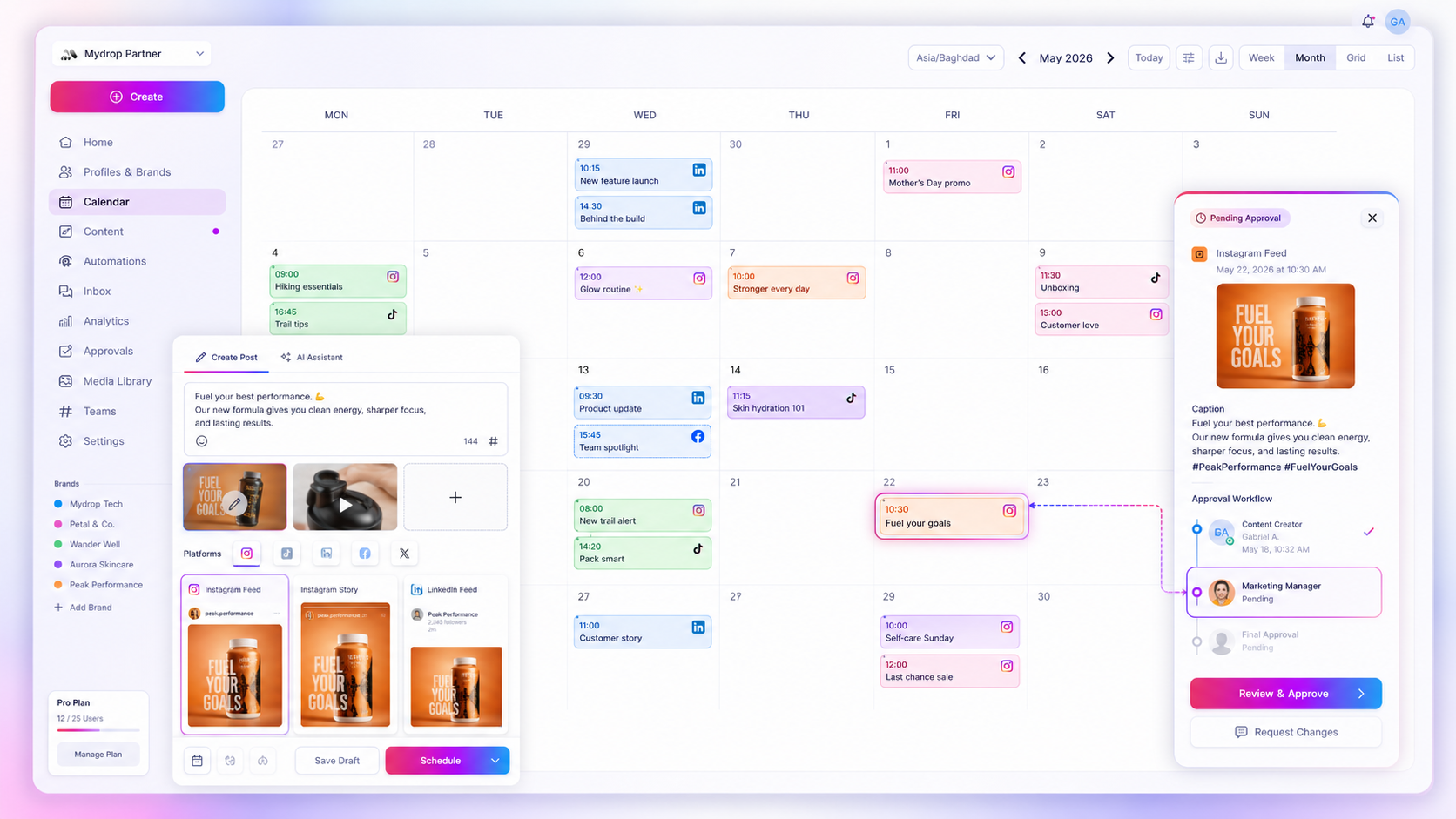
The most effective agencies stop treating UTM tracking as a post-publishing chore and start managing it as an integral part of the campaign container. If your team still relies on manual spreadsheet entry to stitch together performance data for clients, you are not just losing time; you are systematically creating "data leakage" that makes your best campaigns look mediocre.
We get it. You are running five different brand accounts, juggling dozens of stakeholders, and trying to hit a publishing cadence that feels like a treadmill. By the time the "reporting day" fire drill hits, the last thing anyone wants to do is manually audit fifty links for incorrect parameters. But that gap-the silence between a post going live and the data hitting your dashboard-is exactly where your agency's credibility goes to die.
"If you cannot assign it, you cannot optimize it." Any tool that treats attribution as a secondary step is not a campaign management system; it is an administrative liability. You need to move from manual, fragmented tagging to a centralized, automated model where the campaign itself acts as the source of truth for every link associated with it.
What the best tools need to handle

The best platforms treat the Campaign as a container, not just a folder name. When you manage dozens of profiles, a campaign should be the central nervous system that dictates how assets, periods, and tracking configurations interact across every channel.
Here is what your workflow needs to cover to stay ahead of the chaos:
| Capability | Why it matters for agencies |
|---|---|
| Centralized Container | All posts under a specific launch must live in one place, instantly filterable by brand. |
| Active-Period Tracking | UTMs should only be active during the flight dates to prevent "stale" attribution data. |
| Cross-Feature Sync | The same campaign config used in the composer must be available in your bulk jobs and automated outputs. |
| Standardized Config | Every team member uses the same utm_source and utm_medium presets, eliminating manual errors. |
The goal is to eliminate the "spreadsheets as a crime scene" phase of your week. When your tools force you to manually type parameters, you are betting that every person on your team is perfect at copy-pasting-and that is a bet you will eventually lose.
Instead, look for systems that allow you to set your tracking parameters once at the campaign level. Once an active period is defined, the tool should handle the heavy lifting, ensuring that every link-whether it is a standard post or part of a larger automation-inherits the correct tracking strings automatically. This shifts the agency burden from data cleaning to data analysis, which is where you actually prove your value to the client.
Where basic tools start to break

The real trouble begins the moment you outgrow your first few dozen posts. Most teams start with a simple spreadsheet to track links, but it quickly evolves into a chaotic, version-controlled nightmare. You know the drill: someone overwrites the utm_campaign value, a copy-paste error introduces a rogue space, or a team member simply forgets to update the tracking parameters altogether. Suddenly, your "reporting day" turns into a forensic investigation of why 30% of your traffic is showing up as (direct) or, worse, attributed to the wrong client entirely.
This is the "Manual Entry Trap." When tracking is a separate, human-dependent step, it is not a matter of if it will fail, but when. The more stakeholders you have involved-copywriters, designers, account managers-the higher the probability of drift. When you scale this across multiple brands, the manual friction becomes a massive coordination debt that slows down your entire publishing cycle.
Operator rule: If your team has to remember to "check the sheet" or "update the UTMs" before every post, you have already lost. The tool must carry the burden, not the person.
The buying criteria that matter
When evaluating tools for enterprise-level social management, you need to look past the flashy UI and focus on how the platform treats campaign identity. A serious tool should treat a campaign as a container that holds the logic, not just a label you slap on a post.
The Agency Tracking Scorecard
Use this scorecard to evaluate whether your current or prospective tool is built for scale or just for show.
| Criterion | What to look for | Why it matters |
|---|---|---|
| Container-based Logic | Can you group posts under a specific campaign? | Keeps data siloed and clean by brand. |
| Active-period Enforcement | Does it auto-apply UTMs only when the campaign is live? | Prevents "ghost" data from stale links. |
| Cross-Feature Assignment | Does it flow into bulk jobs and AI drafts? | Eliminates the need for manual retagging. |
| Permission-Layer Security | Can you restrict campaign access by brand? | Stops cross-client data leakage. |
| Tracking Autonomy | Does it handle parameter construction automatically? | Eliminates human error in URL strings. |
The non-negotiable feature here is active-period UTM tracking. You need a system that knows exactly when a campaign starts and ends. If you schedule a post for a launch that kicks off on Monday, the tool should automatically append the correct tracking parameters only if the campaign window is open. If it’s outside that window, the tool should either warn you or strip the tracking to keep your analytics dashboard from getting polluted with "out of bounds" traffic.
At Mydrop, we see that the most resilient teams stop treating campaigns as afterthoughts. By defining a campaign as a container-complete with its own logo, color-coding, and tracking configuration-you turn a manual, error-prone process into an automated publishing standard. When you select a brand, the system knows exactly which campaigns are valid, allowing your team to focus on the content while the platform quietly handles the attribution math in the background. If your tool doesn't automate the metadata, it's forcing you to manage spreadsheets when you should be managing strategy.
How Mydrop supports this workflow
At Mydrop, we have seen that social media scale fails from coordination debt, not a lack of ideas. When you are managing dozens of stakeholders across five markets, the spreadsheet approach is not just inefficient; it is a ticking time bomb for your data integrity.
We built our Campaigns feature to remove the "Spreadsheet Gap" by making UTM attribution a structural part of the publishing flow, rather than an afterthought. When you assign a post to a campaign, the platform automatically handles the heavy lifting. The tracking logic is bound to the campaign container, which means your utm_source, utm_medium, and utm_campaign parameters are applied consistently every time, whether you are publishing a single post or bulk-scheduling a hundred assets.
Because we treat the campaign as the container, you also gain visibility into status and duration. By defining an active period, you ensure that UTMs are only appended during the campaign window. This prevents "data bleed," where old, expired posts continue to muddy your fresh reporting dashboards. It allows your team to move fast without needing to manually verify tags or double-check naming conventions-the system enforces the governance you set during the campaign setup.
A simple shortlist checklist
Before your next demo or sales call with a potential tool provider, run through this 5-point sanity check. If the tool fails on these points, keep looking.
| Feature | Requirement | Why it matters |
|---|---|---|
| Centralized Container | Can you group posts by a campaign object? | Prevents fragmentation and ensures consistent branding across all channels. |
| Active-Period Logic | Does the tool automatically toggle UTMs based on dates? | Stops "data bleed" from expired content hitting your active analytics. |
| Bulk Assignment | Can campaign tags be applied in bulk or via automations? | Essential for teams outputting hundreds of posts per cycle. |
| Role-Based Governance | Does the tool restrict campaign edits to authorized users? | Protects your tracking schema from accidental "creative" naming. |
| Native Integration | Are UTMs appended at the point of publishing? | Ensures the link is "pre-tagged" before it touches the platform APIs. |
Decision check: If your team has to manually enter a single UTM parameter on a live dashboard, your tracking process is broken. Automate the metadata at the point of creation, or stop calling it a tracking tool.
Conclusion
The difference between a frantic reporting day and a calm, data-driven morning is how you manage your campaign containers. You can either continue to treat UTMs as a manual chore, accepting that you will lose 20-30% of your attribution accuracy to human error, or you can shift to an automated, campaign-bound workflow.
Most agencies do not have a tracking problem; they have a coordination problem. By shifting your perspective from "tagging posts" to "managing campaigns," you reclaim the time your team spends cleaning data and put it back into the creative strategy that actually wins clients. Focus on tools that treat your campaign periods as a hard constraint, and you will find that the "reporting fire drill" starts to look a lot more like a straightforward, routine review.