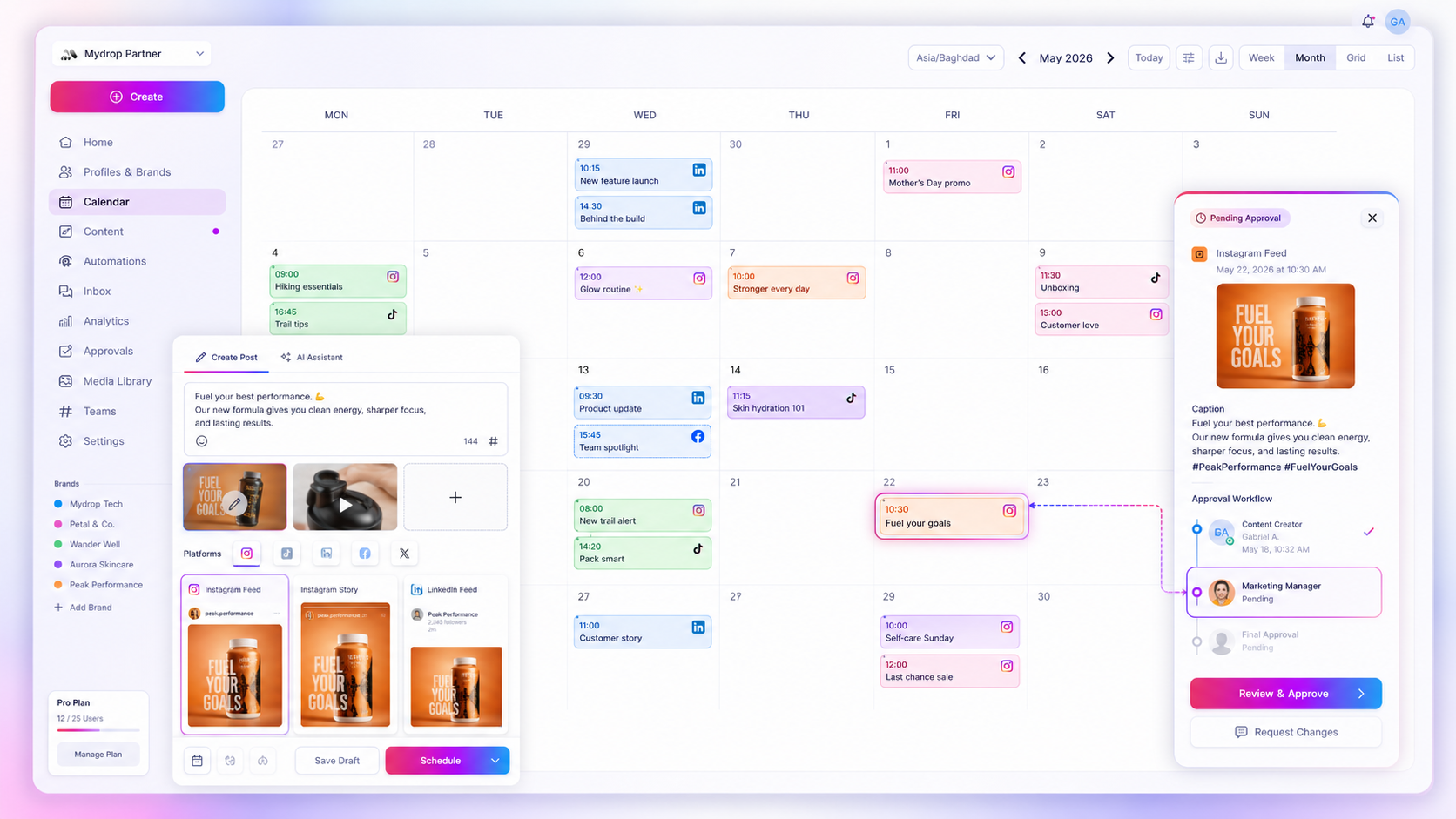
Stop treating UTM parameters as a final to-do item for every individual post. If your team is manually appending strings like utm_source and utm_medium in the composer, you are not just wasting time; you are systematically corrupting your analytics through inconsistent naming. We have seen this across thousands of posts: when tagging is left to human memory, the resulting GA4 data becomes a fragmented mess of "summer_sale," "Summer-Sale," and "summer-sale-2026." You do not need a better spreadsheet to force compliance. You need to move UTM logic out of the composer and into a centralized campaign structure.
We get it. The pressure to ship content across multiple brands, platforms, and regional teams is relentless. The spreadsheet of doom-the one where you try to force every team member to use the exact same naming convention-is not a management tool. It is an admission of defeat. By shifting your operating model to a campaign-based structure, you ensure every link is tagged correctly by default, every time the campaign is active.
The decision teams usually frame too broadly

The mistake most teams make is failing to distinguish between high-level campaign reporting and the granular tactical tagging of individual posts. You want to know if your "Q3 Product Launch" drove revenue, but you are currently treating the utm_campaign field like a creative writing exercise for every social media manager on your team.
This lack of distinction is a classic case of coordination debt. Creative assets require human nuance and brand-specific tailoring, but utility data-like your tracking parameters-should be treated as fixed infrastructure.
When you define tracking at the post level, you introduce a point of failure for every single update you publish. When you define it at the campaign level, you treat it as an operating rule.
Comparing the tracking workflow
| Feature | Manual (Agency Chaos) | Automated (Campaign-Based) |
|---|---|---|
| Setup | Spreadsheet template | Campaign definition in Mydrop |
| Logic | Manual copy/paste per post | Baked into campaign settings |
| Enforcement | Human memory / Audit | System-level auto-append |
| Error Rate | High (typos, casing mismatches) | Zero (standardized logic) |
| Data Health | Fragmented, requires cleaning | Clean, ready for attribution |
Operator rule: If a post is not tied to a defined, period-locked campaign, it should not have marketing-grade UTMs. Anything else is just noise in your dashboard.
Standardization is not about policing your team's creativity. It is about removing the repetitive manual steps that lead to data corruption in the first place. At Mydrop, we find that once teams move the UTM configuration out of the composer and into a campaign object, the "spreadsheet of doom" essentially vanishes. Your team can stop worrying about whether they remembered the correct underscore syntax and get back to focusing on the actual content strategy.
What should stay manual and what can move faster

The golden rule for scaling your social operations is simple: Automate the plumbing, keep the craft.
If you are spending time on the mechanics of link tracking, you are robbing your team of the focus they need to make your creative assets actually land. Creative content-the hook, the visual, the brand voice, and the specific timing of the post-is the high-leverage work. That belongs in the hands of your humans.
Data hygiene, however, is a repetitive, low-context task that computers are objectively better at. When your team is manually assembling long strings of UTM parameters, they aren't "crafting" anything; they are just doing data entry.
In our experience, teams managing hundreds of brand profiles often fail not because their content isn't good, but because their coordination debt is so high that they lose control of the data.
Decision check: Never ask a human to type a string that a system can generate from a template.
If you are forcing your team to remember whether to type utm_source=facebook or utm_source=FB, you are already losing. Move the parameter structure into a campaign-level configuration. Once the campaign is defined, the Mydrop publisher can handle the append logic automatically. Your team just needs to select the campaign.
The tradeoff matrix
Moving to an automated campaign model requires a shift in how you view "total freedom." You are trading the ability to ad-hoc tag a link for the guarantee of clean, actionable data.
Most enterprise teams find this is a bargain, but it helps to be clear-eyed about the change.
| Feature | Manual Tagging (The "Freedom" Path) | Automated Campaign (The "Scale" Path) |
|---|---|---|
| Consistency | Low: Prone to typos, casing, and syntax errors. | High: Fixed naming conventions by design. |
| Speed | Slow: Requires manual entry per link. | Instant: Appended at the moment of publish. |
| Agility | High: Can change parameters instantly. | Moderate: Requires a brief campaign update. |
| Compliance | Non-existent: No way to enforce standards. | Built-in: Parameters are defined at the source. |
| Visibility | Fragmented: Reporting is a mess of aliases. | Centralized: All posts map to a single campaign. |
The "Freedom" Path is a mirage. When your reports show traffic from summer-sale, Summer_Sale, and SummrSale, you don't actually have freedom-you have a broken analytical feedback loop.
You are not losing control by automating your UTMs; you are finally establishing a standard so you can actually measure what is working. At Mydrop, we see the most successful teams using campaigns not just to track links, but to group their strategy.
When you align your UTM structure to your campaigns, you move from "chasing data" to "evaluating outcomes." That is the difference between a team that is just publishing and a team that is actually learning.
If a post is worth publishing, it is worth tracking. If it is worth tracking, it should be part of a structured campaign. If it isn't part of a campaign, ask yourself why you are posting it in the first place.
How to pilot the workflow safely
You do not need to flip a giant "ON" switch and risk your entire reporting suite overnight. The most successful teams we see start by piloting this logic on a single, low-stakes brand or a single recurring campaign.
Pick one upcoming campaign to serve as your testing ground. Instead of manually drafting the links in your primary sheet, map the parameters directly into your campaign settings. This removes the "middleman" of copy-pasting strings and lets the software handle the concatenation.
If you are using Mydrop, you can define your utm_source, utm_medium, and utm_campaign once in the campaign configuration. Once set, any post you associate with that campaign will automatically have those tags appended to every link during the publishing window.
Workflow check: If you cannot link a post to a defined campaign, you should not be using campaign-level UTMs. Use static, long-term URLs instead. This keeps your "Campaign" reports clean and prevents "orphan" traffic from muddling your data.
Before you go live across every account, run this three-step readiness check:
- Verify your taxonomy: Have your team lead agree on a case-sensitive naming convention for
utm_source(e.g., alwayssocialvs.Social). - Audit the links: Take three test posts, assign them to your pilot campaign, and preview them. Ensure the output string matches your target format exactly.
- Check the gatekeeper: Confirm that anyone with "Composer" access knows to select the campaign before they paste their link.
The operating rule to keep
The most common trap is letting your UTM strategy grow into a Frankenstein monster of custom strings for every possible edge case. To scale your operations, you must be disciplined enough to say no to "just one more custom tag."
Once you have automated the heavy lifting, your goal shifts from creating tags to maintaining the taxonomy. If someone on your team needs a new utm_term or a specific utm_content string, they should be able to define that inside the campaign settings, not by overriding the link manually.
If you find yourself opening a new browser tab to check a spreadsheet for "the right way to tag this," you have already failed the efficiency test. The right way to tag it is the way the system is configured to do it.
Conclusion
At the end of the day, your analytics are only as good as the discipline you apply at the point of origin. Manual tagging is a human-scale habit being applied to a machine-scale problem. By moving your UTM logic into a centralized campaign structure, you strip away the guesswork and stop the drift that slowly turns a decade of marketing data into a pile of unreadable noise.
Start small, tighten your taxonomy, and let your publishing tools do the boring work. You have enough to worry about with content strategy and brand voice; stop spending your afternoon fixing strings in a spreadsheet. Your future self, and your reporting dashboard, will thank you.