
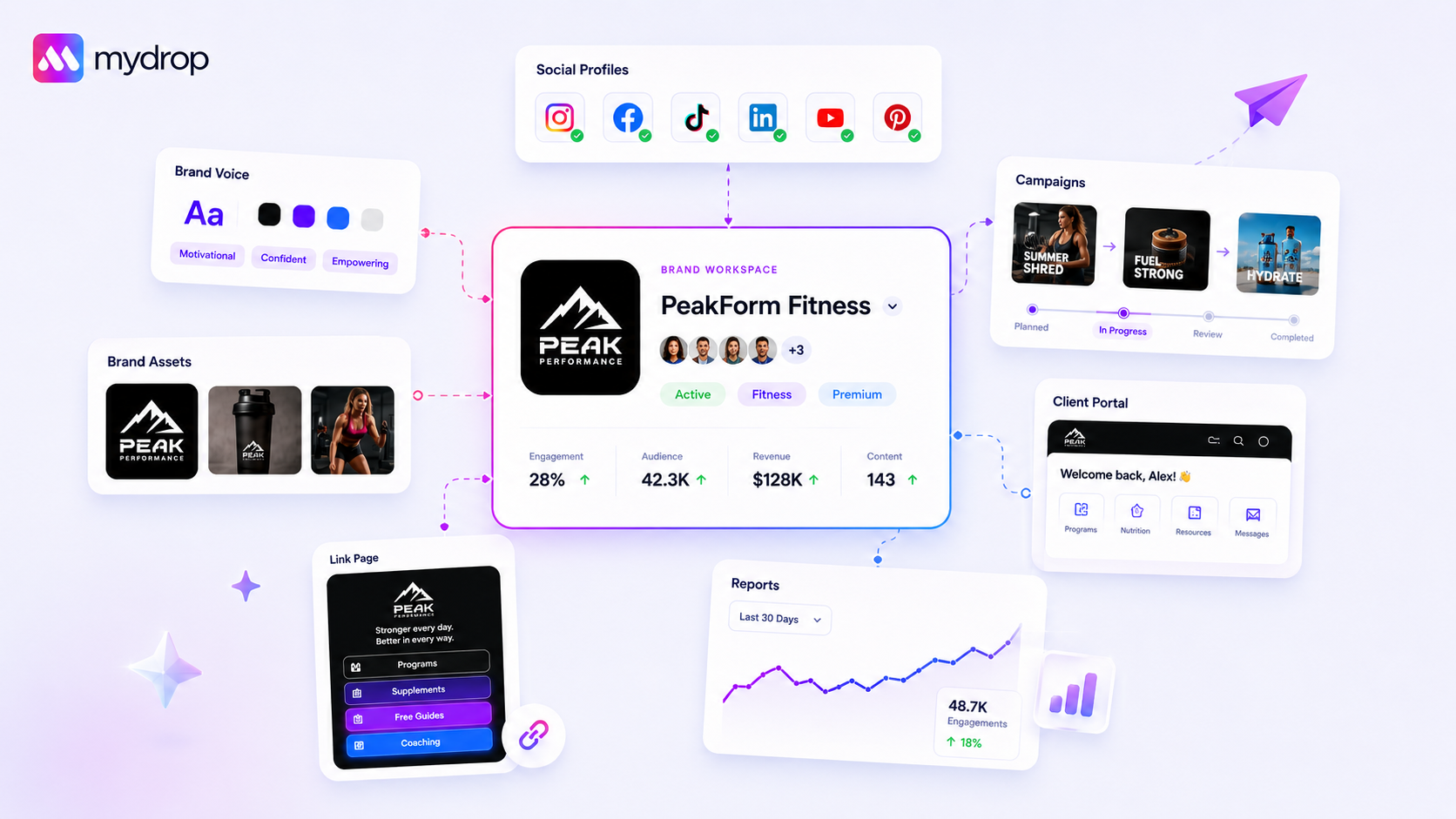
The best social media asset management tool is not a dedicated digital asset manager, but an operation-native platform that binds your brand identity-colors, fonts, logos, and tone-directly to your publishing workflow. When your team has to leave the composer to hunt for a logo or verify a hex code, you have already lost the efficiency battle. Centralized brand management is the difference between scalable social media operations and a bottleneck of file-hunting that kills creative momentum.
We get it. You are likely juggling dozens of folders labeled "final_v2_updated" spread across Slack, Drive, and your desktop. It is a messy middle that turns simple scheduling into a high-stakes scavenger hunt. Every minute your social lead spends chasing down the right asset is a minute of creative energy burned on administration rather than strategy. Across hundreds of brand profiles, this "coordination debt" adds up to a significant, hidden cost.
At Mydrop, we have seen this across thousands of campaigns. Teams usually fall into the same traps because they treat asset storage as a generic file dump rather than a living, breathing part of their brand identity.
What the best tools need to handle

An effective system must do more than store files; it needs to understand the context of the brand. If a tool doesn't know that a specific blue is for your secondary sub-brand or that a particular tone guide should apply to all AI-generated captions, it is just a digital warehouse.
To avoid the "folder chaos" trap, you need to evaluate tools based on how they bridge the gap between static storage and active publishing.
| Feature | Traditional Storage | Integrated Brand Identity |
|---|---|---|
| Searchability | File name or tag based | Brand Group context |
| Asset Updates | Manual replace in every doc | Automatic propagate (living assets) |
| Workflow | Copy-paste to editor | Drag-and-drop from profile context |
| Context | None | Tone, goals, and target audience |
The best tools prioritize Asset Proximity: your brand assets are only valuable when they exist exactly where the work happens.
Operator rule: Never settle for a tool that forces you to manually reconnect assets when creating a new link-in-bio page or campaign. If your brand context isn't automatically pulled into the creation flow, the system is fundamentally broken.
When you look for a platform, check if it allows you to group profiles by brand. This ensures that when you edit a brand color or update a logo, the change is reflected everywhere you publish, report, or generate content. If you are still importing the same company logo into five different browser tabs every time you draft a post, you are working against your own efficiency.
Where basic tools start to break

Your current asset storage likely suffers from what we call coordination debt. You started with a folder structure that made sense, but as your team scaled, the "final_v2" drift took over. Basic cloud storage services are optimized for retrieval, but your team needs application.
When your assets live in a generic drive while your publishing happens in a social dashboard, you have created a permanent bridge that you must manually walk across ten times a day. That bridge is where productivity dies.
Common mistake: Treating asset storage as an archive rather than an active component of your publishing engine.
Here is how the cracks usually appear:
| Symptom | The Hidden Cost | Why it happens |
|---|---|---|
| Asset Searching | 15+ minutes of lost focus per post | Files are named by date or status rather than brand context. |
| Manual Updates | Inconsistent brand colors across 50+ posts | Hex codes are copy-pasted from stale spreadsheets or chat threads. |
| Context Switching | Higher error rate during rapid publishing | The editor doesn't "know" the brand tone, causing "off-voice" content. |
| Re-import Friction | Bottlenecks in new campaign launches | Every new landing page or link-in-bio requires re-uploading the same logos. |
When you manage dozens of profiles, these seconds turn into hours of wasted administrative overhead. You aren't just moving files; you are managing a bottleneck.
The buying criteria that matter
Stop shopping for "more storage." Instead, look for a platform that treats your brand identity as data, not just a collection of image files.
If you are evaluating tools, use this scorecard. If a platform doesn't hit these marks, you are just buying a faster version of the same chaos you already have.
1. Unified Brand Context
Does the tool simply hold files, or does it hold brand intelligence? A mature platform should store your color palettes, font families, target audience definitions, and marketing goals in the same environment where you draft content. If the tool can't help your AI assistant or your team "remember" the brand voice for a specific campaign, it's just a file cabinet.
2. Live Asset Synchronization
Avoid tools that require manual file updates. Your brand identity should be dynamic. If you update a primary logo in your brand group, that change should propagate across your linked publishing tools and link-in-bio pages immediately. At Mydrop, we use Brand Groups to ensure that every profile in a client's cluster is always pulling from the same set of truth-certified assets.
3. Integrated Intake
Can the tool do the heavy lifting for you? Look for features like website import and automated color extraction. Setting up a new brand should take minutes, not hours of manual data entry.
Decision check: Never manually enter data that your software can extract from your own website.
4. Workflow Proximity
The ultimate test is simple: Can your team stay in the editor? If they have to download an asset from a central repository and then re-upload it to a scheduler, the tool has failed. You want a native link between your brand folder and your composer. This is the difference between a team that struggles to keep up and a team that scales effortlessly.
Most teams do not have a content problem. They have a decision bottleneck caused by their tools. Don't let your infrastructure decide how fast you can grow.
How Mydrop supports this workflow
At Mydrop, we usually see that teams struggle not because they lack creative assets, but because those assets are untethered from the people and platforms using them. We built Brand Groups to solve this specific coordination debt. Instead of just creating a "Brand Folder" that lives in isolation, a Brand Group in Mydrop acts as a living container that binds your identity directly to your social operations.
When you set up a Brand, you aren't just uploading a logo. You are grouping profiles, syncing your color palette, and defining your tone in a way that the AI composer and your publishing tools can actually read. If a manager updates a primary brand color or switches a logo in the Brand detail, that change propagates instantly across the workspace. You stop chasing "v2_final" files because the source of truth is always the active brand profile.
Workflow check: If your publishing tool doesn't know your brand context, it's just a scheduler. It isn't a strategy partner.
This setup saves hours every week by removing the manual re-importing loop. Whether you are building a new campaign or spinning up a link-in-bio page, the tool already knows your brand's font family, approved hashtags, and tone guidelines. You spend less time hunting for hex codes and more time ensuring your content actually hits the mark.
A simple shortlist checklist
Before you decide on an asset management shift, run your current setup through this quick sanity check. If you answer "no" to more than two of these, your operations are likely hitting a hard ceiling.
| Criteria | The "Stale Storage" Test | The "Integrated" Standard |
|---|---|---|
| Searchability | Searching by file name | Searching by Brand/Campaign |
| Context | Files exist in isolation | Assets tied to Brand/Tone |
| Updates | Manually re-uploading changes | One update, universal sync |
| Setup Time | Hours of manual import | Automated website extraction |
| AI Access | Copy-pasting context | Native AI brand awareness |
Action items for this week:
- Inventory your "drift": Identify the top three assets that get updated across different teams (e.g., logos, primary hex codes).
- Audit the "Reconnect": Count how many times your team has to re-upload a standard asset when starting a new campaign.
- Check for "Living" integration: See if your current tool allows you to update a brand asset in one place and have it reflect across all scheduled content instantly.
Conclusion
The messy middle of social media management is rarely about the quality of your ideas; it is about the friction of your execution. You can keep fighting the battle of scattered folders and constant manual re-imports, or you can build a system where your assets are as active and intelligent as your team.
The goal isn't just to store your files in a slightly better way. It is to move your brand assets into the same room where the work happens. Once you stop treating storage as a warehouse and start treating it as a conduit for your publishing pipeline, your output capacity changes overnight. Stop managing files and start managing the brand. Your team will thank you, and more importantly, your strategy will finally have the runway it needs to scale.