
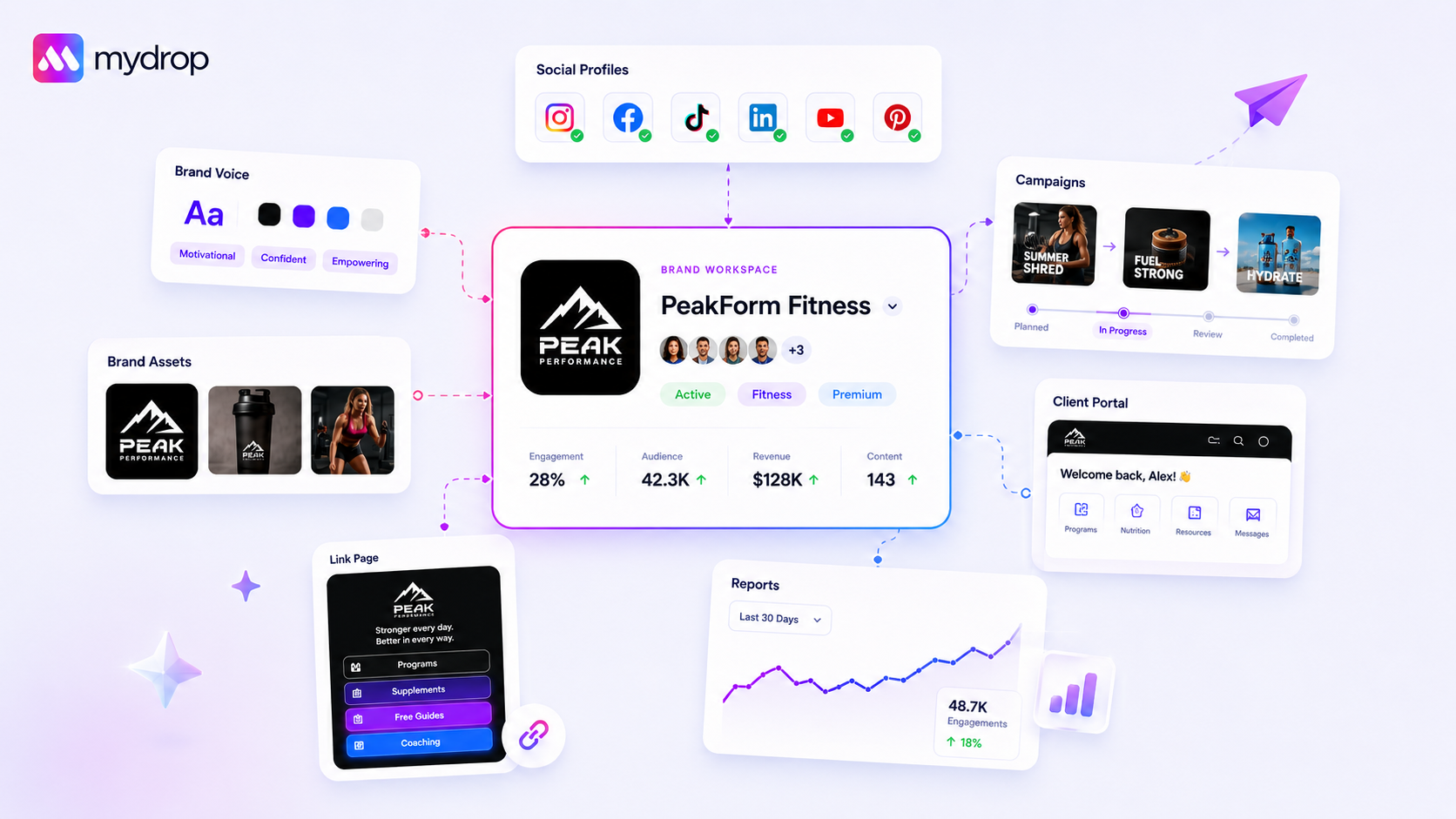
To stop brand identity drift, you must stop treating your brand as a collection of static files and start managing it as a live centralized intelligence layer that enforces constraints across your entire publishing stack. The drift doesn't happen because your creative team lacks talent; it happens because your current system forces them to hunt for assets while the AI is left guessing about tone.
We get it. You are juggling three clients across five platforms, and everyone is under pressure to produce more. By the time you are staring at a social caption at 6 p.m., the brand guidelines are usually a distant memory buried in a PDF nobody opened for months. You aren't failing; you are just working with a broken operating model where the "source of truth" lives in a dozen different folders, Slack threads, and half-forgotten cloud drives.
Where the handoff is actually breaking

The drift usually starts the moment a campaign moves from a strategy document into execution. When your assets live in a Dropbox folder while your AI tool lives in a browser tab and your publishing schedule lives in a spreadsheet, you have effectively created a manual synchronization tax.
Every time a team member grabs a "good enough" version of a logo or guesses a font size because the original file is archived, the brand identity weakens. Multiply that by hundreds of posts, and you end up with a feed that looks like a collage of disjointed experiments rather than a unified strategy.
Here is why your current setup is likely leaking integrity:
- Asset Fragmentation: You aren't just storing files; you are storing potential failure points. If your team has to download, resize, and re-upload assets, they will inevitably deviate from the standard.
- Context Loss: Human memory is not a reliable substitute for structured guidelines. If your AI isn't explicitly prompted with your brand's current tone, goals, and prohibited hashtags, it will default to a generic, robotic voice that alienates your audience.
- Stale Caches: This is the silent killer. You update a brand color or a logo, but an old version remains cached in your team’s local environment or an outdated tool integration.
At Mydrop, we see teams struggle with this across thousands of posts. The fix isn't more training sessions; it's a Brand Hub where the identity data is inextricably linked to the profiles. When you use Brand Groups and Assets, you move away from "searching for the right file" and toward a system where the brand context is already loaded into the composer and the AI.
Operator rule: If your team has to ask "which version of the logo do I use," your system is broken. Centralize the assets, define the tone in structured fields, and treat the brand group as the mandatory starting point for every campaign.
If you are unsure where your team stands, use this audit to see if you are building a brand or just moving pixels around.
| Audit Area | The "Drift Trap" Indicator | The "Brand Hub" Standard |
|---|---|---|
| Asset Access | Hunting through Slack/email/folders | All logos, colors, and files in one place |
| Tone Governance | Relying on writer memory/vibe | AI prompted by structured tone data |
| Profile Sync | Adding profiles manually to each campaign | Profiles inherited from the Brand Group |
| Website Import | Manual color/asset extraction | Automated extraction from site URL |
| Intelligence | Goals/Audience in a separate PDF | Defined within the brand intelligence field |
When you treat your brand as a live intelligence-driven hub rather than a static folder, you remove the human friction that causes drift in the first place. You stop being a "brand police" officer and start being an architect of a system that makes consistency the path of least resistance.
The coordination debt checklist

Most teams do not have a content problem. They have a decision bottleneck. To see exactly where your process is leaking, run this brief audit on your last three client campaigns. If you cannot answer these questions within sixty seconds, you have a governance gap.
| Audit Area | The "Drift" Pattern (What to fix) | The "Hub" Pattern (Goal) |
|---|---|---|
| Assets | Logos and fonts live in shared drives; team members "guess" the latest version. | Assets live in one central location; AI and team pull from a single source of truth. |
| Colors | Hex codes are copy-pasted from old posts or Slack messages. | Palettes are locked in the system; publishing tools auto-apply approved values. |
| Tone | Captions vary wildly based on who is writing, leading to "persona whiplash." | Structured brand guidelines feed into generative tools to enforce consistent voice. |
| Context | "Target audience" and "marketing goals" exist only in a PDF that no one reads. | Brand intelligence fields define these constraints for every piece of content created. |
If you scored poorly on three or more points, your team is likely burning hours on manual quality control. This is the stage where the legal reviewer gets buried and the creative director spends half their day checking font sizes instead of strategy.
How to move decisions closer to the work
The secret to stopping drift is to stop treating your brand as a loose collection of files and start managing it as an active layer of your publishing stack. When you decouple your brand identity from your campaign workflow, consistency becomes a chore. When you pull them together, it becomes the default.
At Mydrop, we see teams managing hundreds of profiles make this shift by using Brand Groups and Assets. Instead of sending a Zip file of logos to every freelancer or new hire, you link those profiles to a specific group where the logo, color palette, and AI tone constraints are already defined. When a team member starts a post for that client, the platform automatically presents the correct assets and constraints.
Decision check: Never store "brand identity" in a document that sits outside your publishing tools. If your AI content generator cannot read your color palette or target audience description, you are asking your team to be the manual bridge, and that is where the inconsistency starts.
Move these three elements into a centralized hub this week:
- Extract and centralize: Use automated tools to pull your current brand colors and assets directly from your website. If you are relying on manual uploads, you are already behind.
- Define the intelligence: Move your "marketing goals" and "target audience" descriptions out of static strategy decks. Input them as structured data into your publishing hub so that every AI generation cycle references these core truths.
- Audit the membership: Group your profiles by brand, not by platform. When you add or remove a channel, the brand context should follow the profile automatically.
This is the part people underestimate. You do not need more brand police. You need a system that makes the right creative choice the easiest one to make. When you do this, you stop chasing errors and start focusing on the actual campaign performance. It feels less like auditing and more like enabling.
The roles and rules that reduce rework
Consistency isn't a result of better creative briefs. It is a result of rigidly defined access. When your design team, social managers, and AI models pull from a single, truth-anchored source, the "drift" disappears.
At Mydrop, we see successful teams move away from shared folders and instead treat their brand as a live intelligence hub. This means setting up a dedicated record for each client or internal group that locks in the essentials. Once you move your logo, color palette, and AI tone guidelines into one of these Brand Groups, you stop hunting for the "latest version" and start relying on the version the system holds.
Workflow check: If a brand asset exists outside your central hub, it does not exist.
If your team is still digging through Slack threads or old email chains to find a brand color code, you are inviting friction. Here is the operational shift that stops the bleeding:
| Role | Responsibility | The "Hard" Rule |
|---|---|---|
| Asset Manager | Syncing the hub with the source | No file updates until the hub is refreshed. |
| Social Lead | Grouping profiles into the correct brand | Profiles never exist as "orphans" without a brand context. |
| Creative Lead | Defining the AI tone and voice prompts | The prompt instructions in the portal are the only truth. |
By forcing these roles to interact with a centralized record, you stop the silent decay of identity that happens when everyone has a slightly different "copy" of the brand files on their desktop.
The weekly habit that keeps the system honest
Processes fail when they are treated as one-time setup tasks. The most efficient teams we support audit their brand hubs on a set cadence, ensuring that as campaigns evolve, the underlying intelligence evolves with them.
Use this Weekly Integrity Check to catch drift before your next major campaign launch.
- Check the Asset Freshness: Open your
Brand Detailscreen. Are the current logo and media files the ones used in the most recent campaign? If not, replace them. - Verify the AI Context: Review the
marketingGoalsandtoneinstructions. Did a client pivot their strategy mid-week? Update the instructions in the hub so the next AI-generated caption reflects the change. - Audit Profile Membership: Ensure every active channel is correctly linked to the brand group. If a new campaign channel popped up, it needs to be mapped to the hub immediately to receive the correct identity assets.
- Color Palette Sync: Check if the extracted website colors still align with current brand guidelines. If the client updated their web design, run a quick re-import to keep your publishing tools in sync.
This takes less than ten minutes per brand, but it prevents the "oops, that was the old logo" conversation that wastes hours of review time.
Conclusion
Your brand identity doesn't dissolve because of one bad designer or a tired social manager. It dissolves because your process allows for multiple "truths" to exist across your team.
The fix isn't to work harder; it is to stop treating your assets as a pile of files and start managing them as a single, centralized record. When you force every AI prompt, post, and campaign launch to pull from that one hub, you transform your identity from a fragile, drifting target into a scalable, repeatable asset.
Stop policing the creative. Start securing the source.