
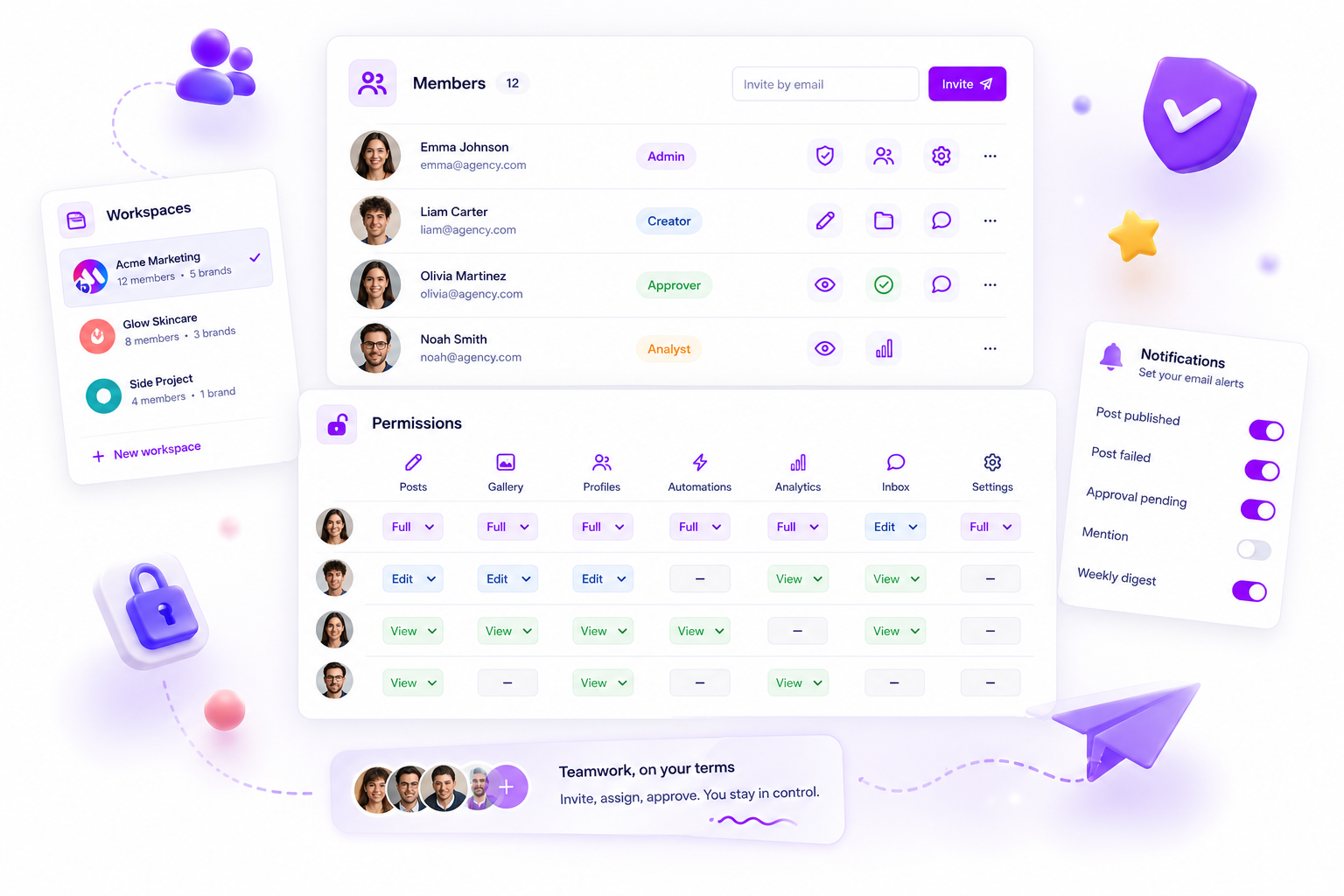
Stop treating role management as a simple on/off switch. For enterprise teams, the bottleneck isn't just "who has access," but "what can this specific role actually do within this specific resource?" When you can’t map roles to granular actions, you aren't managing a team; you’re managing risk. Scaling social operations often feels like fixing a plane while flying it. To stop this chaos, you need a system that maps User Identity → Resource Type → Allowed Action. If a tool only offers basic Admin/Editor toggles, it is built for a freelancer, not an enterprise. To kill coordination debt, you must move beyond static roles toward granular, resource-action mapping.
We get it. You are juggling clients who need read-only access, junior creators who need freedom to draft but not publish, and managers who need to maintain strict quality control. This is the messy middle of permissions where most operations grind to a halt. When roles aren't granular, you end up manually overriding access, creating an undocumented back door that hurts security and wastes time.
What the best tools need to handle

The best systems treat permissions as an agile matrix rather than a static hierarchy. You aren't just assigning roles; you are defining the boundaries of a contributor's influence. Across thousands of posts and dozens of stakeholders, we have seen that teams fail when they rely on broad, predefined roles. A truly scalable tool must allow you to define custom actions for every resource-whether that is drafting, editing, approving, or analytics reporting.
Look for tools that prioritize the Resource-Action Mapping principle.
| Action / Role | Viewer | Contributor | Manager |
|---|---|---|---|
| Create Drafts | - | Yes | Yes |
| Edit Existing | - | Yes | Yes |
| Approve Post | - | - | Yes |
| Export Analytics | Yes | - | Yes |
Note: The best systems allow you to adjust these columns per user.
If a tool cannot map the user to the specific resource action, it is not enterprise-ready.
Operator rule: If your permission system requires a manual email to the admin every time a contributor needs access to a new profile or report, you have already lost.
The goal is to eliminate the permission bottleneck entirely. When you have to stop your workflow to change a role, that is coordination debt accumulating. The best platforms allow you to define these permissions once and apply them automatically, rather than needing constant, manual maintenance. This is where Mydrop shines; our Team Members and Permissions feature lets you move beyond static role definitions, letting you define arbitrary resource-action maps that actually reflect your team structure.
Where basic tools start to break

Most teams start with a simple role hierarchy: Admin, Editor, and Viewer. It works fine when you have three people managing one brand profile. But once you scale to managing dozens of profiles, multiple markets, and hundreds of stakeholders, this "all or nothing" model turns into a liability.
The breaking point usually happens when you try to apply a rigid role to a nuanced situation. You have a junior creator who needs to upload drafts to a specific channel but shouldn't be able to change the post's targeting or approve it. Or a client who needs to see the final approved calendar but definitely shouldn't be able to edit the captions or delete assets.
When your tool only has three or four static roles, you end up with two terrible choices: either you give them too much access (risking a brand disaster) or you give them too little (creating a massive, manual bottleneck).
This is where the spreadsheet becomes a crime scene. You end up having to manually override permissions, or even worse, you have "shared accounts" where everyone logs in as an Admin just to get things done. That isn't just inefficient; it's a security and operational nightmare. You lose all visibility into who did what, and you create undocumented backdoors in your process.
Operator Alert: If you find yourself frequently using one "shared" account across multiple people to bypass permission restrictions, your current role management system is actively creating operational debt.
Every time you rely on a manual override or a work-around, you aren't just saving time-you’re creating a point of failure that will break exactly when you can least afford it, like at 6 p.m. on a Friday during a major campaign launch.
The buying criteria that matter
When evaluating tools for enterprise social management, you need to look past basic role labels and evaluate how they handle Resource-Action Mapping. Can you define exactly what a user can do to a specific type of resource?
A tool is only enterprise-ready if it can handle the matrix of Who + What Resource + Which Action.
Use this scorecard to audit your current system and evaluate potential platforms.
Permission System Maturity Scorecard
| Maturity Level | System Logic | Operational Impact |
|---|---|---|
| 1. Static | Basic Admin/Editor/Viewer roles. | High bottleneck, frequent manual overrides. |
| 2. Role-Based | Customizable roles, but limited to global access. | Better, but still lacks resource-specific granularity. |
| 3. Granular | Access defined by resource type (e.g., Posts only). | Good, but complex to manage at scale. |
| 4. Action-Mapped | Access defined by action per resource type. | Solid control, reduced coordination debt. |
| 5. Adaptive | Full resource-action mapping per member. | Scalable, secure, and operationally lean. |
To reach maturity level 4 or 5, look for three non-negotiable features:
- Granular Overrides: Can you grant specific access to one brand profile without changing the user's global role?
- Custom Templates: Can you create a "Client-Reviewer" template that you can quickly assign to new users without configuring everything from scratch?
- Audit-Ready Transparency: Can you see exactly who has access to what, and when those permissions were last updated?
In our experience, teams that don't hit at least level 4 spend nearly 20 percent of their week just managing access requests and troubleshooting permission issues.
Scorecard: If your current tool forces you to map permissions globally rather than per-resource, you’re stuck at Level 2 or 3.
At Mydrop, we designed our Team Members and Permissions feature to move beyond static roles specifically to solve this. Instead of hard-coded enums, we use an arbitrary member resource/action map. This allows you to define exactly who can create, read, update, or approve within specific resources like posts, profiles, or analytics. It means you can give a junior contributor freedom to draft in one market, while strictly limiting their ability to edit or publish in another, all without needing a manager to step in and handle the setup.
How Mydrop supports this workflow
At Mydrop, we have seen enough chaotic product launches to know that fixed role hierarchies are just a band-aid. When you manage dozens of brand profiles and hundreds of stakeholders, "Editor" means very different things to a copywriter versus a legal reviewer.
We built our Team Members and Permissions system to move past that. Instead of hard-coded roles, Mydrop treats permissions as a granular map. For every member in your workspace, you define a specific resource-action pair. This means you can authorize a contractor to draft posts for one specific brand profile while entirely restricting their access to analytics, inbox threads, or the ability to approve content.
This structure allows you to build access templates that reflect your actual team structure rather than forcing your team to fit a software developer’s idea of a "Manager."
Operational rule: If you have to share account passwords or rely on manual email approvals outside of your tool because your current permissions are too rigid, you do not have a role management problem-you have a broken security model.
Because we store these permissions as flexible maps, adding new resources is straightforward. When we introduce a new feature, you simply update the member role template to include it. You never have to rebuild your entire team structure just because the platform added a new capability.
A simple shortlist checklist
When you are vetting a new platform, use this checklist to see if the tool is actually enterprise-ready or if it just looks the part.
- Resource-Action Granularity: Can I restrict access at the action level (e.g., can-create, can-approve, can-delete) for every major resource type?
- Inheritance vs. Overrides: Does the system allow for base roles with specific, per-member overrides, or is it strictly "everyone with this role gets the exact same access"?
- Audit Trail: Is there a clear, immutable log of who modified a member’s permissions and when, ensuring compliance isn't just a promise?
- Notification Control: Can team members toggle their own operational email preferences so they aren't buried in noise irrelevant to their specific tasks?
- Scaling Efficiency: Can I clone a set of permissions for a new team member, or do I have to manually configure every new hire from scratch?
Conclusion
The messy middle of permissions is where most social operations grind to a halt. You stop worrying about what to post and start worrying about who is allowed to click what, and that is a failure of your tooling, not your people.
Stop accepting tools that force you into a box. You need a system that adapts to how your team actually works-mapping access to the specific resources they touch every day. Scaling isn't about doing more with less; it’s about doing more with control. If your software vendor tells you that basic Admin-Editor-Viewer roles are sufficient, they have clearly never had to explain to a brand manager why a junior intern accidentally published a test asset to the main channel at 6 p.m. on a Friday.
Take the time to audit your current bottlenecks. If the friction is in your workflow, fix the workflow. But if the friction is in your access control, get a better tool.