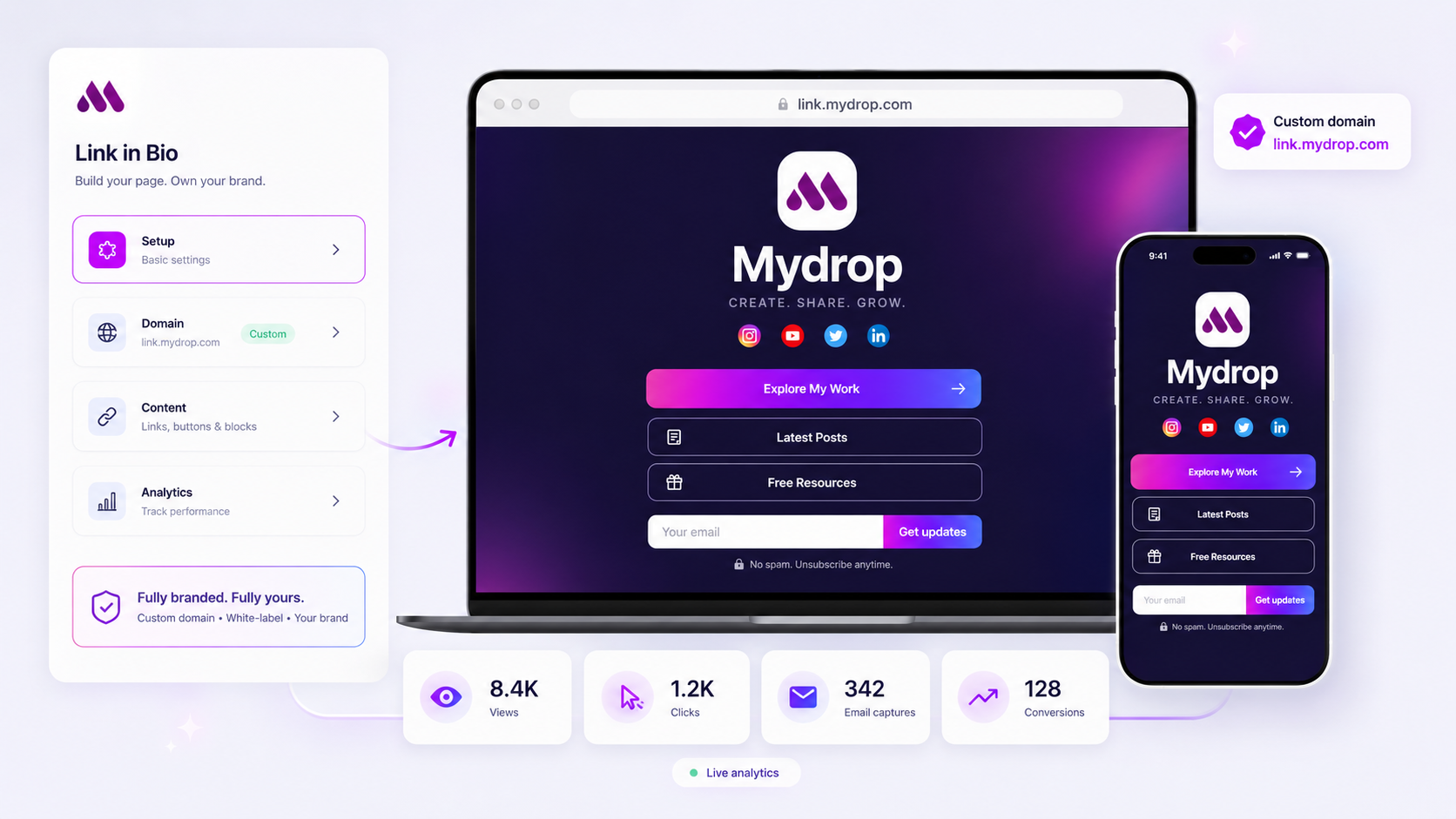
Your link-in-bio page should be a high-performance landing page that captures leads, not just a glorified list of links that leaks traffic to third-party platforms. If your current tool doesn't support native email capture, branded custom domains, and direct file distribution, you aren't optimizing your social traffic; you're actively handicapping it. For teams managing dozens of brands and high-stakes campaigns, using a consumer-grade aggregator is a bottleneck. You need a conversion surface that treats your audience's arrival as the start of a branded customer journey, not the end of a social interaction.
We know the drill. You are juggling ten campaigns, multiple brand guidelines, and a mountain of content assets. Trying to force enterprise-grade tracking through a simple link-list tool feels like progress until you realize you are losing visibility on every lead that clicks away to a generic, unbranded page. When we see teams struggle with this, it is rarely because they lack content. They usually lack a reliable conversion infrastructure that bridges the gap between social engagement and CRM entry.
Let us audit where you are and where you need to be.
What the best tools need to handle

The difference between a generic link page and an enterprise-grade conversion surface comes down to how much work the page does for you after the click. You are not just directing traffic; you are gathering intelligence and qualifying leads.
To meet the standard of a professional marketing stack, your platform must handle these five core capabilities:
| Capability | Enterprise Requirement | Why it matters |
|---|---|---|
| Branded Domain | Full mapping to links.yourbrand.com |
Trust and SEO equity. No third-party redirects. |
| Native Email Capture | Secure, GDPR-compliant lead form | Capturing intent without driving traffic away. |
| File Distribution | Direct download of media kits/assets | No external hosting; frictionless access. |
| Cross-Device Tracking | Full UTM support and pixel integration | Knowing exactly where the lead originated. |
| Content/Feed Integration | Hydrated social posts on-page | Keeping the user engaged within the ecosystem. |
When these components are missing, you create friction. At Mydrop, we see teams that rely on basic tools constantly fight "link decay"-where the time between clicking a link and engaging with your actual asset is filled with unnecessary redirect hops. A true conversion surface removes those hops. It should not require your visitor to leave the branded experience just to download a file or subscribe to a list.
Operator rule: If your visitor has to leave your branded destination to complete a high-value action, your link-in-bio page is not a conversion surface-it is a transit hub, and you are losing leads at every transfer.
Before you commit to a new workflow, check if your current tool handles these as native components or if it requires a web of third-party integrations that break as soon as your campaign scale shifts. If you cannot verify the conversion event directly inside the editor, you are not tracking; you are guessing.
Where basic tools start to break

The reality is that consumer-grade link-in-bio tools are built for individuals, not departments. When you try to force them into an enterprise workflow, the cracks show up in your conversion data first. If your link page acts as a glorified directory, you are essentially creating a leaky bucket for high-intent traffic.
Think about the path of a potential enterprise lead. They click a link from your LinkedIn, expecting more information about a case study or a white paper. Instead, they hit a generic, unbranded page with a list of buttons that leads to a third-party domain. Suddenly, the trust you built in your social content is diluted. Even worse, the "black hole" effect kicks in: the data doesn't flow back to your CRM, you cannot attribute the click to a specific campaign, and you have no idea if that user was a qualified prospect or a bot.
At this scale, the lack of native lead capture is not just a convenience issue-it is a massive bottleneck. Relying on simple link-outs means you are losing direct ownership of the lead. You are essentially paying to drive traffic, then letting it wander off without a chance to capture their contact info, distribute that specific file, or nurture them on-page.
Most enterprise teams realize too late that they have built their social strategy on a foundation of coordination debt. Managing dozens of brand profiles and hundreds of assets across different teams means you need centralized control, not fragmented third-party accounts that your security team does not even know exist.
The buying criteria that matter
If you are auditing your current tools, start by asking if they are designed to be a directory or a conversion surface. Enterprise marketing requires a different set of guardrails and capabilities. You are not just looking for a button host; you are looking for a destination that acts as an extension of your website, maintaining brand integrity and data ownership.
The following scorecard is a starting point for assessing whether your current setup is enterprise-ready. If you are scoring lower than a 4 on this, you are likely leaving leads-and ROI-on the table.
Conversion Integrity Scorecard
| Capability | Enterprise Necessity | The "Broken Link" Warning Sign |
|---|---|---|
| Branded Domain | Use own domain (e.g., bio.yourbrand.com) | Redirection to 3rd-party domains kills trust & tracking. |
| Native Capture | CRM/Email list integration | Relying on link-outs means 0% lead capture rate. |
| File/Asset Access | Secure, gated file distribution | No native file hosting means you cannot verify downloads. |
| Data Fidelity | Full UTM/pixel coverage | Limited analytics prevents ROI-based optimization. |
| Governance | Multi-brand/role-based access | Shared accounts for multiple brands create risk. |
Scoring Rule: Assign 1 point per capability present. 0-2: High Risk. Your link pages are essentially traffic leaks. 3-4: Emerging Efficiency. You have some control, but still rely on workarounds. 5: Enterprise Ready. You have a dedicated conversion surface that you own and measure.
When we build tools at Mydrop, we see this pattern constantly: teams trying to scale social distribution with tools that were not built to talk to their CRM or their security stack. It forces the marketing team into manual data entry or, worse, leads them to abandon tracking entirely.
Decision check: If your link page does not allow you to capture a lead without that lead leaving the branded environment, you are not optimizing for conversion. You are optimizing for bounce rates.
The best enterprise link pages are not just lists; they are lean, branded mini-sites. They should host your media kits, gated downloads, and recent content feeds under your own roof. If you are still sending high-value traffic to a generic platform because "it was the easiest tool to set up," it is time to audit your distribution strategy.
How Mydrop supports this workflow
When you manage multiple brands, the biggest trap is treating your social traffic like a passive audience. Instead, you need to view your link-in-bio page as a dedicated, branded destination for conversion. At Mydrop, we designed our platform to turn those "link lists" into functional mini-sites because we saw too many teams losing potential leads to simple redirects.
The workflow change is simple but high-impact. Instead of linking directly to a generic landing page where a user might bounce, you bring the conversion point directly to their current context. You add an email capture block or a specific media kit download directly to the bio page. Now, the visitor doesn't have to navigate your main site; they take the action while they are still in that high-intent state of mind.
This also solves the coordination debt we see across large teams. Because you can manage these pages as branded assets, you can standardize the look and feel across all your accounts. You get the benefits of a native landing page without the overhead of building one for every single social post. You stop fighting with link aggregators and start managing branded conversion surfaces.
Workflow check: If a visitor has to click more than twice to find the primary asset or email form from your bio, you are leaking leads; assume a 50% drop-off at every unnecessary click.
A simple shortlist checklist
To see where your current setup stands, use this scorecard. If you check "No" for more than two of these, your current platform is a bottleneck, not a conduit.
| Feature | Basic Link Tool | Mydrop Path | Decision Rule |
|---|---|---|---|
| Email Capture | None or 3rd party | Native, CRM-Synced | If you can't capture in-page, it's a lead leak. |
| Domain Control | Subdomain (theirs) | Custom (yours) | If the URL doesn't match your brand, trust is lower. |
| Analytics | Click-count only | Full conversion path | If you can't map to a sale, you're flying blind. |
| Asset Hosting | No | Native, gated delivery | If files live elsewhere, you lose the visitor. |
If you are auditing your process this week, start with this practical sequence to regain control of your social traffic:
- Define the primary lead-capture goal for your next campaign, whether that is a newsletter sign-up, asset download, or registration.
- Review your current bio domain and check if it aligns with your core brand identity.
- Audit your current conversion steps by counting exactly how many clicks it takes for a user to complete an action.
- Shift the most important asset-the one you are currently burying under a generic link-directly into your primary conversion page.
- Connect your CRM to your link-page data so those leads don't just sit in a tool you ignore.
Conclusion
The difference between successful social media teams and everyone else rarely comes down to better graphics or more frequent posts. It comes down to how they handle the traffic they already have. Teams that win treat their bio links not as a directory of places to go, but as a critical part of their conversion infrastructure.
Stop thinking of your bio link as a place to dump links. Start treating it as your front door. If your current tool isn't helping you capture leads, host assets, and maintain brand consistency, it is not serving your team. The cost of switching is almost always lower than the cost of continuing to lose those leads. Take the time to audit your path, align your tools, and make sure that every click actually goes somewhere valuable.