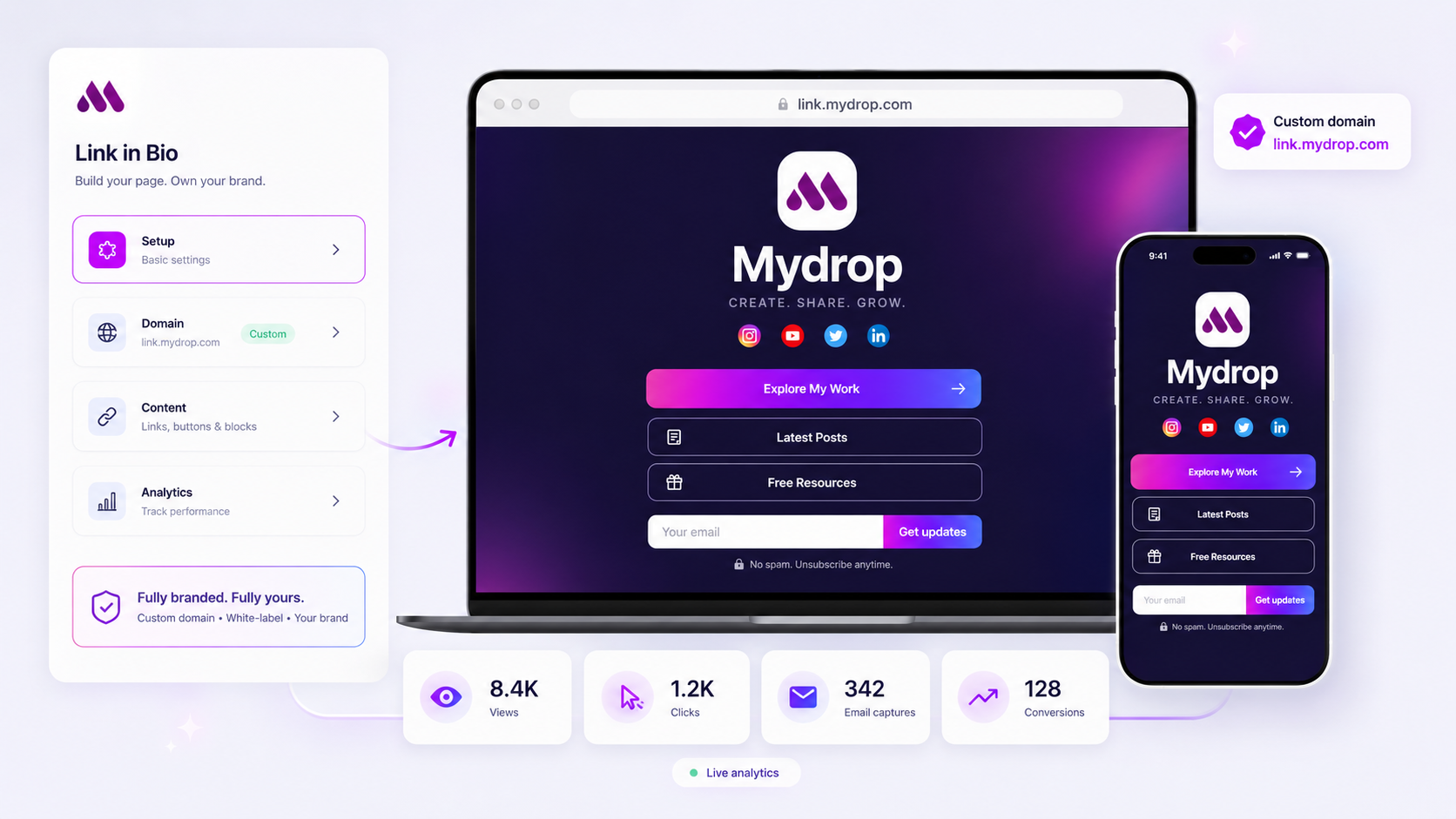
The move to a custom domain becomes mandatory the moment your "link-in-bio" transitions from a social traffic funnel into a primary landing page capturing emails, distributing media kits, and acting as the official SEO authority for a specific campaign. If your page is serving as a high-intent conversion surface rather than just a directory for your latest posts, those shared platform slugs are actively holding your brand back.
We get it. Managing dozens of brand links across multiple platforms feels like playing whack-a-mole with consistency. You are balancing the speed of setting up a new campaign against the nagging feeling that you are building your best conversion assets on rented ground. You want to move fast, but you don't want to explain to a stakeholder why their flagship campaign lives at a generic URL instead of their actual web property.
The decision teams usually frame too broadly

Most agencies treat the "custom domain" question as a branding vanity project. They look at the logo, they look at the URL, and they decide based on whether the brand feels "premium" enough. That is the wrong filter. The real cost isn't the price of a domain or the ten minutes it takes to point a DNS record. The real cost is coordination debt.
When your high-value campaign pages live on platform-managed slugs, you are essentially renting your own conversion data. You lose the ability to maintain clean, persistent SEO signals, and you complicate the lives of your web team who need to manage tracking pixels or custom head-scripts across a fragmented landscape.
Here is how to tell if you are currently stuck in the "Slug Trap":
| Symptom | Hidden Cost | The Reality Check |
|---|---|---|
| Campaign URL changes | Broken social shares | If your URL expires when the campaign ends, you lose all legacy traffic. |
| Pixels scattered | Attribution blind spots | Without a custom domain, standardizing pixel tracking across 20+ brands is a manual nightmare. |
| SEO Authority | Rented equity | If you are capturing emails or hosting media kits, that page is a landing page. Don't let the platform keep the credit. |
At Mydrop, we see teams managing hundreds of brand profiles where the decision to move to a custom domain is treated as a standard operating procedure for any asset expected to live longer than a single launch window. If your page's conversion value-measured in lead captures or file downloads-exceeds the minor overhead of domain management, you have already outgrown the shared slug.
Stop waiting for a "rebranding" or a "big launch" to justify the switch. If you are collecting user data, you are already acting as an enterprise publisher. Start owning the infrastructure that supports that work.
What should stay manual and what can move faster

We have seen this across dozens of agencies: teams spend hours agonizing over domain mapping for temporary contest pages that vanish in a week, while their main brand assets sit on generic slugs for years. It is essentially an inversion of your team’s actual value.
Keep it manual and simple-using platform-provided slugs-for short-term, high-velocity experiments. If you are running a two-week influencer activation or a limited-time product drop, don't waste your IT team's afternoon on DNS records. The goal here is speed of deployment, not long-term equity. Use the Mydrop slug to get the content live, track the clicks, and then archive it.
However, move to a custom domain for anything that requires long-term brand sovereignty. This includes your main profile bio, evergreen media kits, or any funnel capturing emails. These are not just links; they are your client’s digital real estate. Leaving them on a third-party slug is like renting a storefront while the landlord is constantly changing the signage-it confuses the customer and hurts the brand's perceived professional maturity.
Operator rule: If the page needs to appear in a pitch deck to a board of directors, it requires a custom domain.
The tradeoff matrix
Deciding when to make the leap can feel subjective, so we use a simple scorecard. When the "Control" side of this matrix starts to outweigh the "Agility" side, it is time to stop hitting 'refresh' on the platform slug and start migrating.
| Feature | Platform-Managed Slug (e.g., mydrop.me/brand) | Client Custom Domain (e.g., link.brand.com) |
|---|---|---|
| Setup Time | Instant (seconds) | Moderate (minutes + DNS propagation) |
| Brand Trust | Lower (looks like a third-party tool) | Higher (fully white-labeled) |
| SEO Authority | Shared with the platform | 100% Client-owned |
| Data Ownership | Platform-governed pixels | Direct pixel and GTM control |
| Maintenance | Zero | DNS records, SSL management |
Threshold for migration: If your monthly traffic exceeds 5,000 unique visitors or you are capturing more than 50 emails a week, the "Agility" of a managed slug is no longer worth the "Control" you lose.
At Mydrop, we often see teams manage these as a portfolio. They keep a handful of domains for their core accounts-the ones that actually drive recurring revenue-while letting smaller, auxiliary projects live on the platform's native infrastructure. This hybrid approach lets you have the professional polish where it drives the bottom line, without creating a full-time job out of managing domain redirects.
The awkward truth? Most agencies don't need a domain for every brand. They just need to stop pretending that every brand deserves the same level of digital infrastructure. Focus your budget and your IT time on the pages that actually act as revenue conduits. Everything else is just noise.
How to pilot the workflow safely
Migrating a high-traffic link page can feel like changing the engine on a plane while it is in mid-air. You do not want to break the social attribution or send your visitors to a 404 page. The secret is to decouple the URL transition from the content update. Treat the move as a DNS propagation exercise rather than a creative one.
Before you flip the switch, run through this sanity check. We have seen too many teams lose a weekend to a typo in a CNAME record.
- Verify your records: Ensure your DNS host points to the target endpoint, not a redirect loop.
- Sync the analytics: Before removing the old slug, verify that your new domain endpoint is correctly firing conversion events and UTM tracking in your Mydrop dashboard.
- The soft launch: Update only one social profile link first. Watch the traffic flow for two hours. If the clicks are hitting your analytics as expected, proceed with the rest of your brand portfolio.
Decision check: Never migrate a link page during a high-velocity campaign window. Always schedule the DNS switch for a quiet period, typically 48 hours after a major launch or 48 hours before one begins.
The operating rule to keep
Complexity in social management is almost always a result of unmanaged growth. If you are managing dozens of links and haven't codified when they graduate to a custom domain, you are just waiting for a compliance headache or a broken conversion path.
Make this a standard SOP for your team: The "Conversion Fidelity" Threshold.
| Trigger | Action |
|---|---|
| Email capture goal | Mandatory custom domain |
| Distributing media kits/files | Mandatory custom domain |
| Cross-brand marketing campaign | Mandatory custom domain |
| Simple directory of links | Retain Mydrop slug |
This creates a clear, repeatable habit. When a brand asset hits these marks, the custom domain move is no longer a debate-it is just part of the project intake. It saves you from those awkward "is this worth the effort?" meetings that happen when a campaign is already live and failing to convert.
Conclusion
The shift to a custom domain is ultimately about claiming ownership of the brand experience you have worked so hard to build. While the convenience of a managed slug is perfect for experiments, the maturity of your brand demands the trust that only a dedicated, white-label domain can provide.
Stop treating your link-in-bio as a temporary billboard. It is a vital conversion surface. Once you align your domain strategy with the actual value the page generates, you stop fighting the platform and start scaling the brand. Move the high-performers to their own homes, keep the experiments agile, and let your team focus on the work that actually moves the needle.