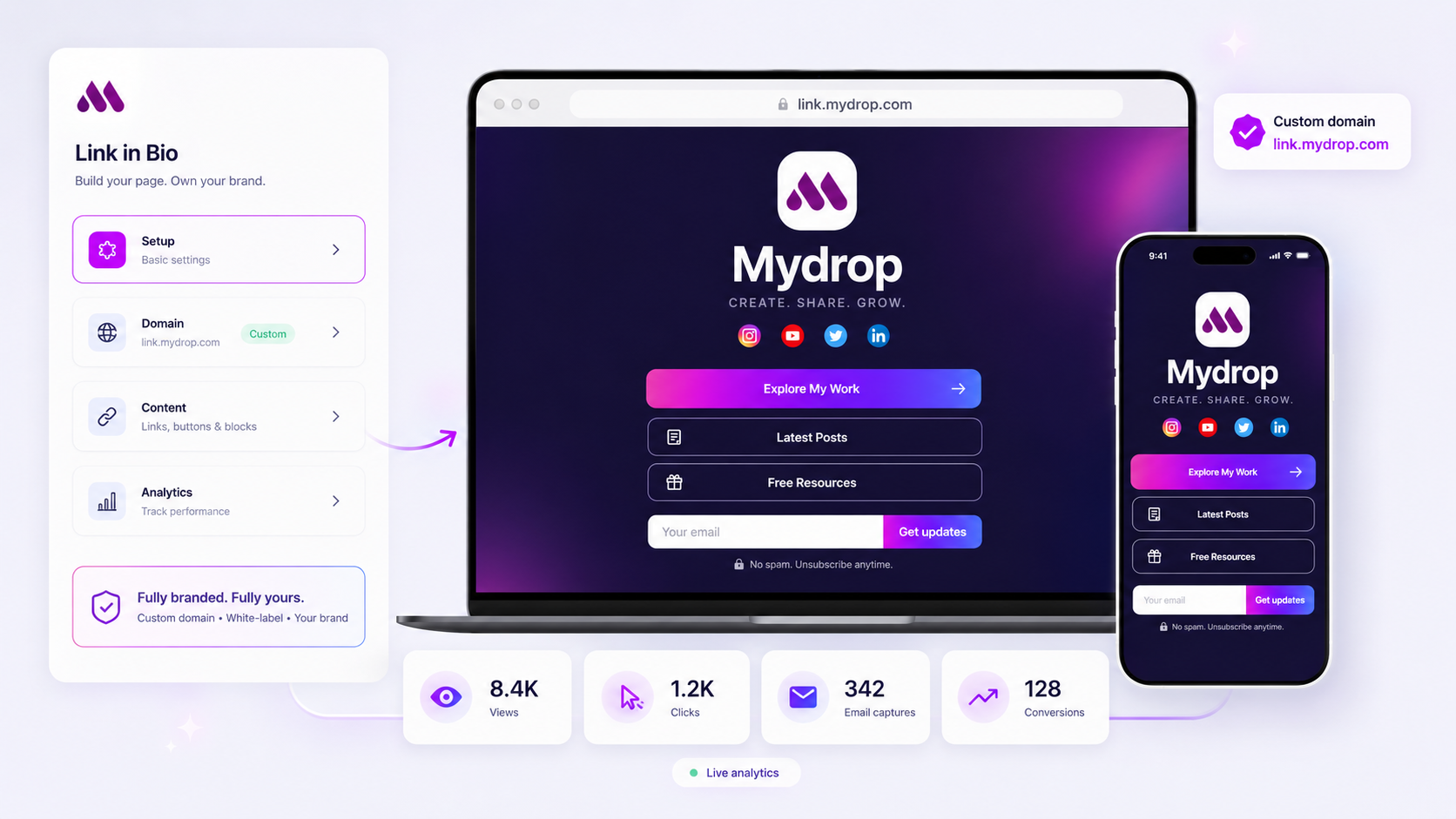
Stop treating your link-in-bio pages as temporary "link lists." For an agency managing multiple enterprise clients, your choice between a branded subdomain (e.g., bio.clientbrand.com) and a platform-hosted slug (e.g., mydrop.bio/client-name) dictates whether you own your conversion data or are simply leasing temporary traffic infrastructure from a third party.
We get it. You are balancing ten client requests this morning, and setting up another custom domain feels like a bureaucratic bottleneck when you just want the link to work so you can hit "publish." But we also know that sinking feeling of realizing you cannot properly track cross-site attribution because your link-in-bio infrastructure is not aligned with your client's core web ecosystem. That is the moment the platform-hosted slug stops being a convenience and starts becoming a data liability.
The decision teams usually frame too broadly

The mistake most teams make is applying a "one size fits all" policy to every client profile. They assume all link pages are equal, so they default to the fastest path for everything-or worse, they force a complex DNS-mapped custom domain on a short-term, three-day campaign launch.
In our experience, the distinction should be based on intent and lifespan, not just the size of the client.
| Factor | Platform-Hosted Slug | Custom Branded Domain |
|---|---|---|
| Setup Velocity | Instant / Self-serve | High / Requires DNS access |
| Trust/Brand Equity | Low / Platform-aligned | High / Client-owned |
| SEO/Search Authority | Diluted | Centralized to Client Site |
| Tracking/Data Control | Limited / Shared | Full / First-party control |
Operator rule: Use platform-hosted slugs for experimentation and short-term tactical campaigns where the goal is rapid iteration. Shift to custom branded domains for evergreen brand hubs where first-party pixel tracking and search index authority are your primary KPIs.
The "Platform Trap" is real: many agencies default to platform-hosted slugs for speed, only to find themselves locked out of sophisticated retargeting and internal analytics integration later. The hidden cost is not the setup time; it is the fragmentation of your client's search authority and visitor data. When you route traffic through mydrop.bio instead of a client-owned subdomain, you lose the ability to easily trigger server-side attribution across their broader site ecosystem.
If a page is intended to be a "digital business card" that exists in every social profile for the next twelve months, it deserves a custom domain. If it is a one-week promotional splash for a product drop, the platform slug is actually the smarter, more agile choice. Standardizing this distinction prevents your team from over-engineering temporary assets while ensuring your permanent ones are actually protected.
What should stay manual and what can move faster

The secret to not losing your mind by Friday afternoon is distinguishing between temporary infrastructure and evergreen brand real estate.
If you are running a two-week influencer activation or a limited-time product drop, don't waste your precious DNS access requests on a custom domain. These are high-velocity, low-longevity assets. For these, a clean platform-hosted slug is perfect. You create it, you track the click-throughs while the heat is on, and you archive it when the campaign ends. It keeps your core agency workflows lean and avoids bloating your client's primary domain management logs with transient entries.
However, the moment an asset enters your evergreen cycle-like a primary link-in-bio hub for a luxury line, a recurring lead-gen page for a service, or a central media kit-you need a custom domain. This is about data ownership and visitor trust. When a user lands on bio.clientbrand.com, they are in a space that feels owned. When they land on a generic third-party URL, the brand experience feels slightly borrowed.
Decision check: Use platform-hosted slugs for anything that lives for less than 30 days. Use custom domains for everything that sits on a permanent media plan or a social profile bio.
The tradeoff matrix
Agencies often stumble because they treat the "cost" of setup as just the time spent in the platform. In reality, the cost is the coordination debt created by choosing the wrong path early.
If you pick a platform-hosted slug for an evergreen project, you might save two hours of internal DNS coordination today. But six months later, you will likely pay for that with messy retargeting, fragmented analytics that don't roll up into the main domain, and potential security warnings that spook high-intent users.
Here is how to weigh those choices before you hit publish.
| Decision Factor | Platform-Hosted Slug | Custom Branded Domain |
|---|---|---|
| Setup Overhead | None / Instant | High / Requires DNS access |
| Trust Signal | Low / Third-party | High / Brand-owned |
| Data Ownership | Platform-bound | First-party / Owned |
| Typical Use Case | Campaign spikes | Always-on hubs |
| Governance Risk | Low / Isolated | Medium / Requires management |
At Mydrop, we see teams struggle most when they try to fix this after the page has gained traction. Changing a domain once you have thousands of clicks and active social signals is the fastest way to break your attribution model and frustrate your analytics lead.
Most teams do not have a technical problem here. They have a governance bottleneck. If you can get your client's IT lead to grant you access to a dedicated subdomain prefix (like hub.clientbrand.com), you solve your measurement problem indefinitely. It removes the guesswork from cross-site attribution and gives you a professional, white-label surface to house your lead-capture blocks and media galleries.
It is better to endure a 48-hour approval loop for a custom domain now than to spend 48 hours manually cleaning up broken attribution data when your campaign hits its peak. Align your domain strategy with the lifecycle of the asset, not the speed of your current caffeine-fueled sprint.
How to pilot the workflow safely
You do not need to rewrite your entire digital infrastructure by Monday morning. If you are currently feeling the strain of "link-in-bio chaos"-where every brand manager is using a different tool and no one can track if a post actually drove a conversion-start by picking one pilot brand.
Use this checklist to move from chaotic link management to a governed, custom-domain setup:
- Audit existing assets: Catalog which links are "campaign flash" (temporary events) and which are "evergreen" (brand hubs).
- Standardize the URL format: Map your evergreen links to
link.brandname.com. Keep themydrop.bio/slugformat only for time-bound influencer activations where fast deployment outweighs long-term domain authority. - Configure DNS once: Work with your IT lead to secure the necessary subdomains across your top three enterprise clients.
- Setup pixel and tracking: Ensure your chosen platform allows for custom head/body HTML injection, so you can host your conversion pixels and analytics scripts on those subdomains directly.
At Mydrop, we see teams fail when they try to move everything at once. Pick the one high-traffic brand where you currently struggle to prove ROI, move their bio page to a custom domain, and track the delta in click-through rates against your platform-hosted baseline.
The operating rule to keep
The most common trap we see isn't technical; it is the belief that "the link" is a static object. In reality, a link-in-bio page is a conversion surface. If you aren't treating it with the same governance as your main website, you are essentially leaving first-party data on the table.
Workflow check: If the page needs to live for more than 30 days, or if it must pass a brand-compliance review to include in a quarterly report, it belongs on a custom domain.
Everything else is just noise. If it is a three-day pop-up or a one-off contest, keep it on a platform-hosted slug and move on. You have enough real problems to solve without obsessing over DNS records for temporary traffic.
Conclusion
The choice between a custom domain and a platform-hosted slug is fundamentally about who owns the outcome. When you use platform infrastructure for enterprise-grade campaigns, you are effectively trading long-term data ownership for short-term speed.
That trade is fine for a weekend experiment, but it is a massive oversight for your evergreen brand assets. By separating your "quick-turn" campaign links from your "always-on" branded hubs, you reclaim control over your tracking, improve your search authority, and stop the constant frustration of fragmented attribution.
Stop treating your agency's social infrastructure as a temporary stopgap. Give your brands the digital home they deserve, map the domain, and start capturing the data you have been missing. It is the single highest-leverage move you can make to stop the coordination debt from piling up.